How Much Money Do You Actually Need to Retire?

Get smarter on investing, business, and personal finance in 5 minutes.
This newsletter is an adaptation from my recent YouTube video on How Much Money Do You Actually Need to Retire?
Even if you are savvy with your money and consider yourself a well-informed investor, you probably still don't have an answer to this question: how much money do you need to comfortably retire?
And that would put you with the majority of Americans who do not know the answer to this question.
And if you don't know where you are going, how are you going to get there?
The good news is it's actually very easy to get a rough estimate of how much money you need for savings in retirement to comfortably retire.
In this week’s Five Minute Money, I am going to walk you through exactly how to do that math and talk about a couple key pitfalls that I commonly see when people try to apply this math.
The 4% Rule.
There is a general rule of thumb of how much money you can withdraw from your portfolio in retirement, and it's usually referred to as the 4% rule.
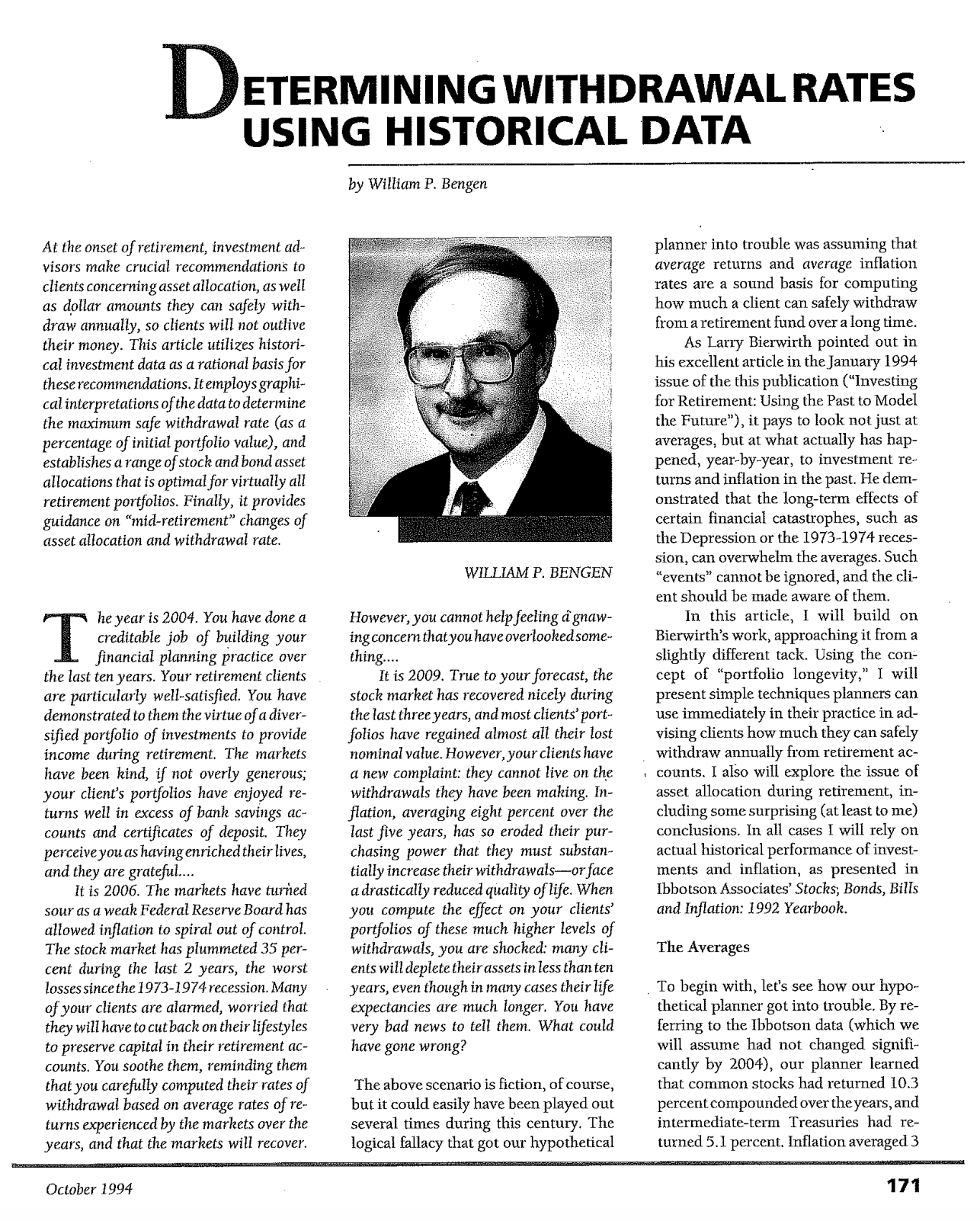
This comes from a 1994 research paper by William Bengen, and later it was independently tested and popularized by a 1998 study called the Trinity Research Study.
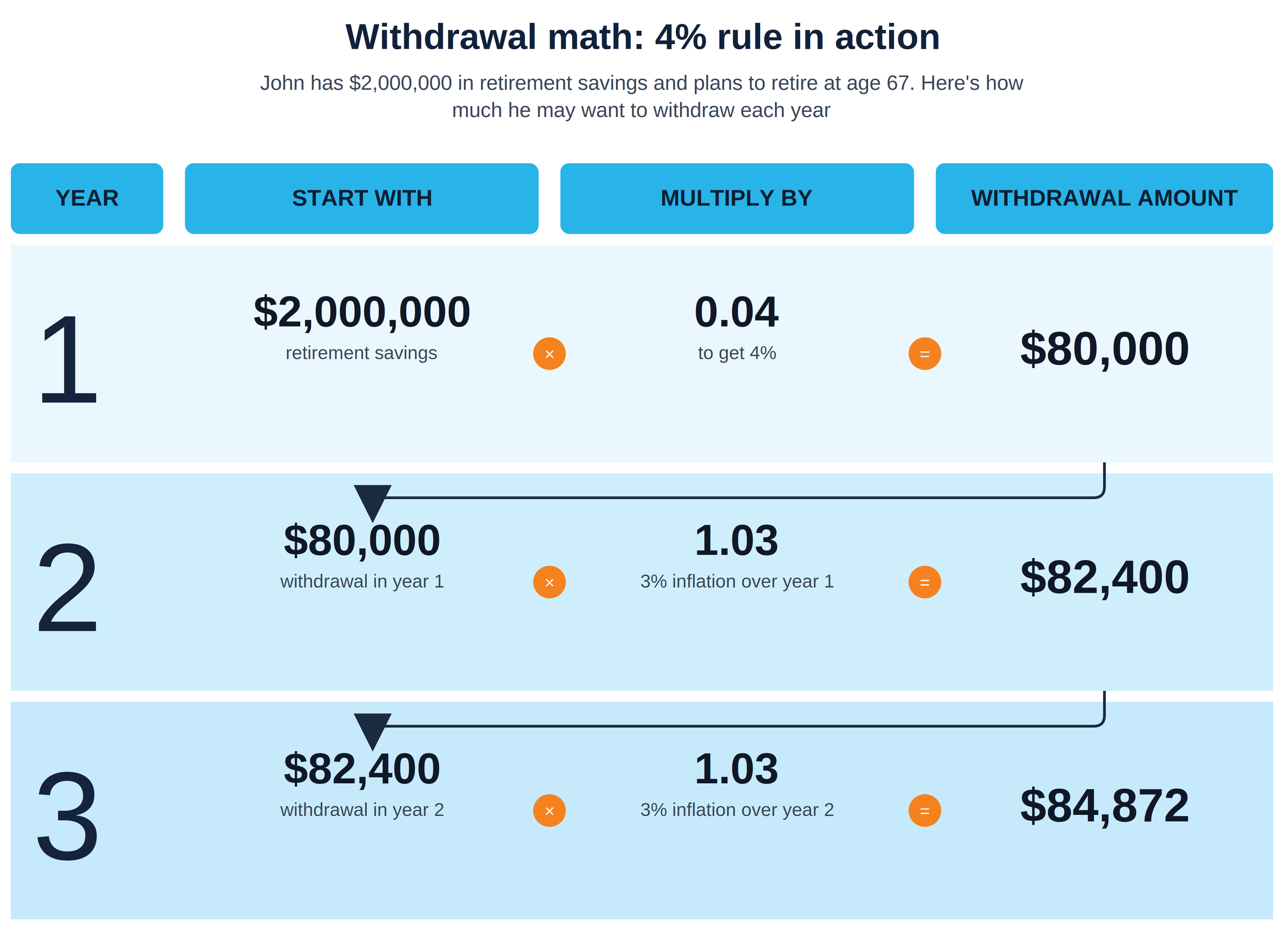
What this basically says is that in retirement, you can withdraw 4% of the initial value of your portfolio, inflation adjusted annually.
So if you have a $2 million portfolio, 4% would be $80,000.
If the following year inflation is 3%, you can multiply that $80,000 by 3%, and that will be how much you can withdraw.
Every year thereafter, you do the same math to figure out how much you can withdraw.
But the $80,000 is how much you're withdrawing in real terms, so that number basically stays fixed.
Now, where is this 4% rule coming from?
How strong of a rule is it and how much faith should we put in it?
These are very good questions.
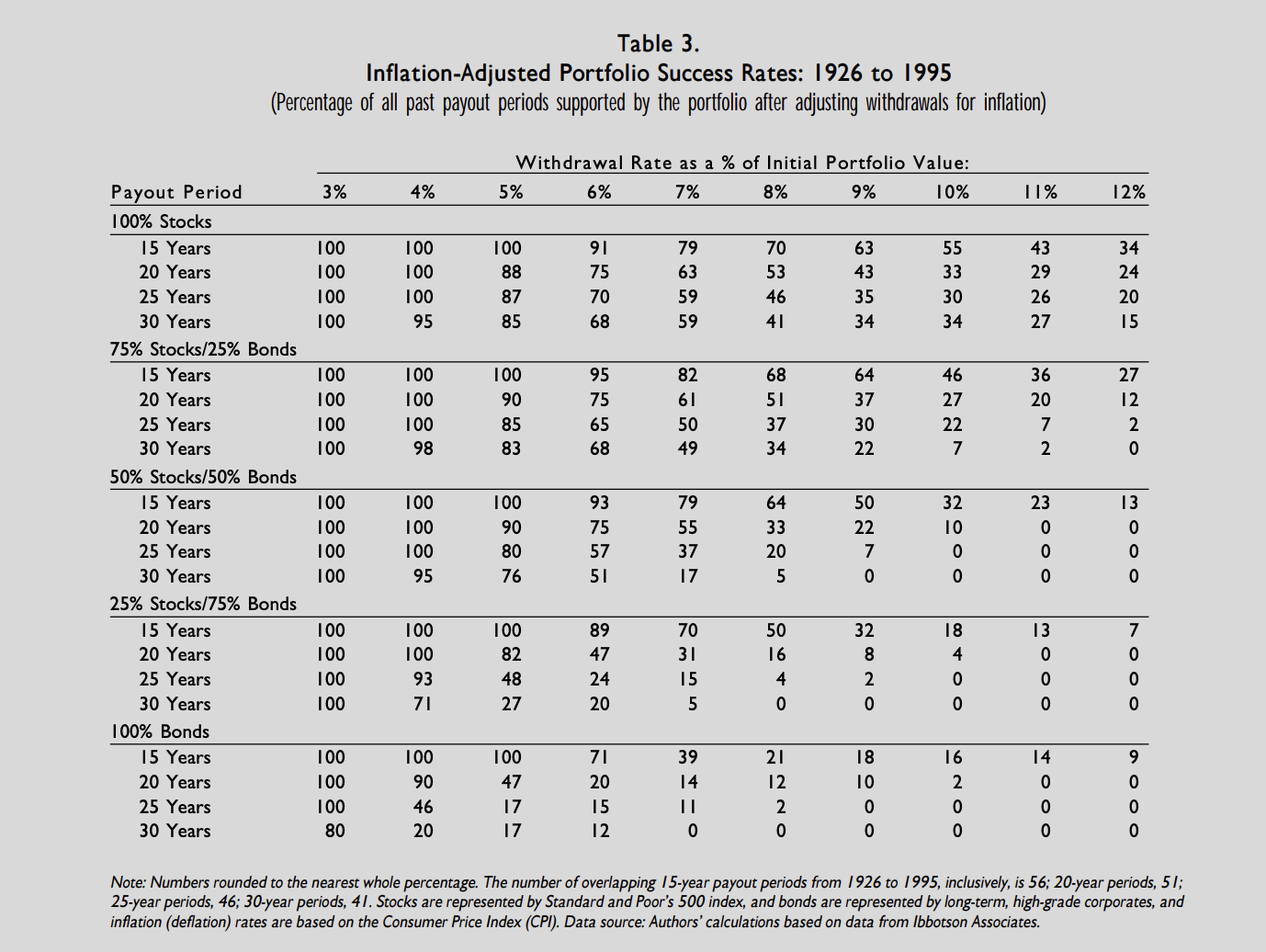
What they basically did when they did this research was they looked at a variety of different scenarios with different returns, different sequences of returns, and different equity versus bond mixes.
What they found was that if you have a portfolio that is 50 to 75% in stocks with the rest in bonds, in 95% of all scenarios, you will have enough money to last you 30 years in retirement if you follow that 4% rule.
So that is where it comes from.
It is a rule that will have you covered in 95% of scenarios for 30 years.
If you plan on living much longer than 30 years after retirement, then this rule will need to be adjusted downwards.
If you are retiring pretty late in life, maybe at 80 years old, and you don't feel like you need to plan for 30 years, a little dark, but maybe you can increase that rate a little bit.
That is the gist of the rule though, and I think it generally works.
It is somewhat conservative, but I much rather a client have too much money in retirement than not enough, and you can always adjust your spending upward if you need to, that's a good problem to have.
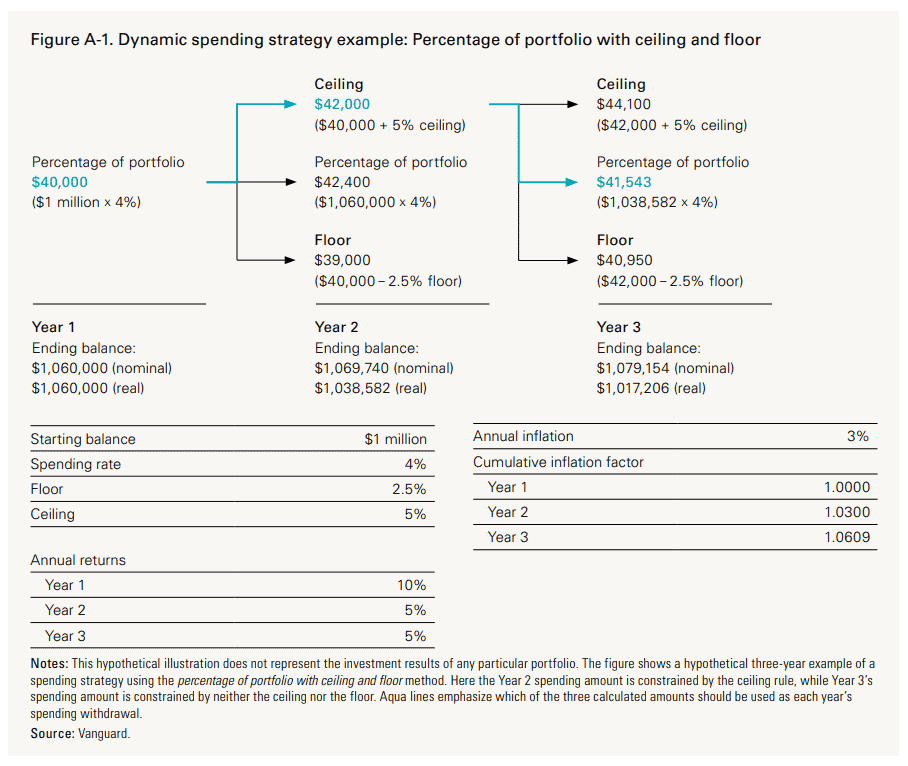
There is something called dynamic spending, where basically if the portfolio does really well in retirement, then you can adjust upwards how much money you're pulling out.
And if it does worse, you can adjust it back downwards, keeping that same original floor.
Although most people probably don't do too well with downward adjustments, so that being a caveat there.
Calculating Your Number.
But how do we actually use this rule, and what are some pitfalls that people may fall into when they're trying to apply it?
So let's make sure we firmly understand how this works.
The first thing we are going to need to do is understand how much money you spend, because this entire rule is centered around your spending, not your income, your spending.
And it's important to point out that you spend after-tax money.
So whatever you're spending is going to be in after-tax dollars, and it's going to be clear in a moment why I'm emphasizing this now.
What I would recommend you do is understand what your expenses are today and try to adjust them as best as you can for the future and what you expect to spend in retirement.
I know right away people are going to push back saying, how can I possibly know how much money I'm going to spend 20 years from now, and what if I have different hobbies, what if I'm living somewhere else?
What I would say is that making some estimates, even if they're not perfect, is much better than making no estimate.
Because if you make no estimate, you're flying blind, you don't know how much to save, you have no goal, and you won't even know if you're off because you never even attempted to get this right.
There is going to be some factors where you are off, but if we get this roughly correct, and there's some conservatism built into the rule, then we could get pretty close to what you actually need to save for retirement.
Having some goal is much better than having no goal.
So what a lot of people do is they'll start with their current spending, and let's say you're paying for kids, they'll adjust out how much they're spending for kids, no more expensive private school tuition or college tuition or activities and food for them, since they are going to be independent by then, at least hopefully they will be, and so you won't need to be paying for them.
Maybe you decide you want to travel a little bit more, you could layer in another $20,000 of travel expenses, whatever you want to add to it, you can feel free to do that.
This is all going to be in real terms, so you don't need to worry about inflation, just keep it in current, real dollars as they exist today.
It's going to keep it simpler this way.
So once you have a good idea of how much you're spending, let's say maybe there's a family that's spending $250,000 a year right now, and they're getting rid of that private school tuition, and they're no longer having to support their kids, and they expect to only spend $150,000.
That $150,000 they're spending, that's going to be after-tax dollars.
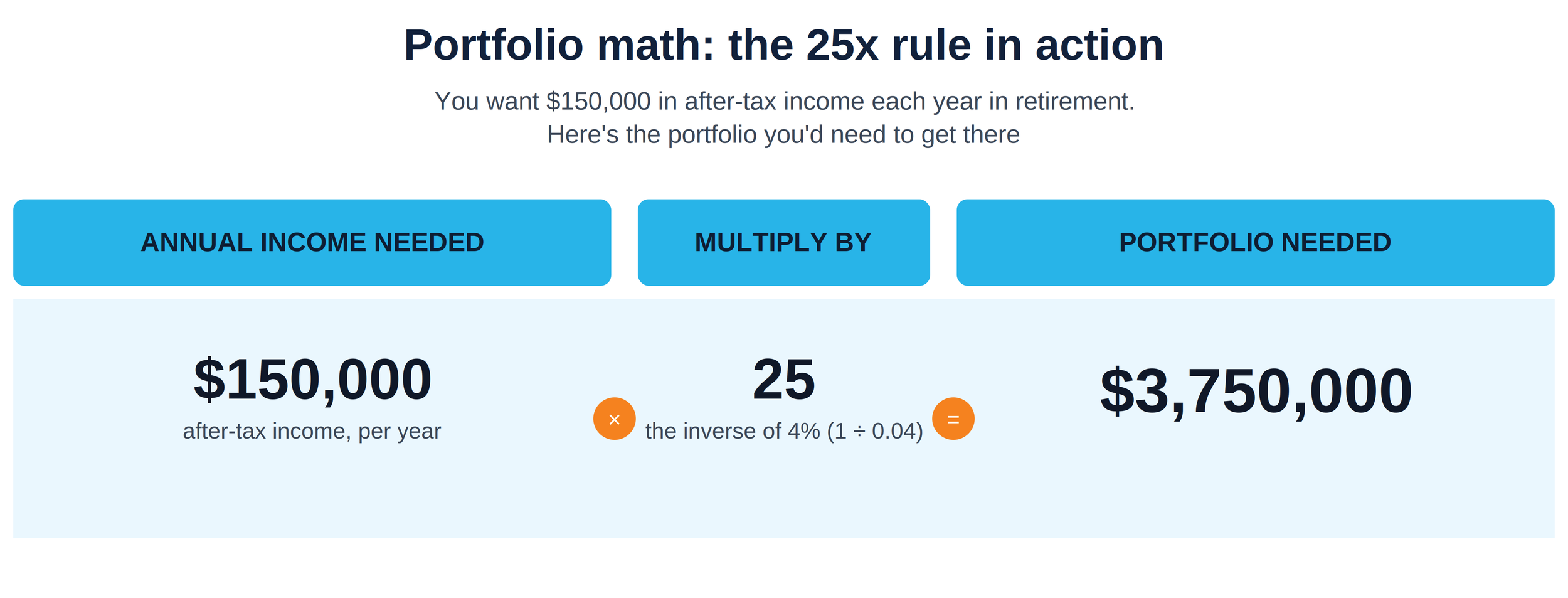
The way the 4% rule works is you can basically just multiply that by 25.
So if you're withdrawing 4% of your portfolio a year, and you need that number to equal $150,000 a year, that's the same thing as just multiplying $150,000 by 25.
You do that math and you're going to get $3.75 million.
Pretty big number, but achievable if you are regularly saving and investing and getting some investment gains to help you out.
Here is the pitfall that you need to be aware of.
A lot of people save in an IRA or a 401(k), or if you're international, any pre-tax account.
This number, the $3.75 million, that is after-tax.
If you're looking at pre-tax money, it's going to have to be a higher number, because in a pre-tax account, when you pull money out of it, you're going to get taxed.
You can estimate what your tax rate is going to be in retirement, and let's just say if it's 30%, that means you're going to need $5.35 million in pre-tax assets.
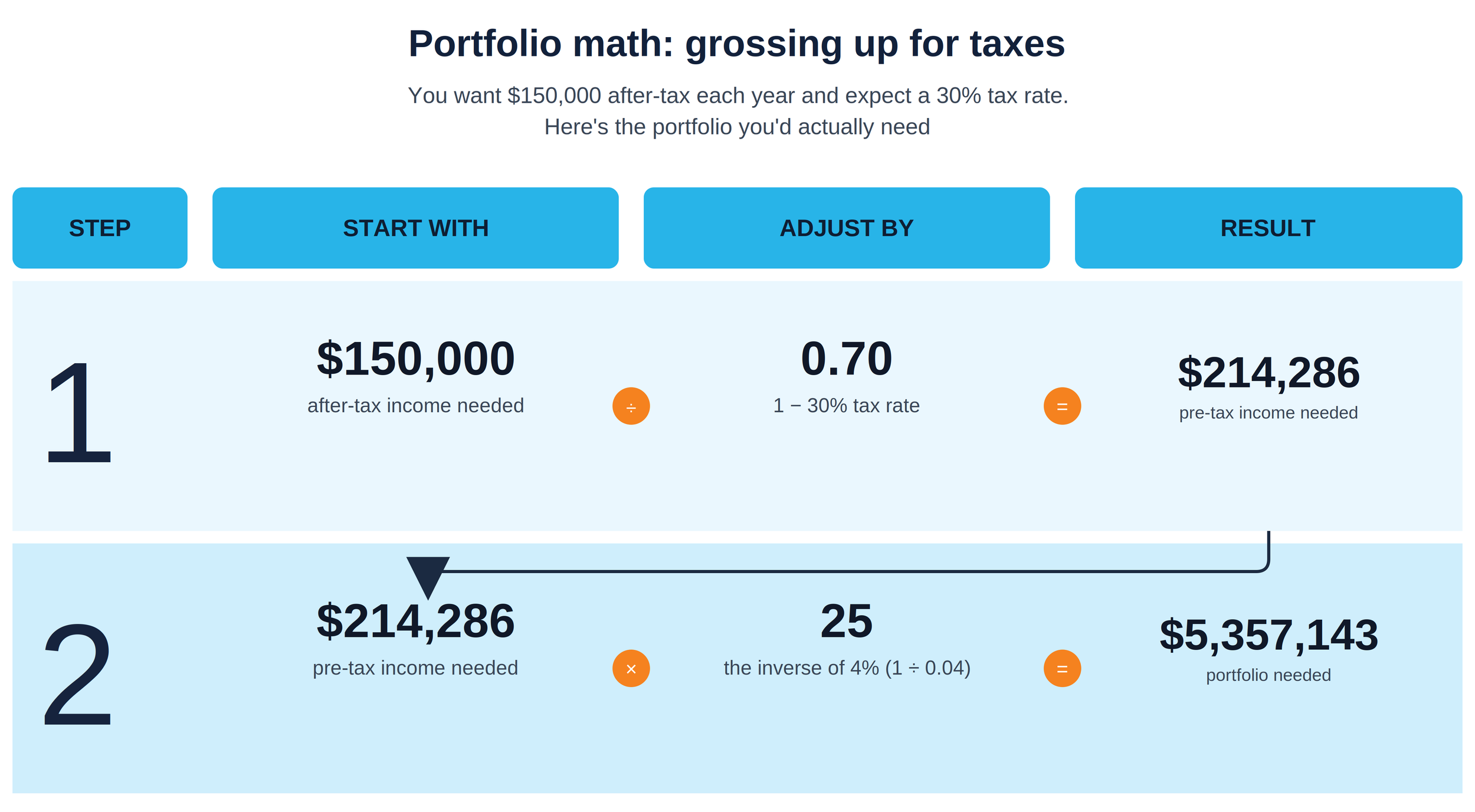
The number is higher, once again, because as money comes out of a pre-tax account, it gets taxed, it gets reduced.
So you basically need to have enough assets to support either on an after-tax basis $150,000 a year, or if you're looking on a pre-tax basis, that's going to be $215,000 in income.
The $215,000 multiplied by 25, that's that $5.35 million.
Both of those numbers are a little rounded, but that's roughly what the math is going to be.
Now, many people are going to have both pre-tax and post-tax accounts, so that's going to complicate the math a little bit more, but you could still do the same math.
You just have to either figure out a blended tax rate, or you treat each asset pool separately when you're doing this math.
That's something where it might help to work with a financial planner to really hammer out that math, but you could definitely do it yourself.
Maybe your favorite AI can help you in that regard.
Factoring in Social Security.
Now, there is another thing that we need to bring into the picture, and it is going to be a good thing, it is going to actually reduce the amount of money you need for retirement, and that is going to be Social Security or a pension, or if you're international, anything that works similarly to Social Security, any sort of retirement money coming in when you retire.
The way Social Security works, though, is that it is going to be taxable income.
Let's continue in this example with adding in Social Security.
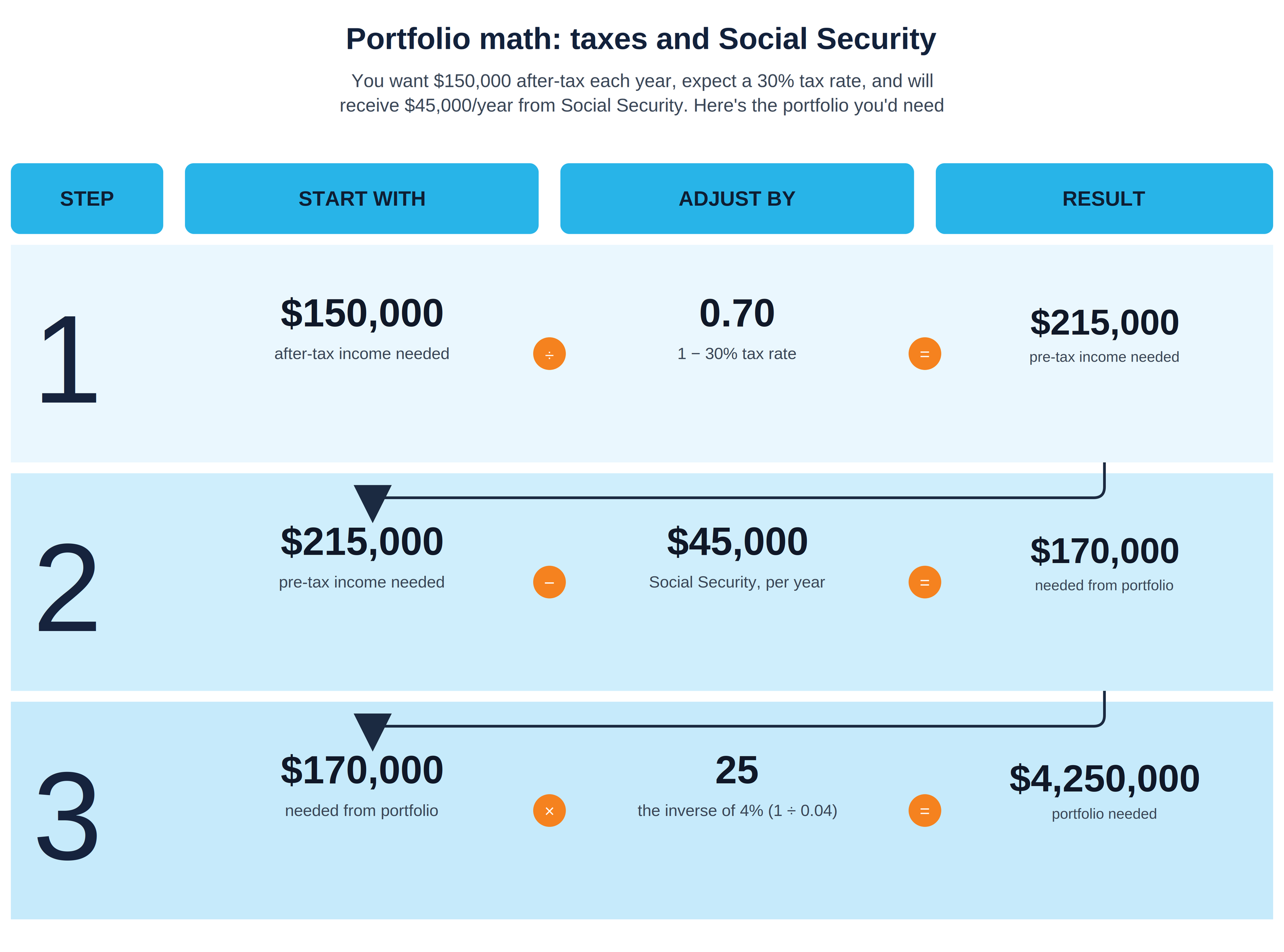
Let's say a couple together is collecting about $45,000 in Social Security.
So we take this $215,000 of pre-tax earnings that they needed to support their expenses, and we could basically reduce it by the $45,000.
So $215,000 drops to $170,000 pre-tax.
That is the new number that they need in pre-tax assets.
You can multiply that by 25 and you get $4.25 million, that is how much money they need in pre-tax.
Or if you want to look at it on a post-tax basis and after-tax accounts, it's going to be a little bit under $3 million that they need.
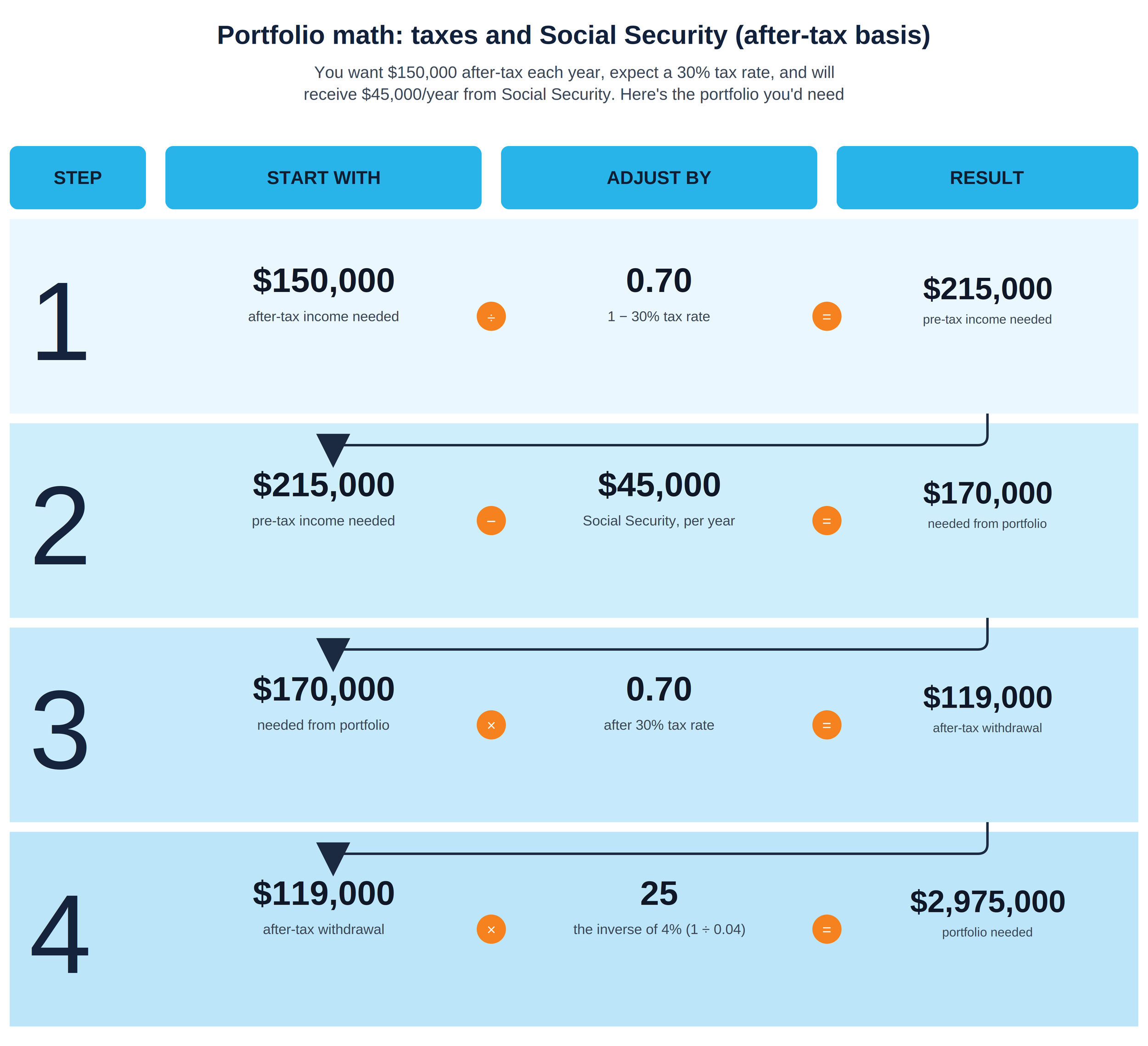
That is how you figure out how much money you need to save for retirement.
Do it on the pre-tax or the post-tax basis, whatever is easier for you and makes the most sense.
That's giving you just a very good rough estimate.
Again, this is a little bit on the conservative side, but things can happen that make it not conservative, if there's no investment gains, we get a couple lost decades, which means the stock market's basically flat or worse performance.
Things can happen, but again, this is 95% of times in their research, this is going to work out for you.
Savings Milestones by Age.
So, that's how much money you need in retirement.
How do you know, though, if you're hitting the right savings goals as you get older?
This is going to be just kind of a rule of thumb table that we have put together, where let's say that you're assuming investment returns of 5% in real terms, so this is after inflation.
What multiple of how much you're going to spend in retirement should you have at various ages?
All of this savings rate is going to be in a multiple of retirement spending, and I'm picking that because, again, to reach that 4% rule, you basically need 25x your retirement spending.
So let's see, when you were younger, what multiple of your retirement spending you should have saved.
If you were looking at this table, you'll see that it starts on age 30, and we're assuming that you have a 1x multiple of how much you expect to spend in retirement saved, all the way up to when you are 67 years old with 25x.
In our example, that was $150,000, because that is how much money you're spending a year in retirement.
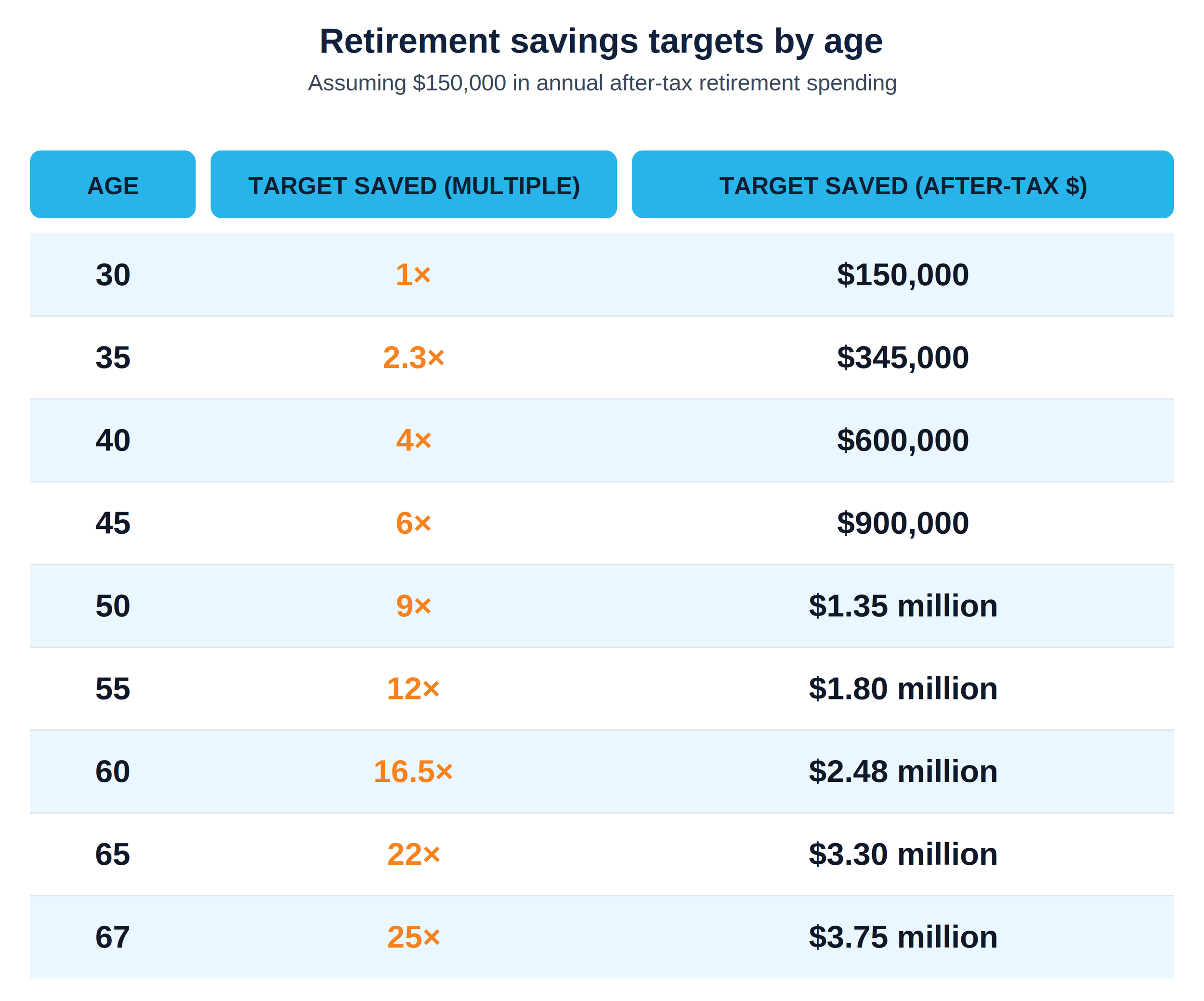
You could see, though, the multiple of how much you're spending in retirement you should have at various ages.
This is just a rule of thumb, but from this you can roughly gather where you are in your progression.
It's worth pointing out that if you're starting early and you're following this, only 30% of that $3.75 million you have by 67 is actually coming from contributions.
70% of it is going to come from investment gains.
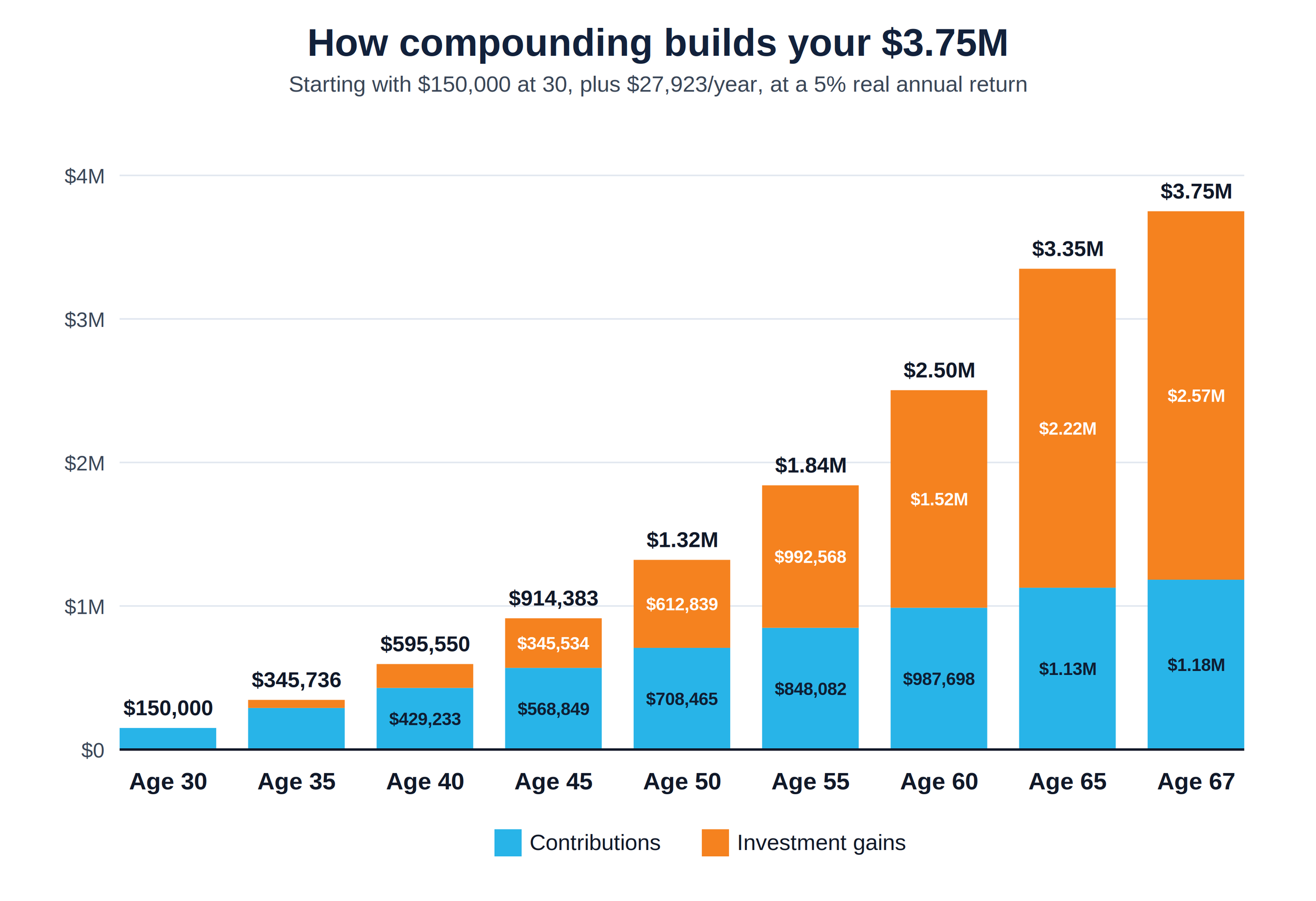
But that is only if you are starting very young and investing very studiously.
Knowing how much you need to retire is one of the most important parts of financial planning.
The key takeaway is that you don’t need to know your exact retirement number, just a reasonable target.
Having a rough idea of how much you need saved and invested is better than none.
Start with what you expect to spend in retirement, multiply that by 25, then adjust for taxes and any income you expect from Social Security or a pension.
From there, you can use your age-based savings milestone to see whether or not you’re roughly on track.
The assumptions won’t be perfect, but having a target gives you something to work toward and a way to measure your progress.
The sooner you start, though, the more you can rely on compound growth rather than your contributions to reach that target retirement number.
So, it’s important to start sooner rather than later.
For more on How Much Money You Actually Need to Retire, check out this video below.
Nothing in this newsletter is investment advice nor should be construed as such. Contributors to the newsletter may own securities discussed. Furthermore, accounts contributors advise on may also have positions in companies discussed. Please see our full disclaimers here.
