Meta Update: Reckless Spending or Attractive Opportunity?
Get smarter on investing, business, and personal finance in 5 minutes.
Business Update
Meta recently reported earnings, so I thought this would be a good time to provide an update on the business.
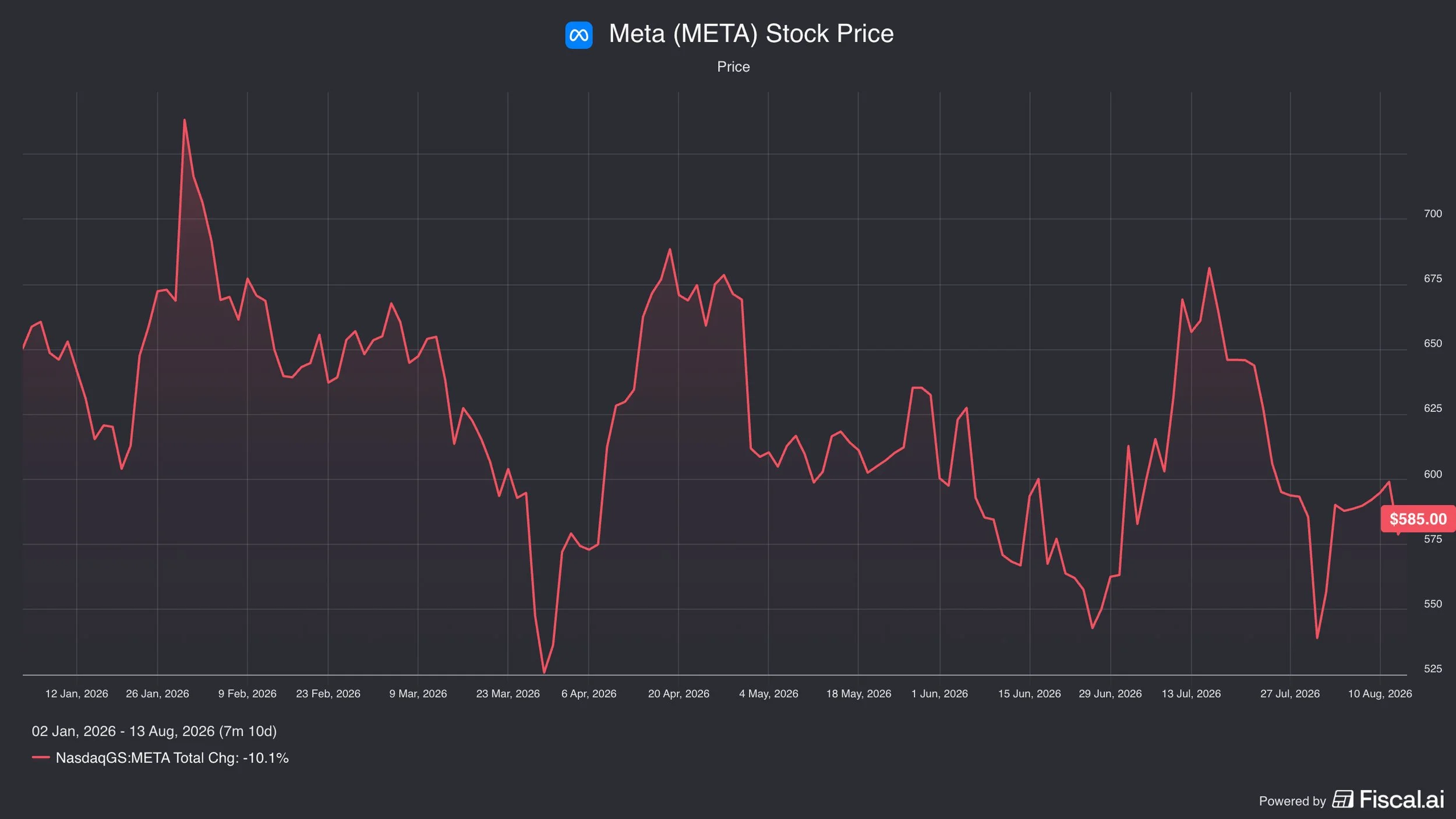
After earnings, the stock fell -9% and is now down -26% from its all-time highs and is down -11% YTD.
I want to go into their 5 call options, because a lot of them kind of get confused together, so I want to really clearly label them out separately.
I'm also going to touch on a risk that I feel like is not getting enough airtime, and it has nothing to do with AI or Capex.
If you're newer to the business, I do have a deep dive out on Meta covering how the ad tech platform works, the bidding dynamics, the auction, and the fact that their buyers are direct response and performance driven, not generally brand advertisers.
You should check that out first if you're newer to the company.
Meta 2Q26 Business Update.
In terms of financials this quarter, there's really not a ton that's surprising.
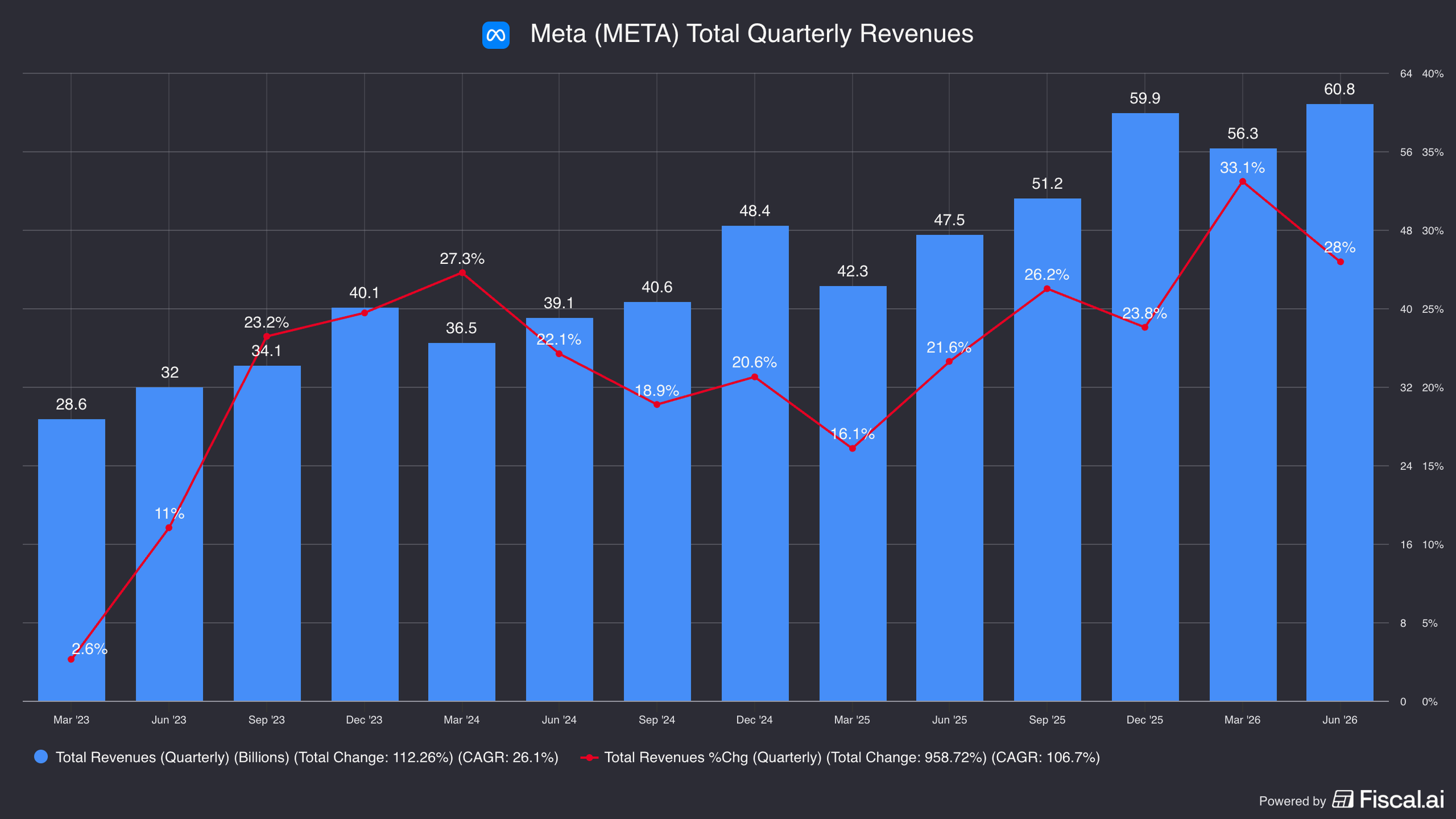
Revenue growth was pretty strong at 27% y/y in constant currency.
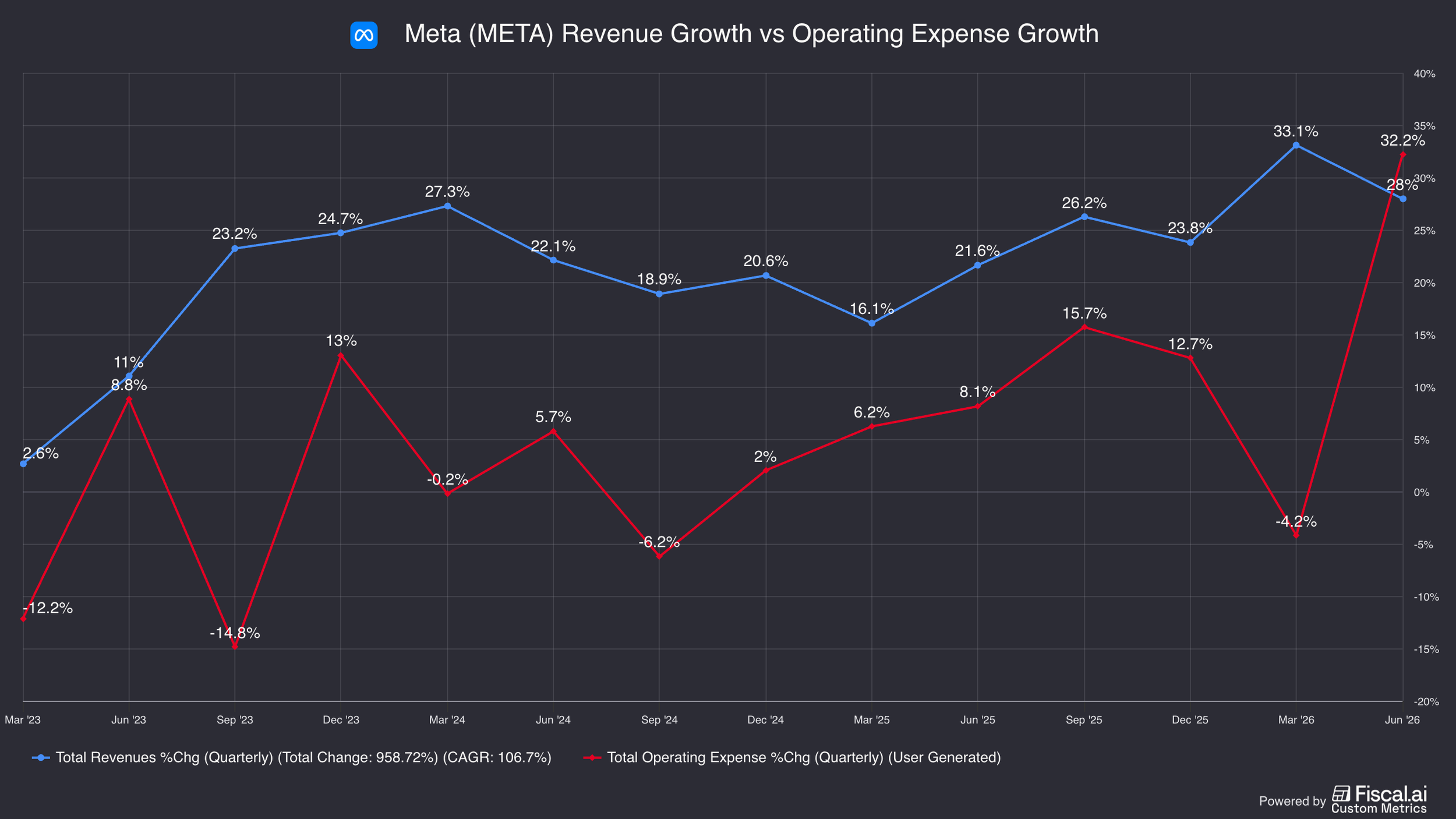
Operating earnings look like they contracted on the P&L, but after backing out a legal settlement and severance pay, they actually grew 9%.
That 9% in operating earnings growth compares to 27% revenue growth, meaning the two are no longer keeping up.
For a couple years after the 2021, 2022 reset, operating leverage was insane, meaning earnings grew faster than revenue.
Right now it's the opposite, expenses are growing faster than revenue.
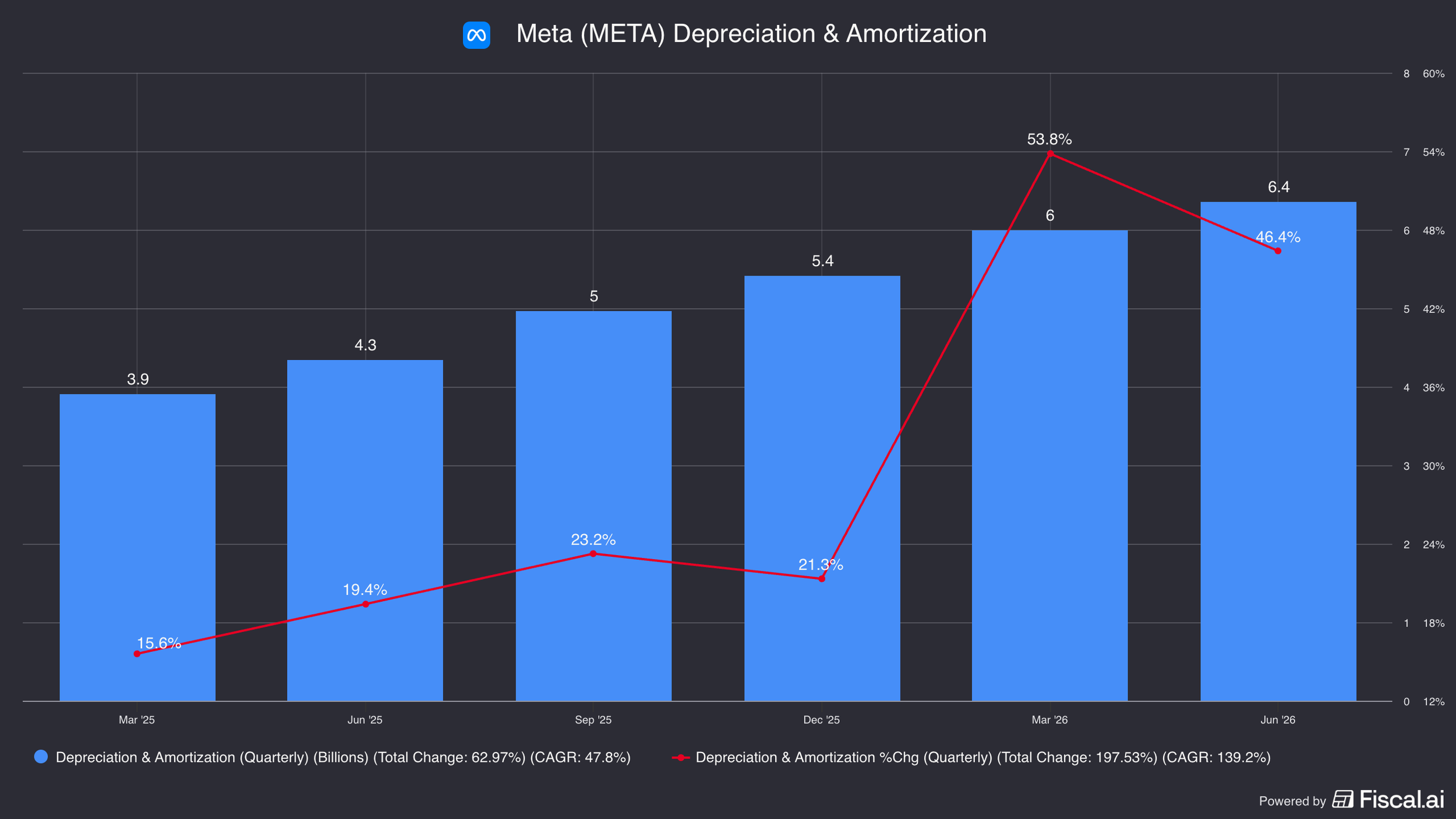
A big reason is the depreciation line item.
Capex spending gets depreciated through the profit and loss statement over time, and depreciation is up almost 50% y/y, continuing to increase as capex spend rises.
They're also spending heavily on AI researchers, with reports of billions spent hiring teams of scientists.
This is being partly offset by firings, including the severance package this quarter, with the hope of becoming a more efficient company.
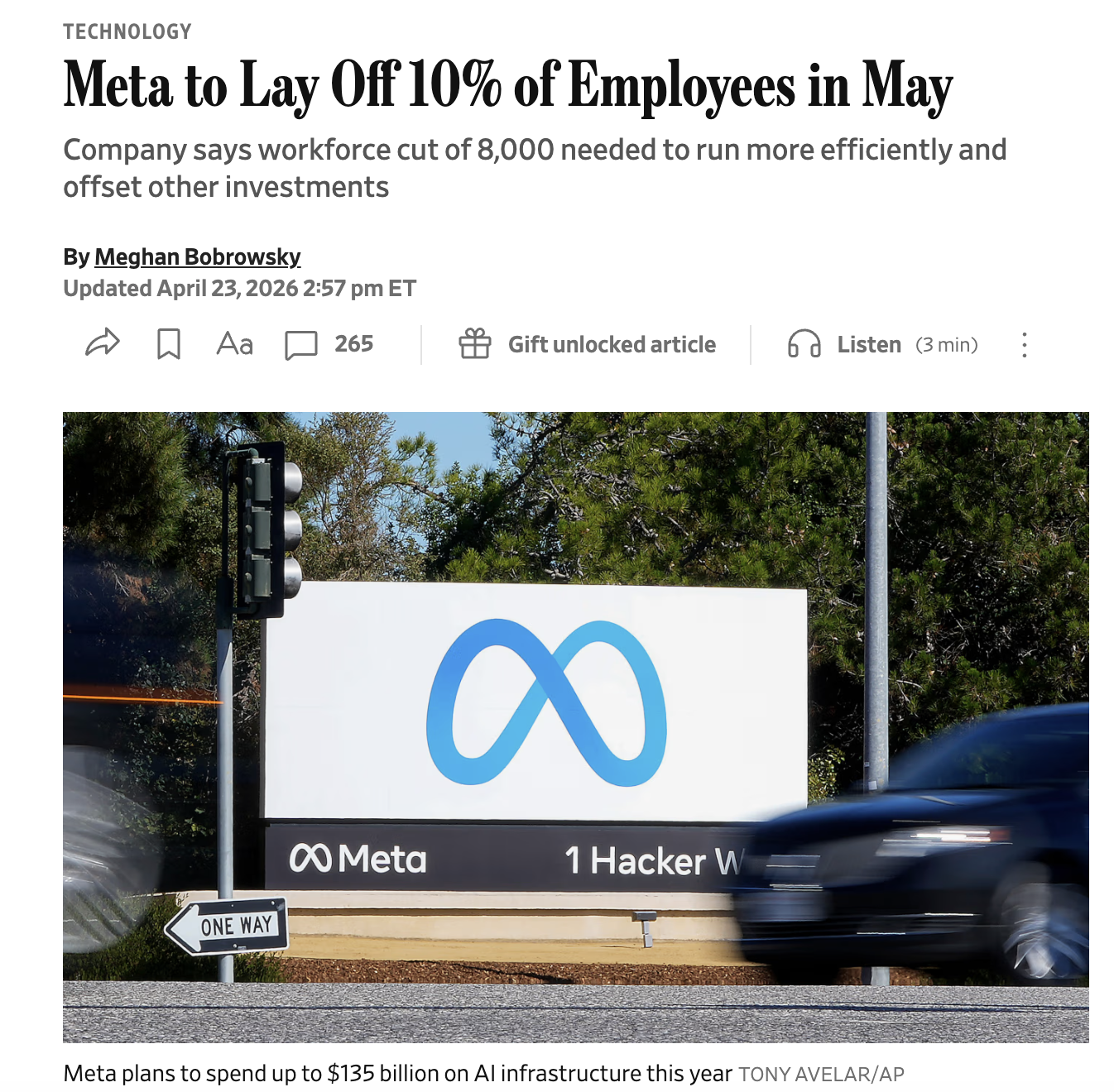
But we're not really seeing that yet, even backing out severance, operating earnings were only up 9% versus much higher revenue growth.
I don't think this is a new paradigm, more an elevated level of spend for a period of time, with operating leverage returning eventually, maybe soon.
What's Driving Ad Revenue.
If we're looking at what really drives revenue for Meta right now, unsurprisingly, it is advertising.
There's two aspects to this, ad impressions, the number of ads shown to users globally, and ad prices.
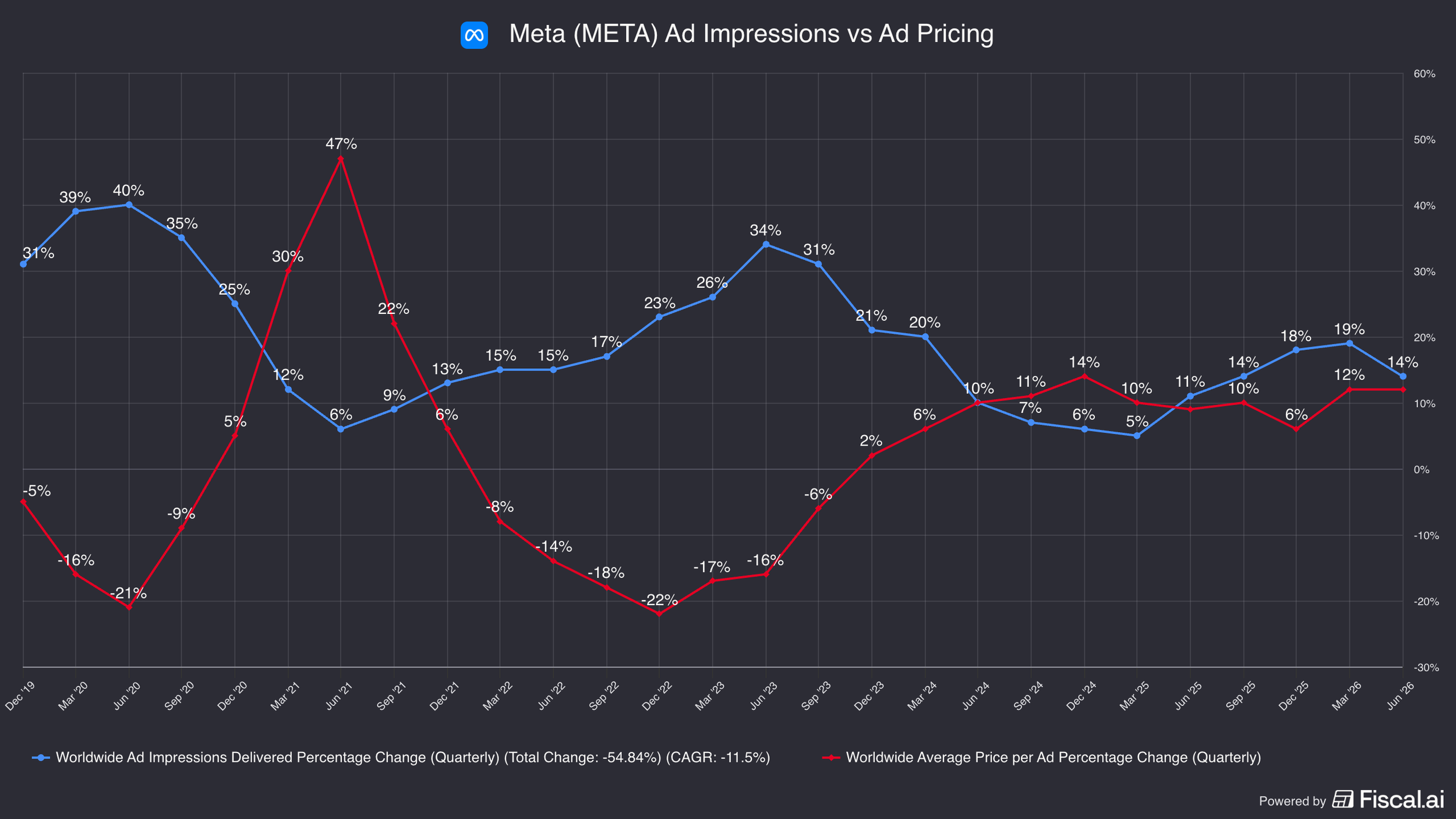
Ad impressions were up 14%, which is usually a mix of two things, ad load increasing, meaning more ads shown per user, and time spent increasing, which they explicitly mentioned on the call.
Basically, the more time people spend on the app, the more ads they can show.
Ad prices increased 12%, and this one trips people up, even analysts who've followed the business a long time.
The common view is that rising ad prices are worse than rising impressions, because it suggests the return on ad spend is falling.
And that's not always true.
People who buy ads on Meta are return on ad spend driven advertisers, looking to place a dollar of advertising and get back three dollars in revenue.
If ad prices rise and they're now paying two dollars for that same three dollars back, that does suggest return on ad spend is falling, which is bad, since once it falls below a certain threshold, advertisers leave the platform and growth slows.
But there are two reasons ad prices can rise.
If you hold everything else equal and Meta isn't getting better at targeting, then yes, rising ad prices mean falling return on ad spend.
But if targeting is getting more effective, the cost per action can stay flat even as the ad price rises, because better targeting compensates for it.
In that case, they're charging more for more effective impressions, and return on ad spend holds flat.
So I don't think you can read too much into ad prices rising relative to impressions as inherently a bad thing.
Within the ad price increases, there's a notable geographical split, North America saw ad prices up 20%, while Europe was up just 10%.
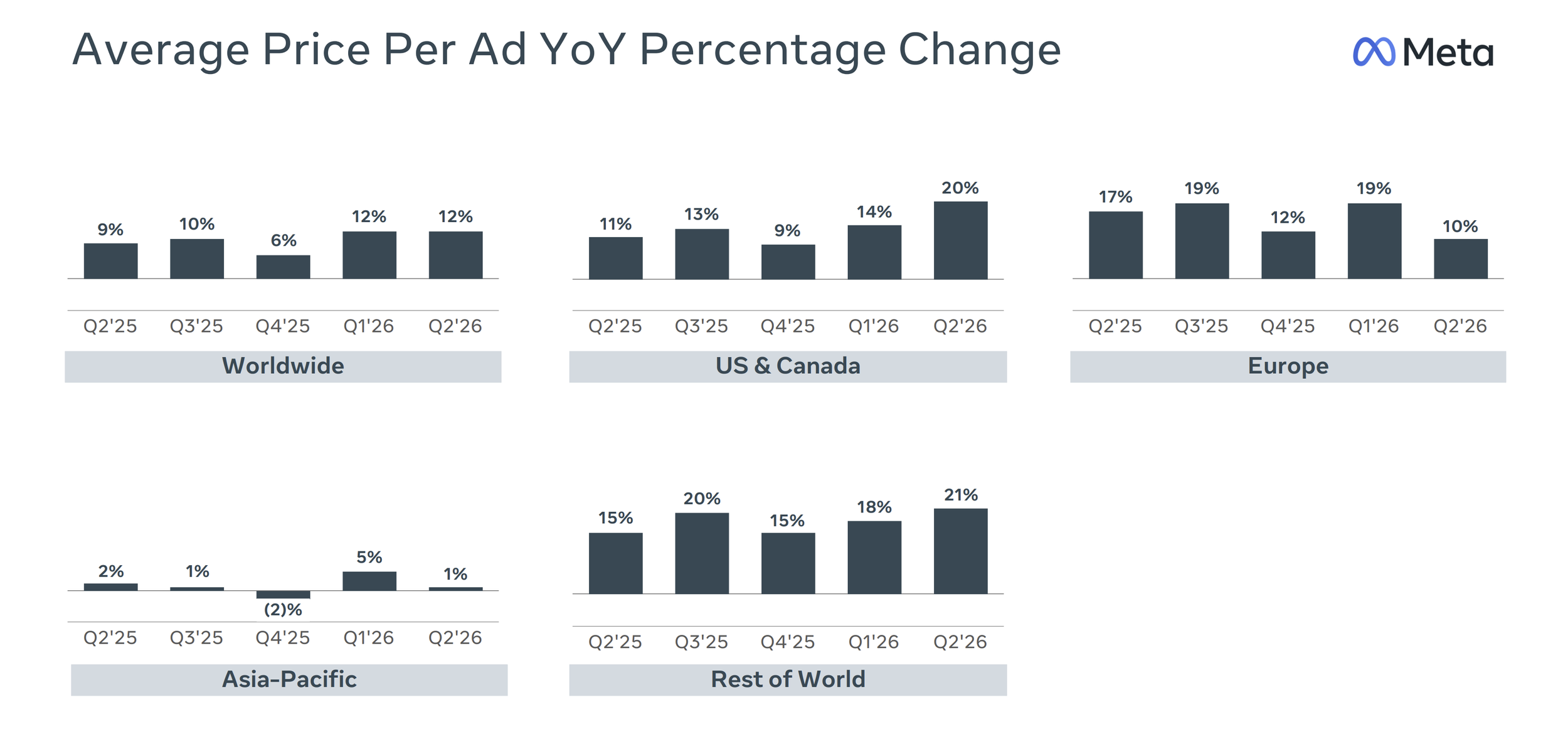
There are always variations across geographies due to different economies and demographics, but worth noting is that Meta just rolled out a less personalized ad offering in Europe, which they said was part of why ad prices weren't as strong there.
Less personalization means worse targeting, and worse targeting means they can't charge as much, since advertisers are driven by hitting a specific return on ad spend.
They flagged this as a potential headwind over the next few quarters.
Revenue Deceleration Guide.
Now if we look at next quarter's revenue growth guidance, they're guiding for 19-25% revenue growth.
That's a little bit of a deceleration to perhaps a meaningful deceleration from the 27% they just did in 2Q.
These are still very high numbers though, and while an investor would like to see growth rates stable to maybe even increasing, this needs to be taken in the context of the valuation and what's being priced in, since 27% growth for any period isn't what's priced into the stock today.
So, there's a deceleration in revenue at the same time capex is increasing, which has people wondering if improvements in the recommendation algorithm and ad targeting are starting to plateau.
I don't think so, but that's definitely an investor fear.
One of the bigger things the market reacted negatively to was Meta saying, for the first time, that they're maximizing capacity not just for 2026 but for 2027, meaning capex spend will be just as high, if not higher, next year.

That's a lot of money, and investors are unsure of the ROI.
They're spending around $140bn in capex this year, a very big number, compared to about $105bn in operating cash flow over the last twelve months after backing out stock-based comp as a cash expense.
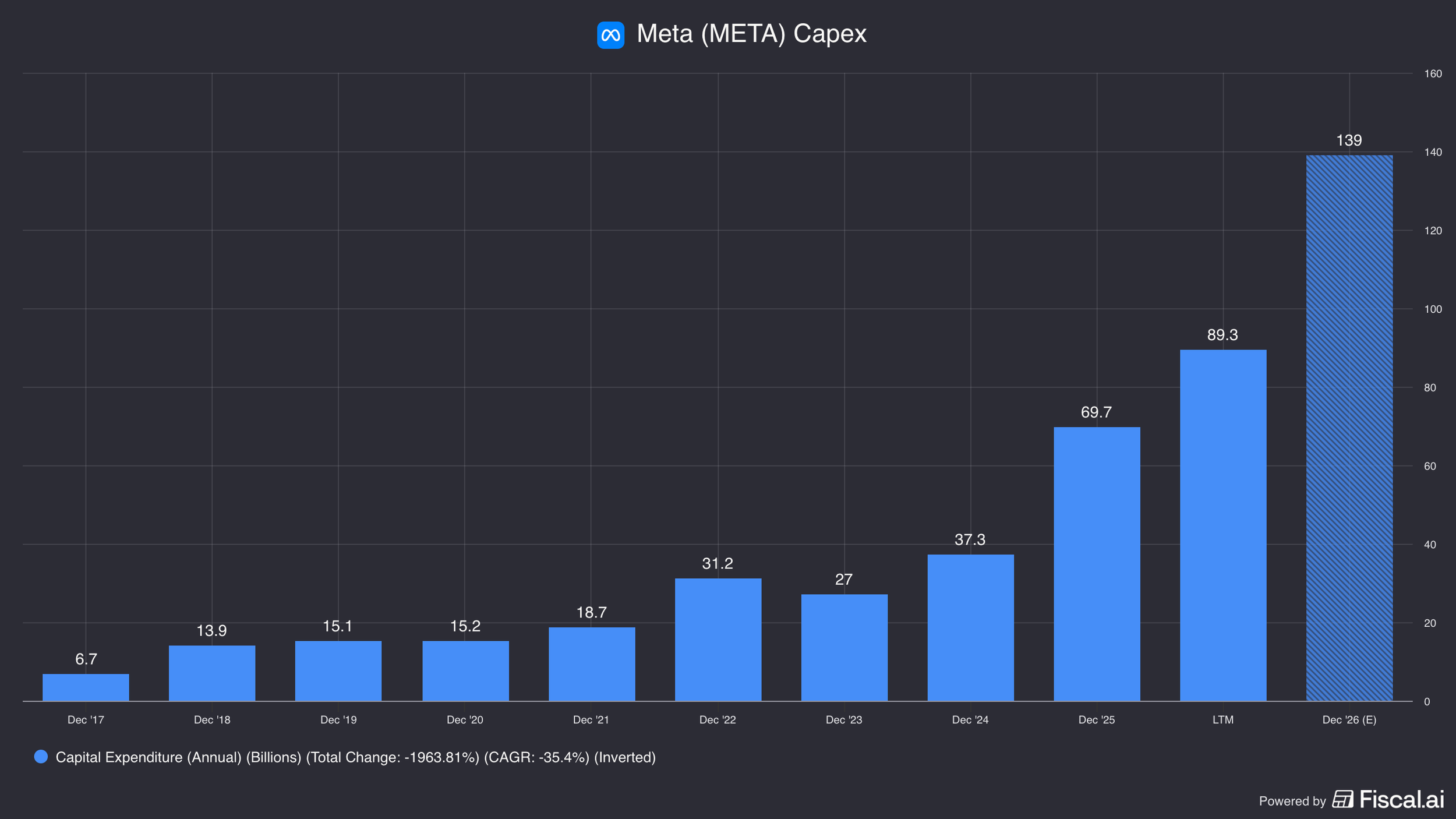
This is a very meaningful number for Meta to be spending, for anyone to really be spending.
In the past, they said capex was for internal uses, making the recommendation algorithm better and improving ad targeting, something investors were totally fine with.
Over the past few quarters, that's changed.
Spending on the core business is easy to justify though, bigger models mean better recommendations and ad targeting, with a clear return on investment, perhaps one of the clearest for any AI use case, and they've shown it every quarter through improvements from utilizing their model, called GEM, that's already improved the feed, the algorithm, and ad conversion.
The rest of the capex is a much more fluid strategy, since they don't fully know how it will unfold.
There are five potential places it can go:
1. Meta Compute
2. Business AI Agent Platform
3. Reselling it (Neocloud)
4. Training their AI model MuseSpark
5. Reality Labs (AR/VR)
Four of those are far more speculative than just using it on the core business.
Meta Compute.
A new thing they've been talking about is Meta Compute, the name of their cloud division.
They haven't said too much about this yet, but the idea is to compete with Azure, GCP, and AWS, selling compute as a cloud service.
In their ideal world, the Meta cloud service would be very tied to the AI products they create with their AI model, much like GCP, which layers its infrastructure with the Gemini model.
That's what Mark Zuckerberg said on the call, they don't just want to sell compute, they want to sell intelligence.
Right now, compute is scarce, so demand is much higher than supply, and Meta is already in talks to resell $10bn of compute to Anthropic.
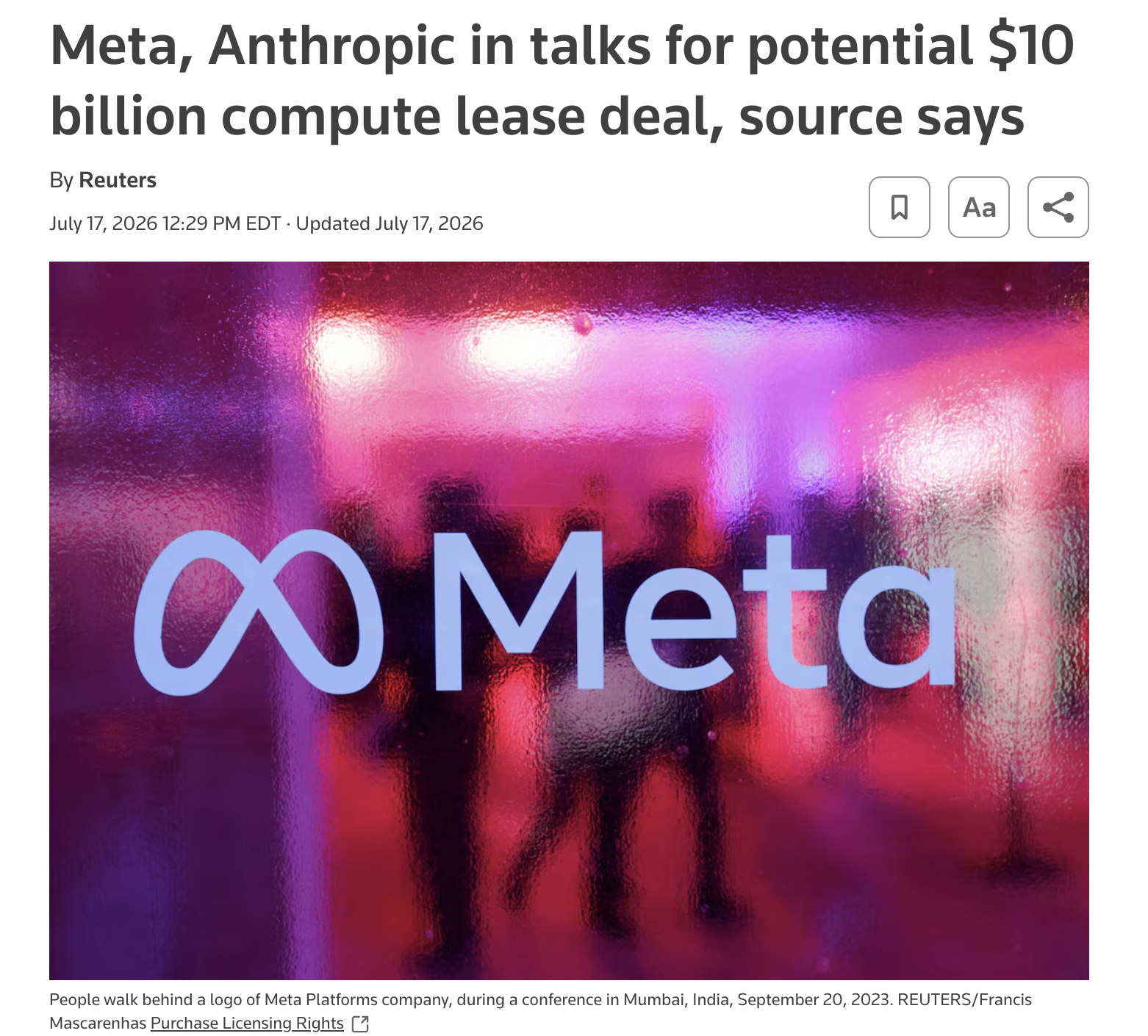
I'm not sure that's the best sign, because what you'd want to see is them monetizing their capacity into something more sustainable.
Zuckerberg said on the call that he doesn't want to make short-term decisions here.
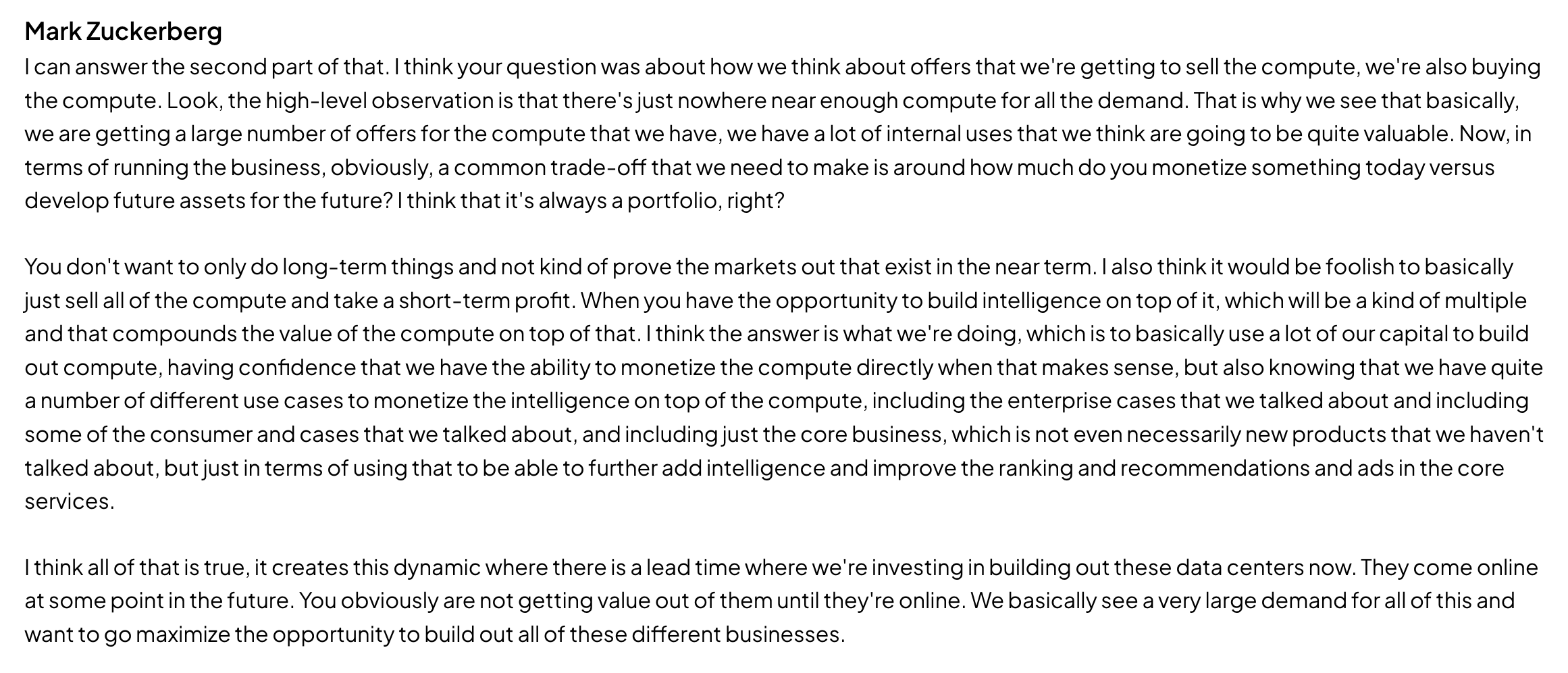
The idea is that once a business is onboarded onto their cloud, and cloud providers tend to be a little sticky to move away from, they're able to sell them on Meta Intelligence and other AI products.
Once a business is using those products, that creates a real sticky customer buying compute and services from them for years to come.
That's the gold standard of what they're going for.
The Business AI Agent Platform.
Some of this compute is going towards is the business AI agent platform, leveraging their AI and compute capacity to sell AI services to businesses.
They're trying to leverage their position with tens of millions of existing advertisers, for whom Meta is often the most important sales channel.
The pitch is to let Meta do more, agents that look at your inventory, tie into your sales data and advertising copy, even help with customer messaging and returns.
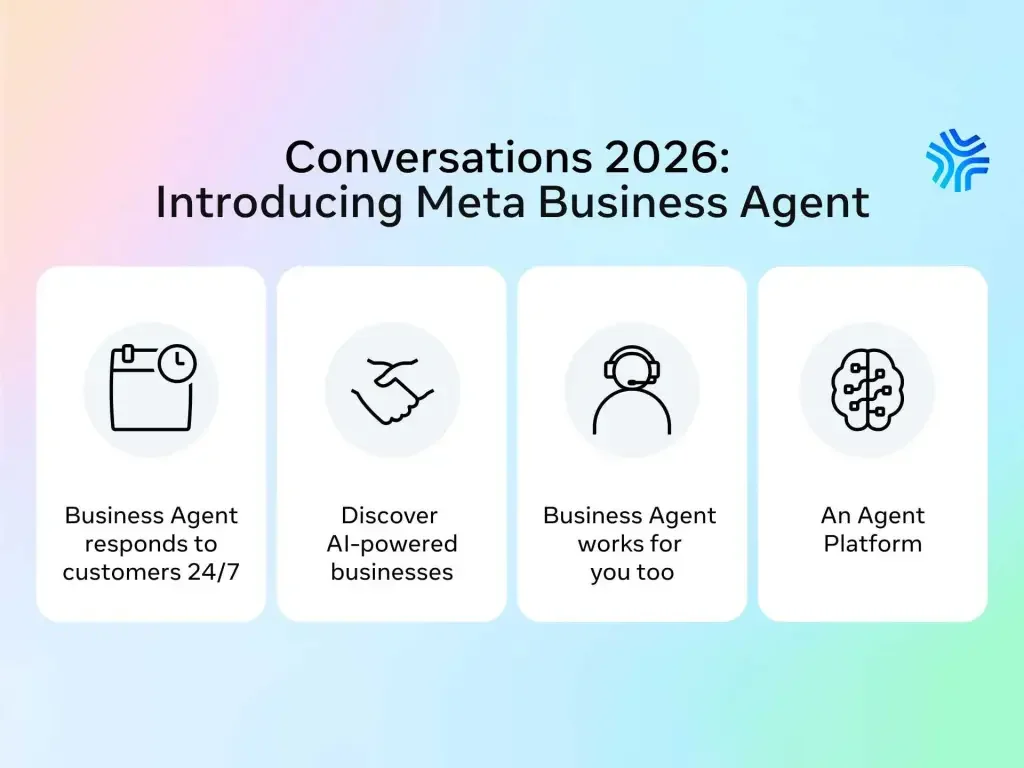
The more the agent gets embedded in a business's operations, the more they can charge, since it's basically a token-based model, and it also puts Meta in a better competitive position.
It's not easy, though, since Google, Microsoft, and Amazon all have large cloud services.
That's where Meta is hoping MuseSpark, their AI model, can help them stand out.
This is a bit like the strategy Adobe used, leveraging Photoshop and Premiere to get into marketing departments and then pushing into analytics.
It's not a bad strategy, it's just a question of whether it works.
Meta already has a built-in advantage here.
They succeeded in small business advertising where Pinterest, Snapchat, and Twitter failed to onboard advertisers, because Facebook already had those businesses on the platform through business pages, which spun up the entire flywheel.
That's around a 100+ million small businesses today, all potential customers for these agents.
Becoming a Frontier AI Model with MuseSpark.
The moonshot, and maybe not quite as unlikely as a moonshot but still a very hard thing to do, is to create a leading frontier model on par with Anthropic or OpenAI, and they're spending a lot of money trying.
If they succeed, that buttresses their cloud services, since you'd then have a leading model together with the cloud infrastructure, selling intelligence people actually want.
Without a good model, it's harder to sell cloud services and AI agents.

This also matters for Facebook and Instagram, since they don't want to be beholden to another company's rules on how their model can be used.
Just to be clear, even if this becomes a $100bn business, that doesn't mean the return on investment was worth it if it takes 10 or 15 years to get there, that's still a pretty bad return.
But it's a call option that exists today, and the money spent is largely a sunk cost already being priced in as a loss in the stock.
Reality Labs.
Since 2021, they've spent over $100bn on Reality Labs, their AR/VR effort.
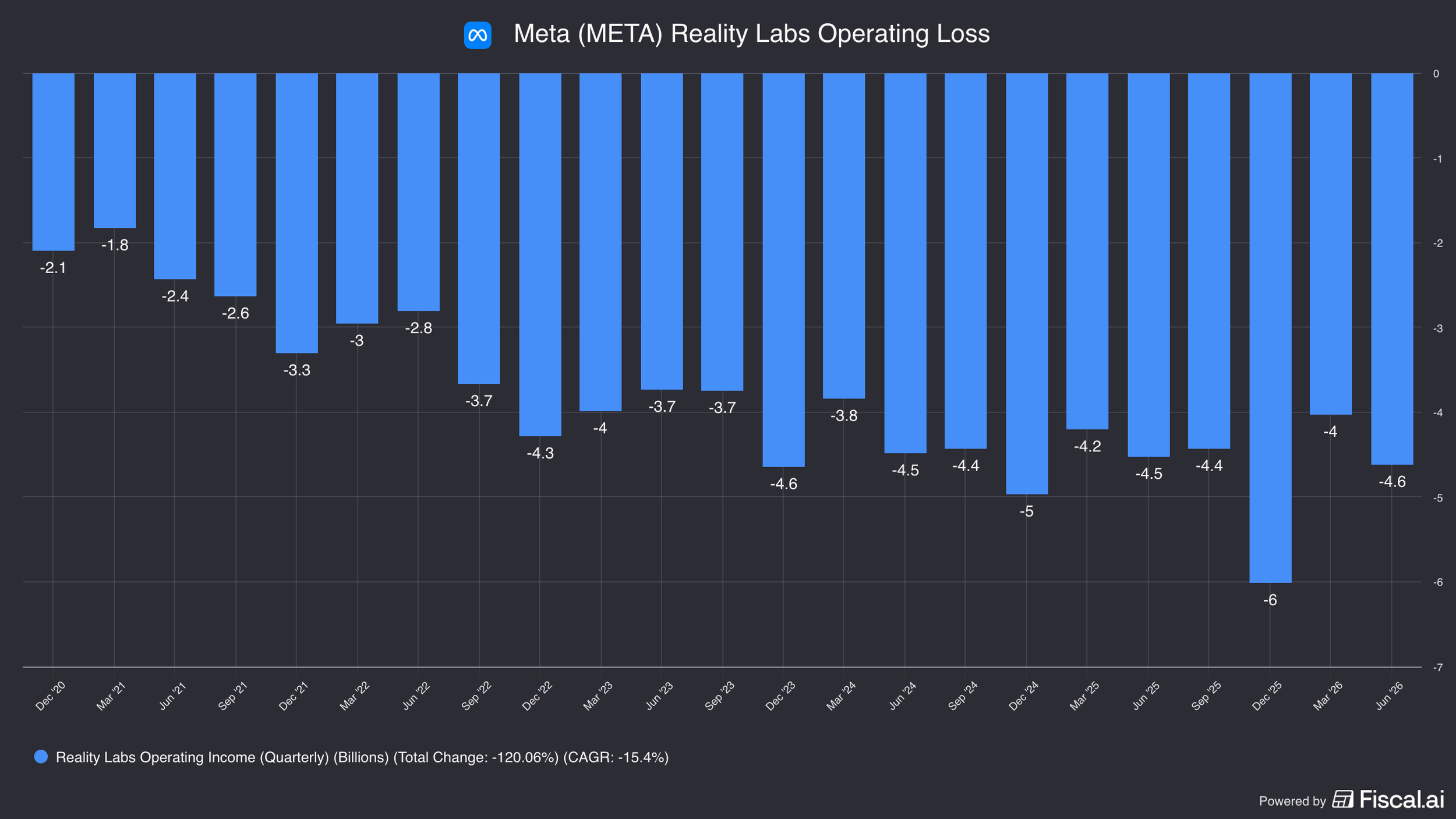
This last quarter alone the segment lost over $4.5bn, on track to lose just under $20bn for the year.
Mark has said they'll continue narrowing the losses, but hasn't laid out a real path to profitability that would rationalize the $100bn already spent, so it's looking hard for them to ever call this a good investment.
That said, AR/VR does seem inevitable as a category within the next ten years, the question is who owns it.
Meta's in the best position right now, Apple's Vision Pro flopped despite being a cool device, and Meta is selling far more in AR/VR than Apple ever has.

The problem has been the lack of a great use case, and that's where AI may bail them out again, combine AR/VR glasses with AI and you get real use cases, like snapping a photo of food to get its nutritional breakdown, without the friction of pulling out your phone.
That's part of why they're so focused on building a strong AI model, they want to own the full tech stack.

Neocloud.
The other thing they've talked about doing with this capex is starting a neocloud, basically reselling the compute.
This would be the worst outcome, since if they end up reselling to other people, it likely means they overestimated how much capex they needed, and it might not work out well, since the current compute-scarce environment won't last forever.
It's also a bit of a use it or lose it situation.
If they don't build toward their own products now, the option to do so later gets worse, since compute is scarce today and commands a premium, but that premium likely shrinks a few years out as the rest of the industry builds out capacity too.
Execution Risk.
Now, all of these different things have a lot of execution risk.
Meta's never been successful with any business outside of their core family of apps.
Instagram, Facebook, even WhatsApp, they've honestly struggled to monetize for a long time.
There's some click-to-message advertising and agents on WhatsApp now, bigger in India and Brazil, but the return on investment probably wasn't great.
If you're trying to get a 10% return since they paid $19bn for it in 2014, you'd need that business to have over a $100bn in revenue.
That's not going to happen, but they probably bought WhatsApp just to keep it out of the hands of someone else building a social network on top of it.
My point is that they have not had success outside of their core apps, and now they're doing several things outside of it at once, the cloud service, the frontier model, the AI business agent platform, the neocloud, and AR/VR.
It's a question mark whether they can execute on any of it.
Google Cloud is a useful comparison.
They only started selling GCP in earnest after Thomas Kurian stepped in in 2018.
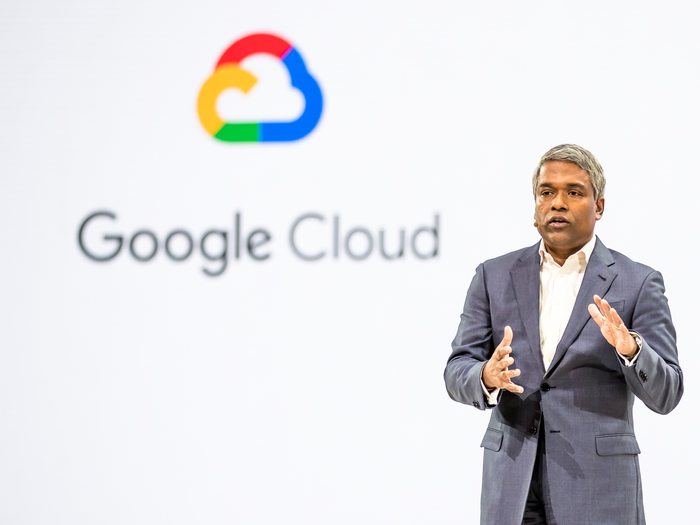
At the time they had around $4bn in sales, and it took until 2023 for that business to turn just a small profit of about a $1.7bn on $33bn in revenue, while spending far less on capex than Meta spends today just on AR/VR.
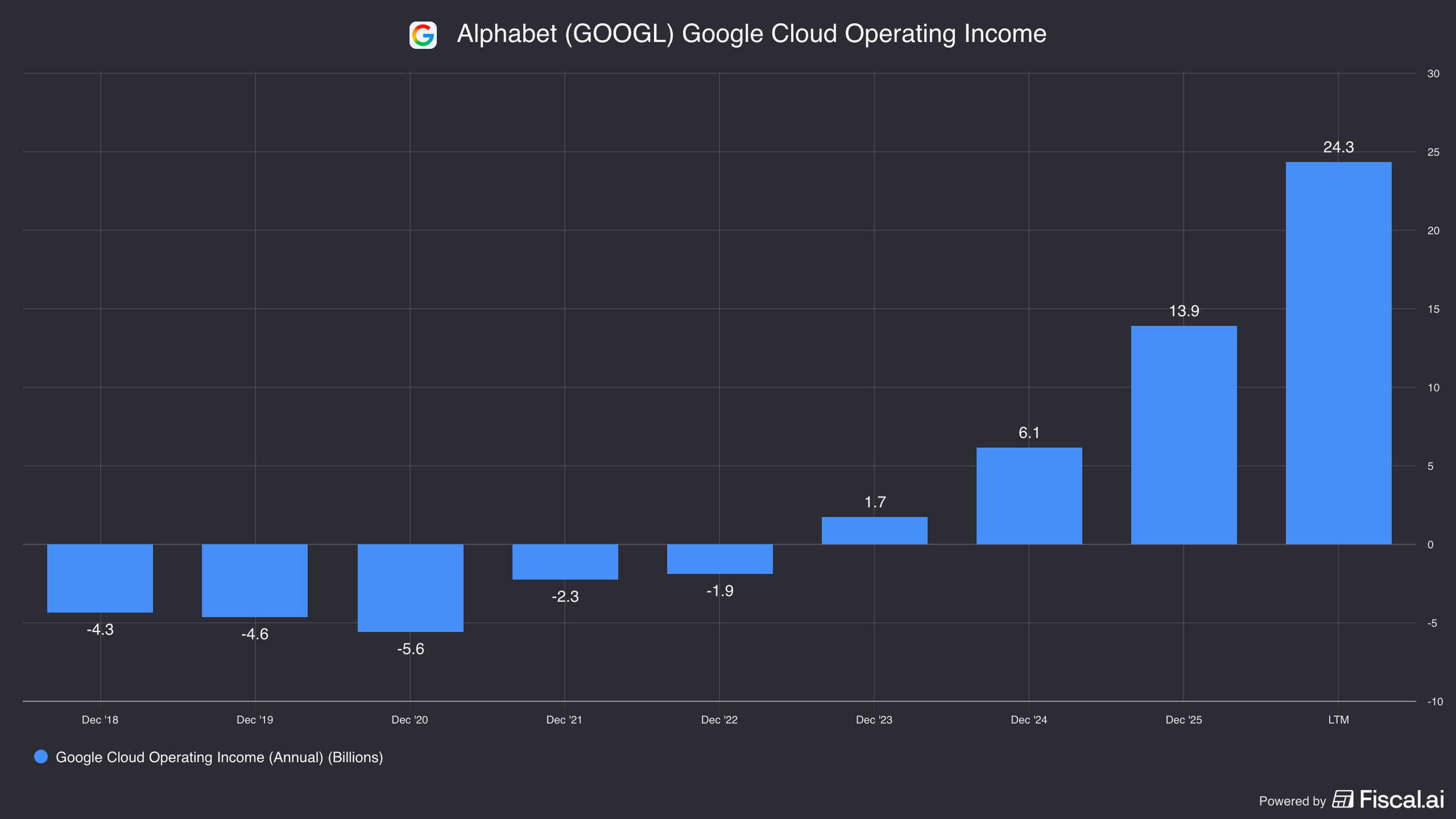
Even Google, which is very good at infrastructure, took a long time to build a sales force and get product market fit.
Meta is trying to do this on a much more compressed timeline, and unless they get something like a frontier model, it's hard to see a big reason someone would go to Meta Cloud.
As long as we're in a capacity-constrained environment, though, that's their opportunity, since a lack of capacity elsewhere forces customers directly to them.
I'm not entirely positive how this goes, and for an investor, that's concerning.
What I will say is that all of these efforts together are basically a couple years of cash flow for Meta.
Even if they all failed and Meta just resold the compute, they'd recover a good amount of their cost, and a good chunk of that hundred forty billion is for internal efforts anyway.
So even in the worst case, you still have a highly cash generative business that should be attractive once it pushes through this investment period.
Instagram and Facebook's success isn't dependent on winning in cloud or having the best frontier model.
They've been improving their ad tech and recommendations without one, so even being six months or a year behind, they can keep getting better every quarter, which is what really matters.
The Litigation Risk Nobody's Talking About.
This is going to be a bit of a non-sequitur, but at the beginning of 2026, there were two state trials, one in New Mexico and one in California, and both verdicts came against Meta, with YouTube also named in one, for being partially responsible for causing a teen's anxiety and depression.
The New Mexico case awarded $375mn and the California case was $6mn, but it's not really about the dollar amounts, those often get reduced anyway.

What it's really about is that this opens the floodgate for a lot more personal injury lawsuits, since a lot of people can now claim Meta caused their depression and sue for money.
Meta is vigorously defending against this and appealing.
What's different about these cases is the legal theory.
Section 230 of the Communications Decency Act says a tech platform can't be held liable for content posted by a third party, which is generally a good thing, since without it Google could be liable for anything that surfaced in search results.
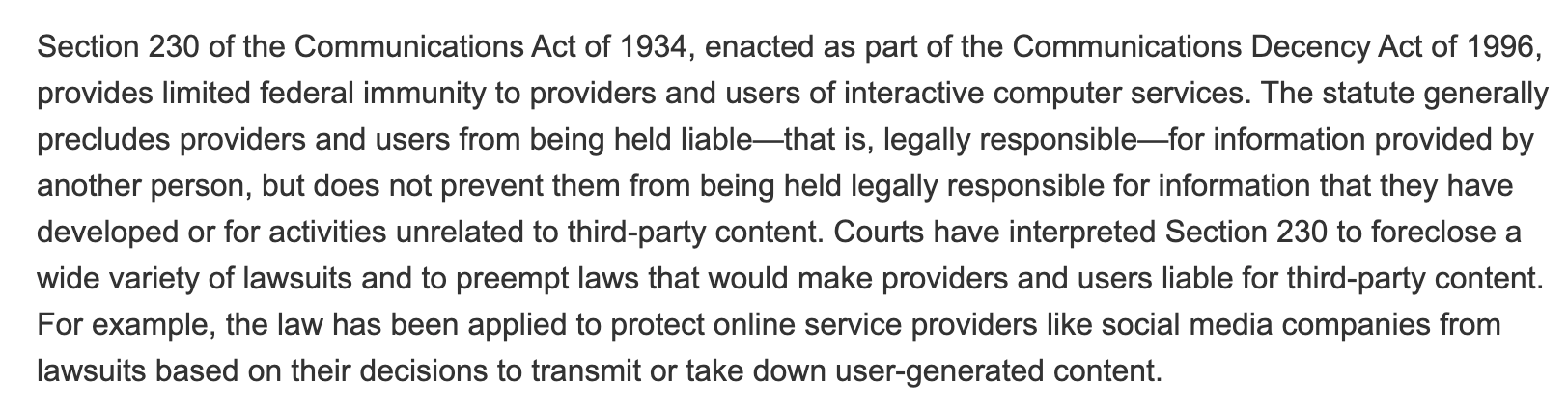
So instead of going after Section 230, these cases claim the product design itself was the issue, not the content, that it was designed to increase engagement to the detriment of child and teen users, and that Meta knew this and did it anyway.
There actually are internal emails from a few years back where Zuckerberg talked about optimizing for time spent on the platform, making content more compelling so users stay longer.
This lawsuit takes that objective and calls it nefarious.
In the past several years, Meta actually switched their metrics away from time spent toward making sure a user enjoyed the session the most.
I don't think social media companies get much sympathy here, generally speaking.
Meta's defense is that a lot of real-world factors feed into depression and anxiety, and they cite a study of 120,000 children showing those with zero social media exposure actually reported lower wellbeing than those with moderate use.

So the research doesn't seem to point to zero social media being the answer either, there's probably some happy middle ground.
But it's not my job to say what I think about social media's impact on society, it's just my job to flag this as an investment risk.
If these trials go against Meta, there could be a lot of hanging litigation for many years, maybe eventually a global settlement, or maybe it just sits in the background until one day it isn't.
I don't know which way courts will rule on whether Meta is responsible for an individual child's depression, that's a hard thing to litigate.
But that's the court's job, and it's my job to tell you that's a risk.
Valuation.
At a $585 stock price, Meta is trading at 20x 2026 EPS estimate of about $29 a share.
If you back out Reality Labs losses, since that money presumably won't be lost forever, it's trading at ~17x.
I won't go through the full reverse DCF here, I do that on Speedwell Research, my research service for professional investors, but the market currently seems to be pricing in a roughly high single-digit growth rate for the next several years before it fades.
That means buying today at that assumption gets you a market average return.
If you think Meta can grow well above high single digits, this could be an interesting opportunity, it's certainly one of the cheapest big tech names right now.
As always, it is ultimately up to you to make your own judgement on whether or not you think the potential returns are worth the risks.
For more on Meta, check out this video below.
Nothing in this newsletter is investment advice nor should be construed as such. Contributors to the newsletter may own securities discussed. Furthermore, accounts contributors advise on may also have positions in companies discussed. Please see our full disclaimers here.
