How to Increase Your Chances of Investing Success

Get smarter on investing, business, and personal finance in 5 minutes.
Whether or not an investment is intelligent doesn't always have to do with what you buy, which can be pretty surprising for a lot of investors.
It could have to do with how much you buy and how different it is from everything else you own.
Imagine you are an insurance earthquake underwriter, and there's this policy with a really attractive fat premium, so you want to underwrite it.
However, if you have to pay it out, it will end up bankrupting you because it is just so large, so it would be a mistake to undertake that policy, even at a very attractive premium.

What you could do instead is split it up to different insurers and take part of that policy, and even better would be if you took on a lot of different policies all across the country with different earthquake risk.
This gets at these two really important factors for investors, diversification and portfolio management, which is the focus of this newsletter.
In this week’s Five Minute Money, I want to give you mental models to think about diversification and portfolio management.
The Point of Diversification.
What is the point of diversification?
Let us imagine that you live a thousand lives, the point would be to be rich in as many of them as possible, since you don't know which one you're going to end up living.

When we think of diversification, it's an admittance that we don't know the future, and I don't think it's ever prudent to put 100% of your portfolio in an individual investment, maybe not even 50%, maybe not even 30%.
I know I'm disagreeing here with Charlie Munger, Warren Buffett's partner, who advises concentration in positions when you understand what that stock is, because good opportunities don't come very often.
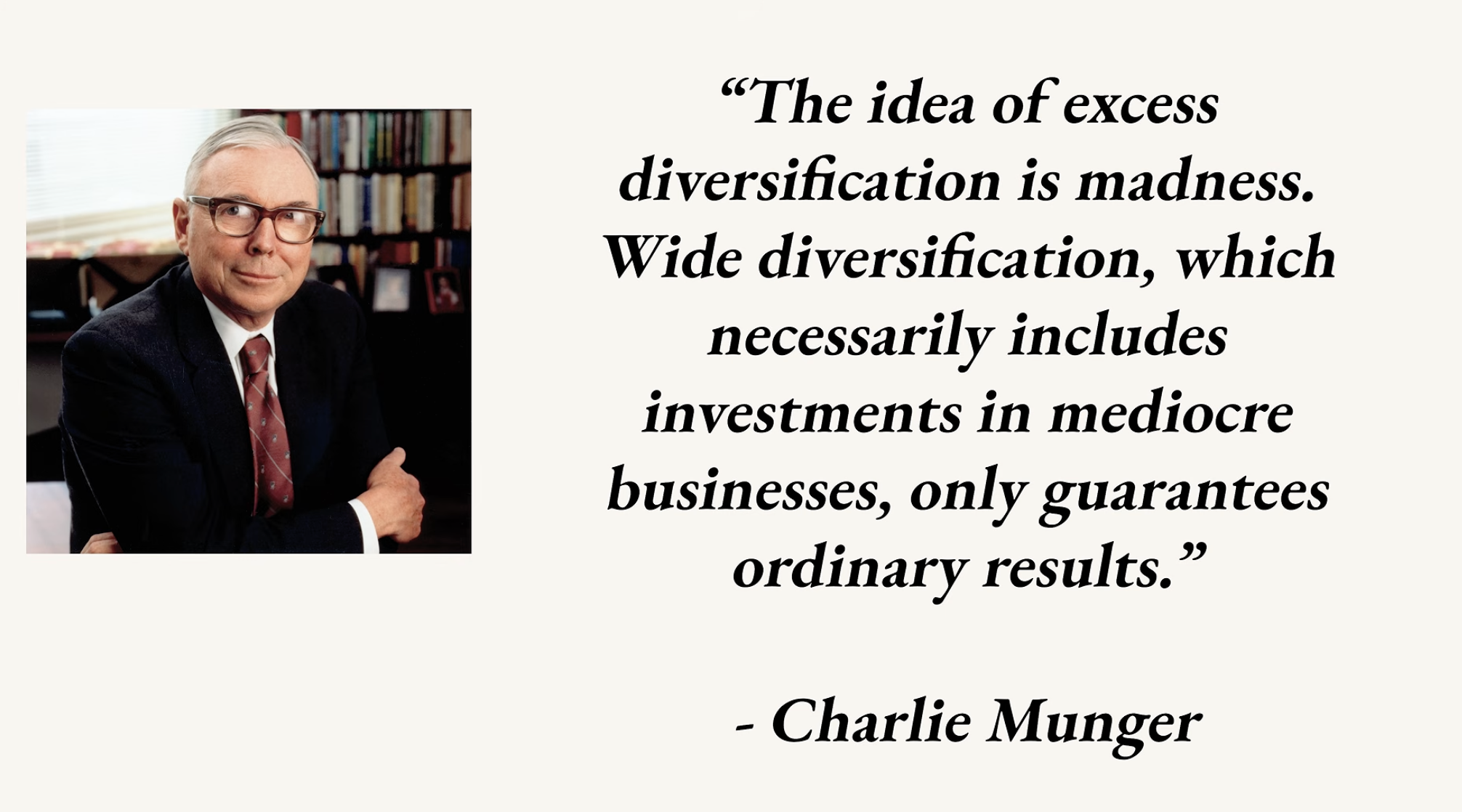
While I don't disagree, at least in my life, I've never seen such a great opportunity that it warranted a 50% position, and there also has to be a little humility, if a stock is down a lot and looks super attractive, there's still risk in it, and if that risk crystallizes, it could be a big mistake.
For the vast majority of people, diversification and limiting how much you're putting in an individual stock makes a lot of sense, especially while you're learning what constitutes a good opportunity.
It's one thing when Munger says this at 80, having seen a lot of markets, it's another thing for someone newer, whose opportunity set is a lot smaller.
When he says that, he's really talking about once in a lifetime opportunities, which don't happen often.
Accepting Risk Instead of Eliminating It.
Diversification is sort of protection against the fact that we can't know the future.
This is maybe annoying because what we do a lot on this newsletter is research stocks, and what we're really trying to do is predict the future, and the future is unknowable.
What we do with the research is try to look a little bit out ahead, but there's always going to be different risk in investment.
Part of being a good investor is not to argue against these risks and say, this is impossible, this isn't going to happen, instead you accept the risk.
I did a Meta Update newsletter a couple weeks ago, and one of the risks I flagged was all of this litigation against Meta, which could result in a settlement or restrictions on their product, an overhang to the business for a long period of time.
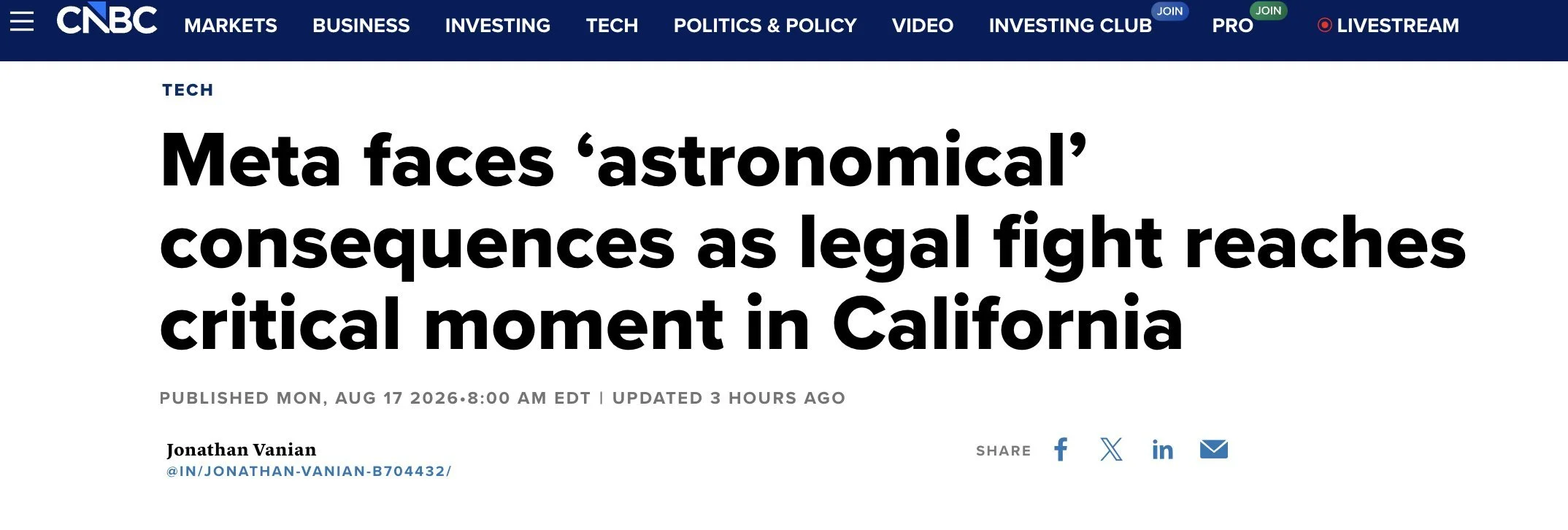
I could take an opinion on the outcome, but it's just an opinion, it doesn't change whether or not the risk exists, it simply does.
When I talk about wanting to be rich in all thousand potential lives, it's an understanding that there's this big distribution of outcomes that can happen, and diversifying increases the number of bets you're making, so you're less dependent on any one outcome.
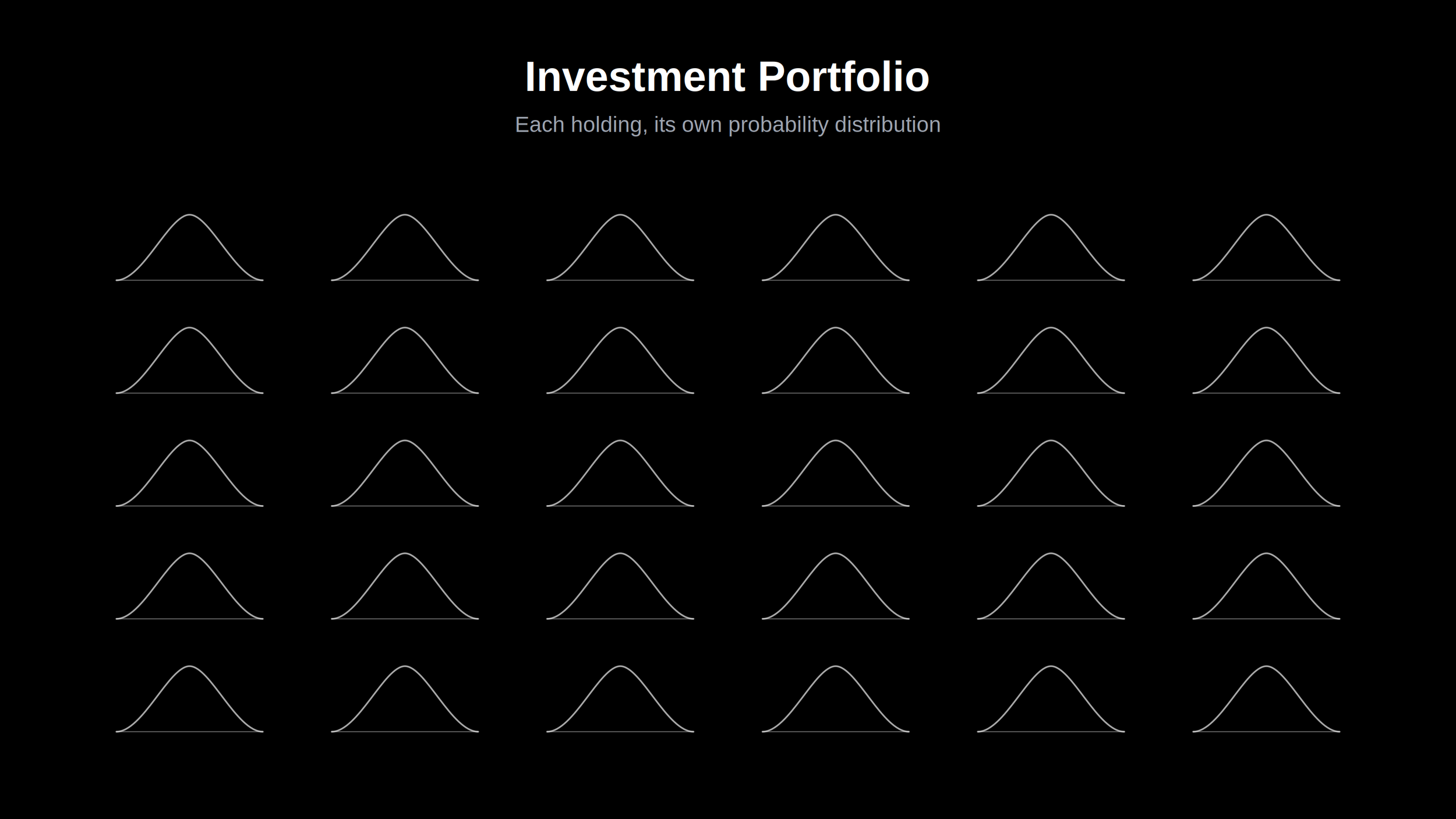
A lot of times when you see someone who has concentrated in a position and it's gone very well for them, it doesn't necessarily mean they did something smart, and this is hard for people to accept.
There's an acceptance that there's a wide dispersion of outcomes, some favorable, some unfavorable, and the point of the investor is to find opportunities where there's more favorable outcomes than unfavorable ones.
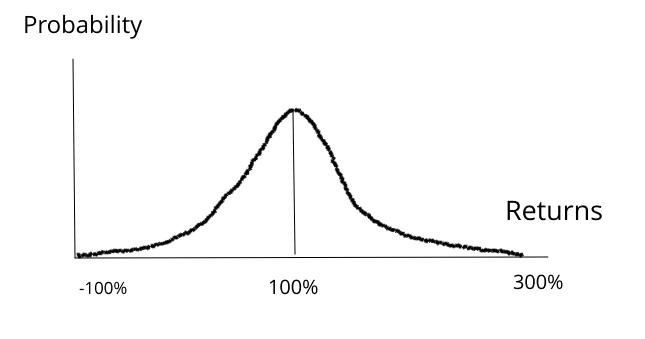
If you make enough of these bets, probabilistically, your whole portfolio is going to have a favorable outcome, but you can't look at an individual bet and know whether it was smart.
It's an expectation that you will lose money as an investor, not always just because you're unlucky, sometimes you'll make a mistake in the research process, which is why you want to limit that by focusing on your circle of competence, but there's also going to be times where you're just unlucky, very far-out events that were very unlikely, and in most scenarios you would've made a lot of money, but it happened anyway.
Even the best stock pickers don't have great odds on any individual bet, when I was at Goldman Sachs, they told us the best analysts' records on buys versus sells usually aren't much better than 50%.
A lot of what determines any single outcome really is left up to luck rather than research.
Warren Buffett's Apple investment is a good example, one of the best he's ever made, but he accepted real risk in it, not just because 20% of Apple's sales were in China, but because their entire supply chain was based there, and during the tariff wars they narrowly got a carve-out exception that could easily have gone the other way.
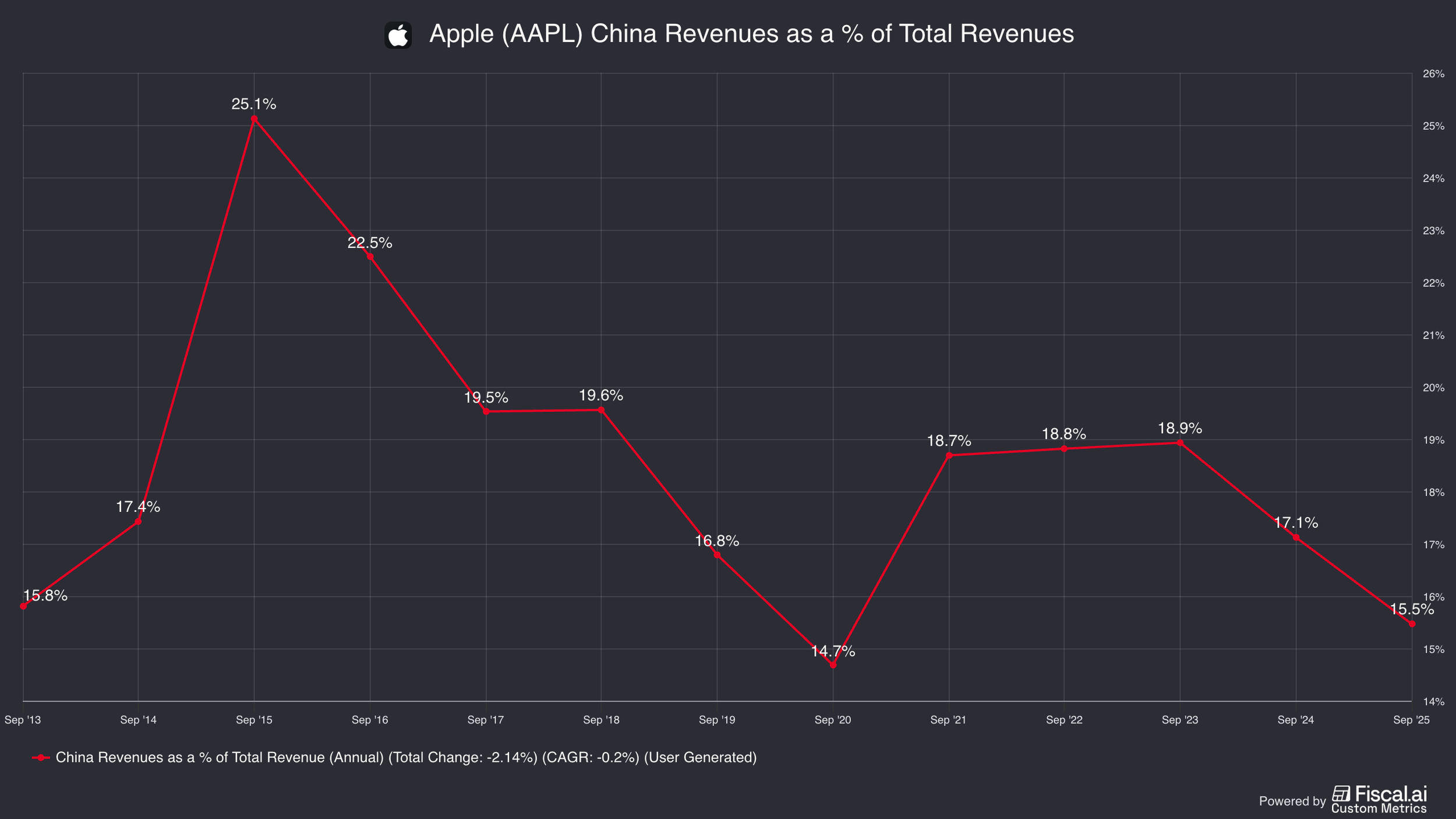
Instead, it was a non-event, one example of how you don't entirely know whether a decision was good or bad based on whether the risk happens.
A key thing I want to emphasize that investors very commonly overlook is that when you're making an investment, it's about accepting risk, becoming comfortable with risk, it's not about eliminating it.
Process vs. Outcome.
To give you a clear example, let's pretend you are playing poker, and you have a four of a kind hand, all aces, the third best hand in poker.

You bet a lot of money because this is a great hand.
Everyone shows their cards, the person next to you has a royal flush, and you lose everything.
Was that a mistake to bet on that hand?
Most poker players would tell you, no.
In the vast majority of circumstances, betting on four of a kind aces wins, so it makes sense to bet big, and just because you lost doesn't mean you did something wrong.

This is process versus outcome, an undesirable outcome doesn't mean your process was wrong.
Diversification is an acceptance that sometimes we'll get undesirable outcomes even with a correct process, so we want more bets, more opportunities for our process to lead to the outcomes we want, because probabilistically, they should, it just doesn't mean it always will, since it's a probability.
Building a Portfolio of Bonds.
Let's get more into how diversification and portfolio management connect, with an example of bonds.
Take an investor picking a portfolio of bonds, with three simplifying assumptions: if a bond defaults it's worth zero, no recovery; you also don't collect a coupon; and this is a one-year portfolio, so you either get your money at the end of the year with interest, or you get zero.
How much yield do you need to compensate for potential losses?
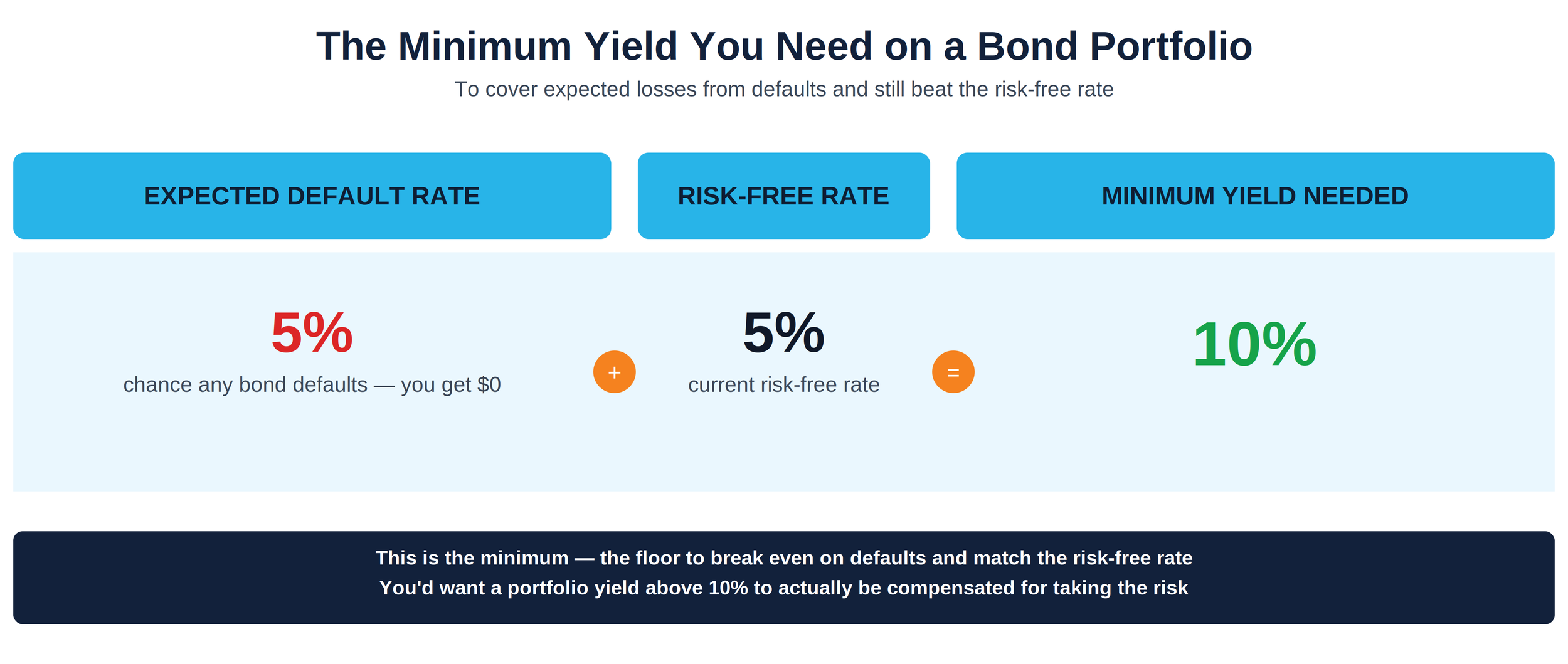
Assume the expected loss on your bond portfolio is 5%, meaning there's a 5% chance any bond defaults and you get zero, including zero interest.
Add that default rate to the risk-free rate, call it 5%, and you get 10%, the minimum yield you'd want on this portfolio.
Now, if you think about the mistakes you can make in constructing this bond portfolio, there's really three separate mistakes.
Mistake One: Insufficient Yield.
The first is that the yield on the bonds isn't high enough to compensate for the risk of default and the risk-free rate, so you didn't earn enough for accepting this risk.
Mistake Two: Misestimating Default Risk.
The second mistake is misestimating the default risk, maybe it wasn't 5%, maybe it was 8%, an issue for the returns you pencil out.
Mistake Three: Correlated, Not Independent, Risk.
The third mistake, and this one is really key to the portfolio management discussion, is not having a high enough number of bonds with independently correlated risks.
To explain, let's say you made me this bond portfolio, 40 bonds, a 20% yield, and an expected default rate no more than 5%, mission accomplished, right?
Then I'd open it up and ask, “Is this right that all 40 issuers are Gulf Coast companies with breakeven oil prices of $60?”
And you'd say, “Yeah! That's how I found these great yields, they're all oil companies based in the same area, isn't that great, it's within my circle of competence too!”
The problem is that every bond in this portfolio shares the same common risk, oil prices dropping, and since they're all in the same location, a natural disaster could stop production for all of them too.

Even though they're different securities, they share the same risk, not independently correlated, if oil prices drop, they drop for all 40 bonds.
The 5% default risk number only makes sense if the bonds are independent, if they all share the same risk, as happened in the financial crisis, you could get wiped out all at the same time.
If they are independently correlated, you have only a 4.8% chance of a 10% loss or greater, and only a 1.4% chance of a 15% loss or greater.
Reducing the risk of loss further just means adding more bonds with independent risk, the crux of portfolio management: more independent bets means less likely everything goes south at once, so it's important to identify the common shared risks amongst your companies.
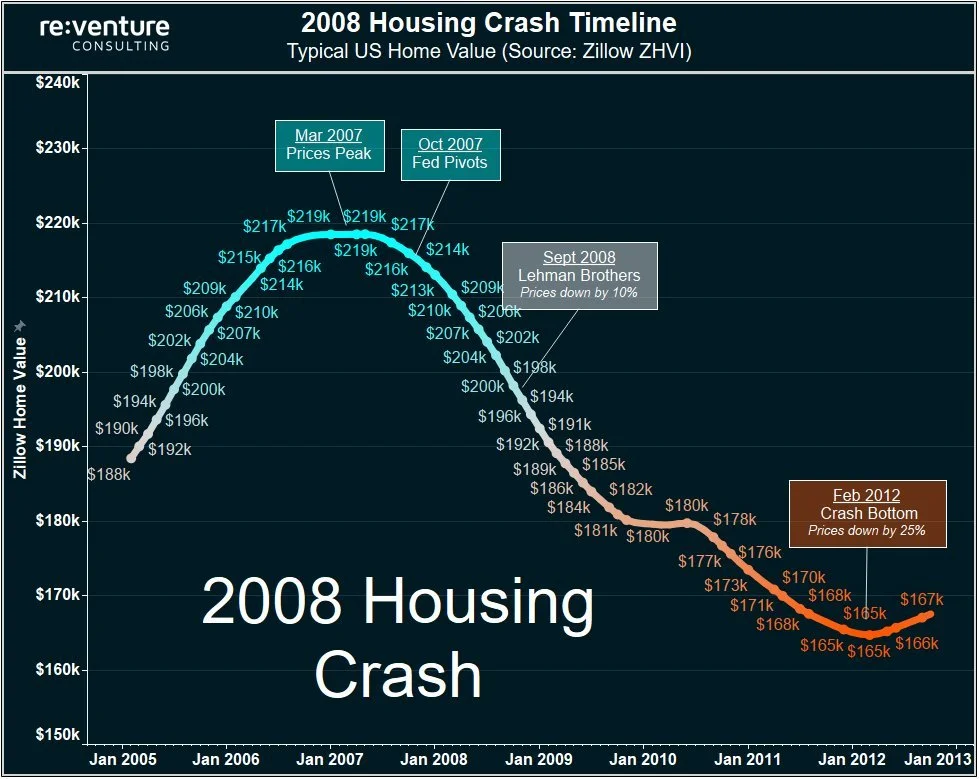
If we think about the financial crisis, the big mistake made by mortgage-backed security investors is that they thought they were diversified because these mortgage-backed securities were across different income strata, geographies, house types, and people all over the country.
Instead, all of these mortgages were dependent on one thing, a bet on home prices, since the lending at that time often required home prices to increase in order for the homeowner to refinance and continue to afford the home.
In your own portfolio, don't make the same mistake, looking for superfluous ways to diversify that don't actually get at the underlying risk.
Do this from a first principles perspective.
If you have a lot of semiconductor stocks, they share a common risk of how much money being spent on AI CapEx slowing, it's not the fact that they're in the same industry classification, since you could have stocks in the same industry that don't share the same risk.
A clear example is Booking.com versus Airbnb, Booking is more dependent on Europe and overseas travelers, whereas Airbnb has more road-trip, US-based travelers, so Airbnb has a little less oil risk, since high oil prices lead to fewer flights and more local road trips, an offset Booking doesn't have to the same extent, showing how two companies in the same industry with similar business models can be exposed to the same risk very differently.

If you invested in Apple, you may think, this is an American company, but 20% of their revenues are from China, and their entire supply chain is based there, so you have China risk.
If you were invested in Snapchat, Pinterest, Twitter, and Meta five years ago before app tracking transparency, Apple's privacy changes actually impacted all of them, even though you might have thought these were different bets with different end markets and demographics.

Now, I don't want you to go too far with this and say, if I have this risk in my portfolio, I need to buy a different company as a hedge against it.
Some people invest that way, I don't recommend it, since you shouldn't invest in businesses to protect the downside of another, it should still be a good investment on its own.
This way of thinking traps you into trying to predict macro and geopolitical trends and find beneficiaries of them, and more often than not, it doesn't go that well.
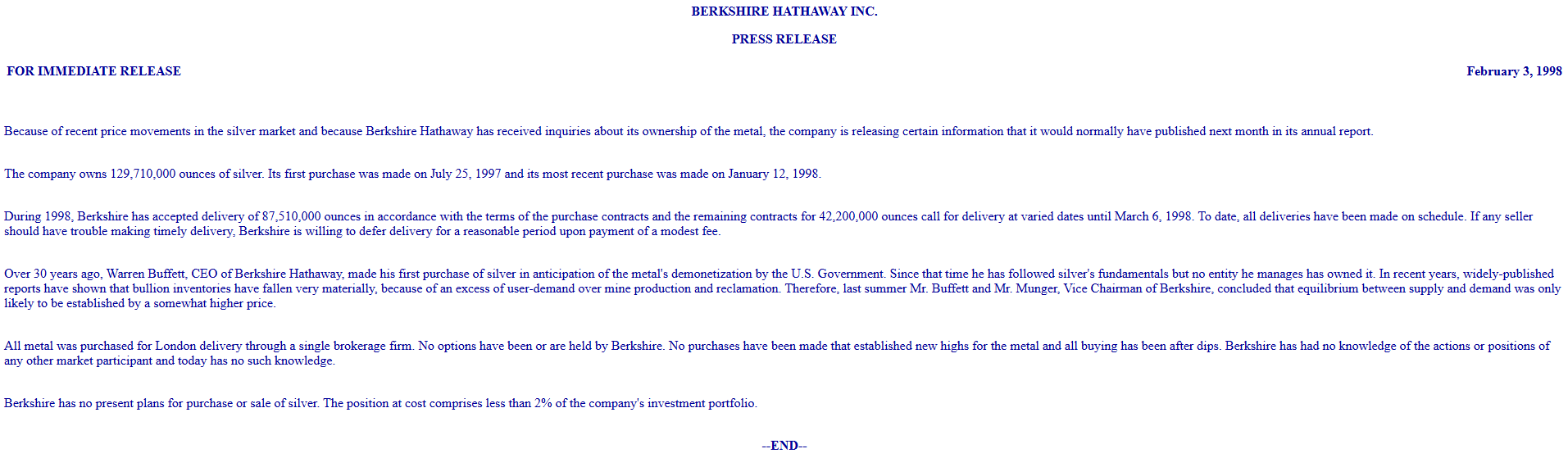
Even Warren Buffett, who says don't invest in commodities, followed the silver market for years and built up a very large position in physical silver, but that didn't work out that well for him either, because it's a hard thing to continually replicate.
The Investment Matching Principle.
Investment strategy in the context of portfolio management, and how the number of bets you make plays into that, is what I want to hit on now.
When we are diversifying, you're going to have a lot more investments in your portfolio, which changes the strategy of your overall portfolio.
Let's say there's two extreme investing strategies.
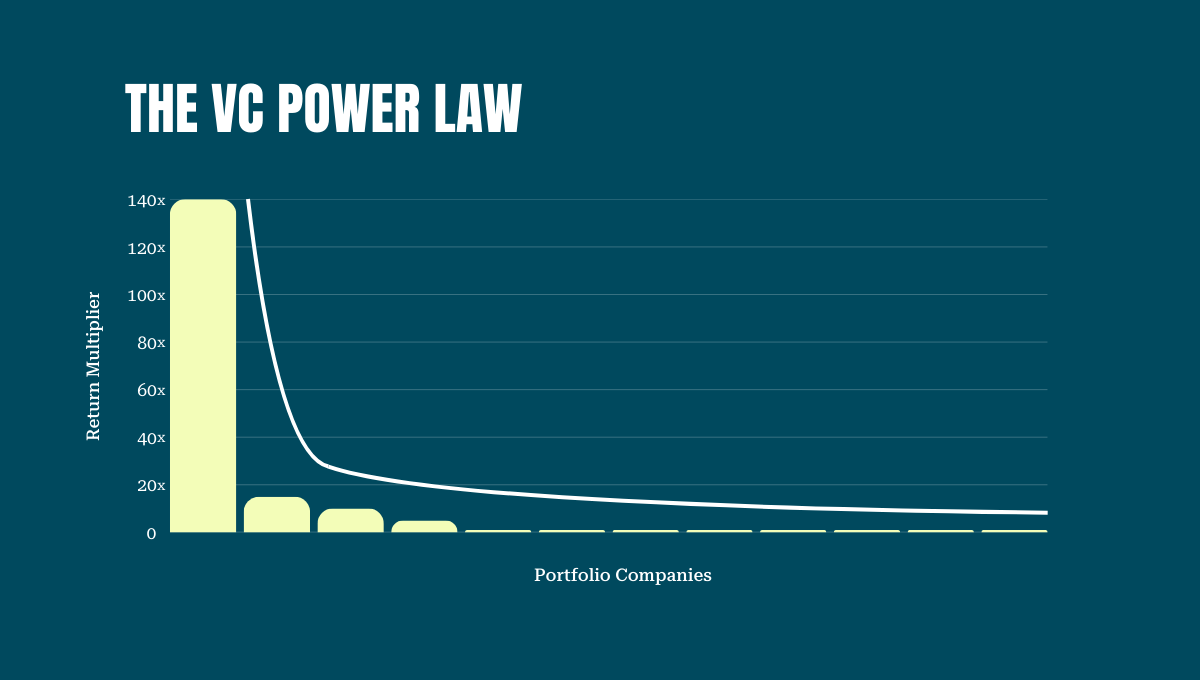
On one end, there's venture capital, focused on upside, looking for businesses that can be 100x returns, which works out to about a 58% CAGR over a decade, that's the hurdle rate.
A lot of the investments won't work out, which is fine, because the winners more than make up for the losers, but with only one investment this wouldn't work, so they build a portfolio of enough companies that at least one really hits.
On the other end, we've got Warren Buffett.
He has his two rules of investing, don't lose money, don't forget the first rule, very concerned about impairment of capital.
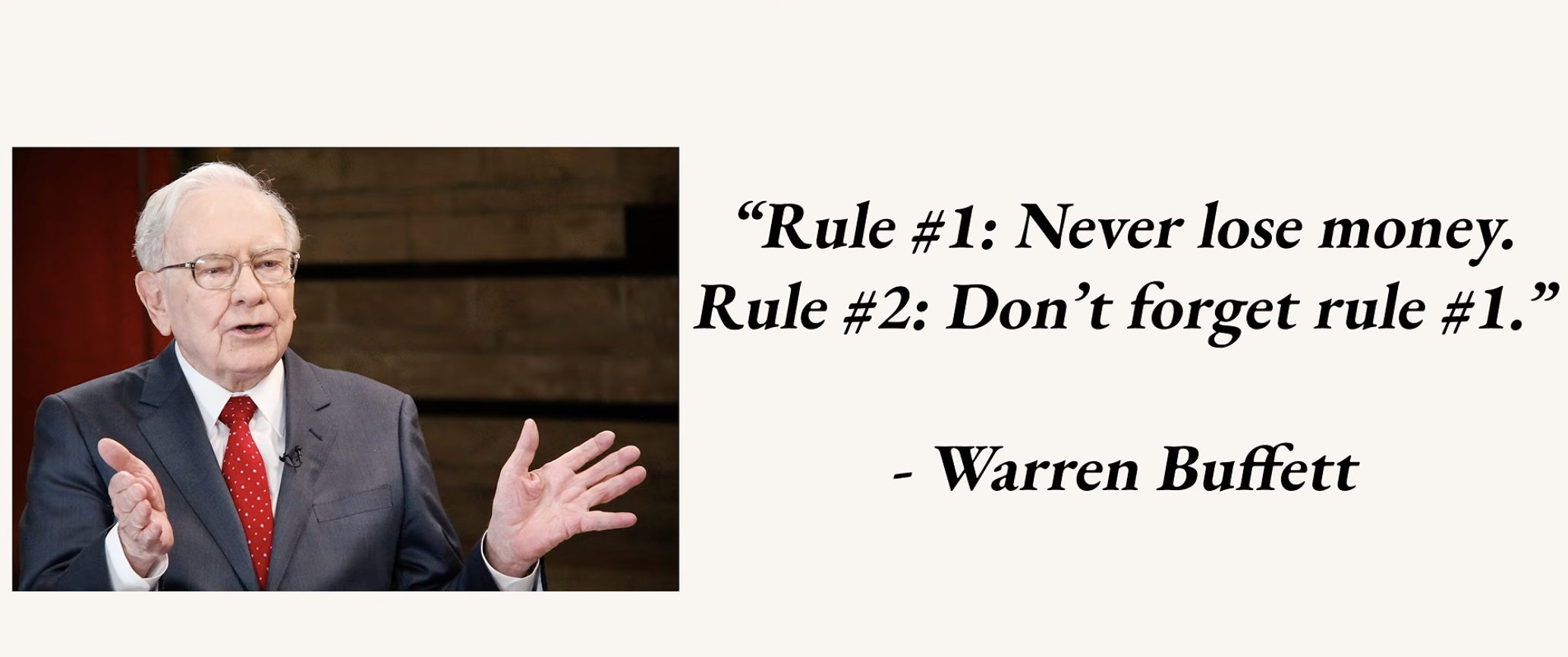
He looks for a 10% pre-tax annualized return, whereas venture capital is looking for 58%.
If you look at Buffett's record over time, it's closer to 20%, usually overshooting his target, while venture funds usually undershoot theirs.
It has to do with the fact that the downside of Buffett's investments tends to not actually be there, in bond portfolio terms, he's figuring the default risk is near 0%, so he doesn't need extra allowances for that, whereas venture's default rate is very high, a default being a business that becomes a zero or doesn't get a big exit.
Because there's so many more losers on the venture side, even a much higher targeted return ends up being a much lower actual one.
Because Buffett is investing in companies he has high confidence in with a very low likelihood of impairment of capital, he can take bigger positions and doesn't need as many, whereas a venture investor would be well advised to make a lot of very small bets and not concentrate in any couple portfolio companies.
If Buffett does concentrate heavily, it's because he views the likelihood of anything negative happening to be so small that it's an acceptable risk-reward proposition.
Let me make this really clear with a simple example.
Say in your portfolio you can invest in two stocks, each either a 3x or a zero, binary, for simplicity.
Your expected return is 50%, so you'd say, that's such a high expected return, I'm going to do this.
But since you only have two stocks, your risk of losing everything is 25%, a one in four chance both stocks are a zero at the same time.
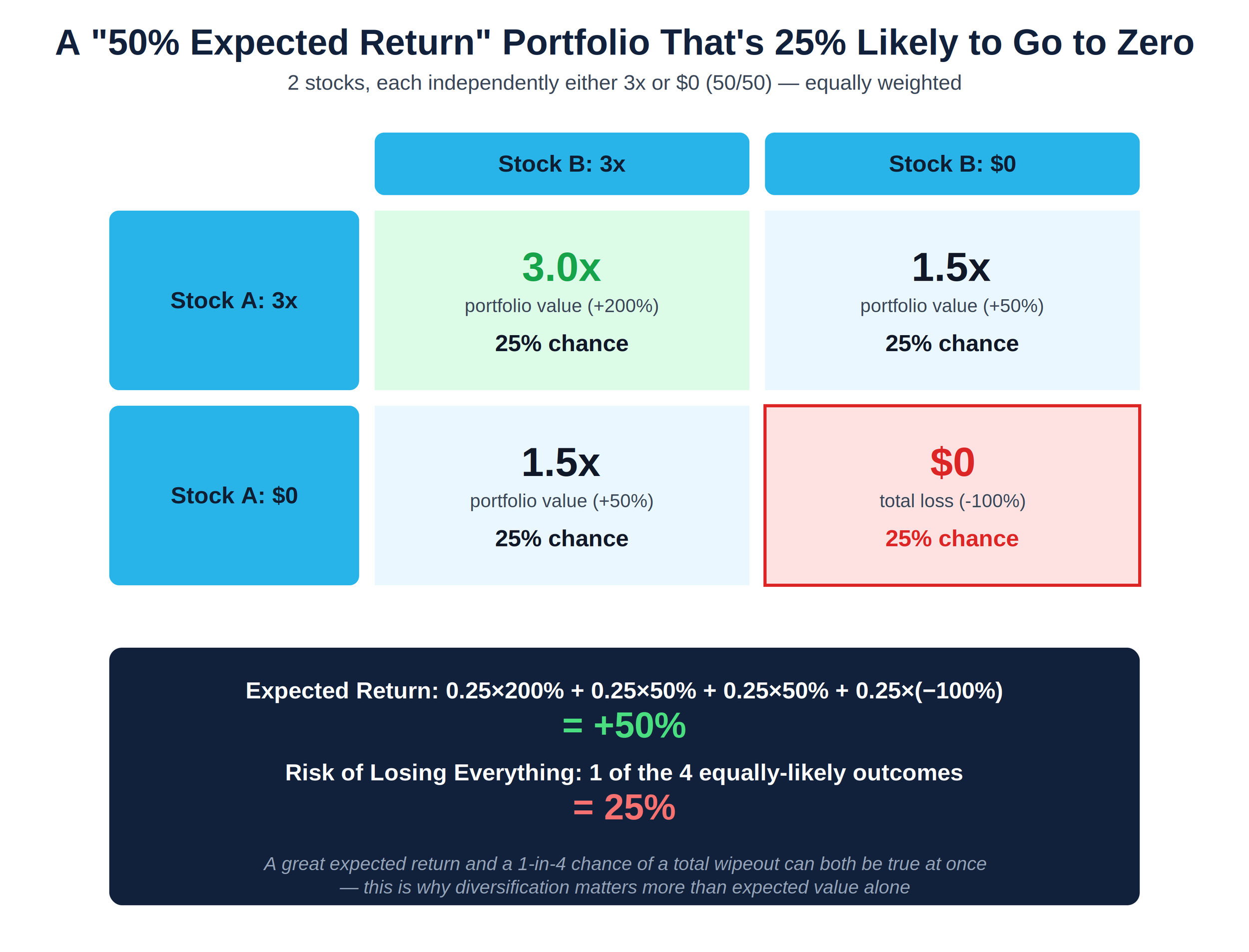
This is the idea Buffett would talk about, the man that was six feet tall who drowned in a river that was four feet deep on average, the expected return of your portfolio doesn't matter if that's not the actual sequence of events you observe.
Going back to the thousand different lives, in this case there's four different lives, in three it's a pretty good decision to make this bet, in one it's not.
What you can do is increase the number of stocks, if you go from two to five, each still either zero or a 3x, the probability that all five are zero drops to just 3%, down from 25% with only two stocks, and the more you add, the more you reduce that probability.
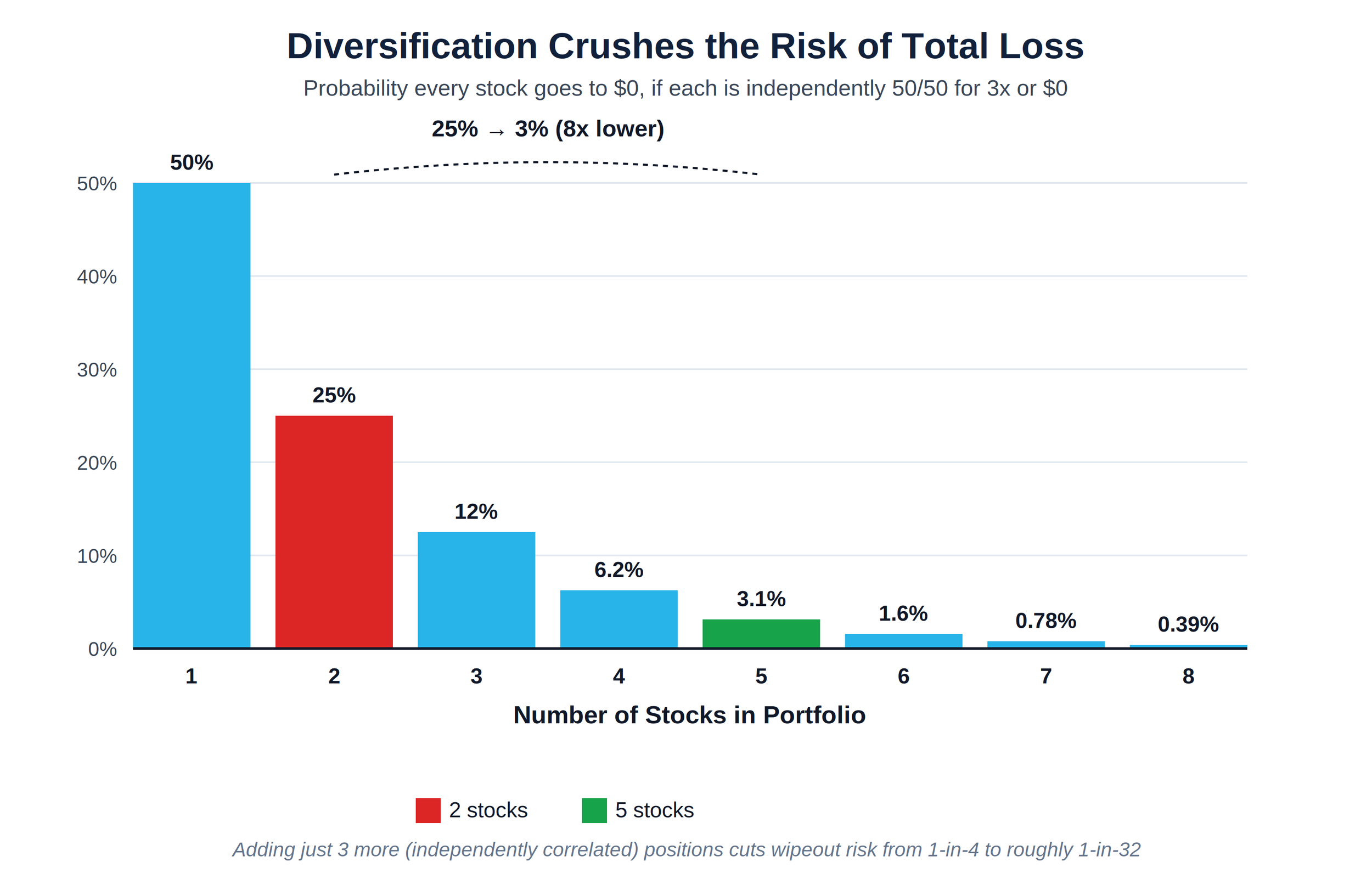
I like to call this the investment matching principle: matching the number of individually correlated investments to the risk-return profile of each one.
Wider distributions call for more of them, narrower distributions mean it's okay to have fewer, the real difference between Buffett's way of investing and venture capital's.
Now, you might be thinking, why don't I just add a ton of stocks to my portfolio?
A really good opportunity doesn't come by that often, and I'm not talking about a good enough opportunity to put 100% of your portfolio in, I'm talking about good enough to invest anything at all, maybe just 5%.
That is primarily what caps how many investments you should hold.
Even Buffett or Munger, if asked whether they'd prefer 1,000 great investments or ten, would tell you 1,000, the reason they don't own 1,000 is because they can only find 10, and when they find one, they put a bunch of money in it, since otherwise the money sits there and does nothing.
If you can only find five truly great opportunities, that's fine, but if you can get that to a 10 or a 15, you're less likely to have a total loss on the portfolio, since the more independently correlated investments you're making, the more likely you are to get whatever you think your expected return is.
Putting It Into Practice.
One thing I like to do is look at the reverse DCF, sensitizing across, say, revenue growth and margin, though you could pick any two variables.
You're looking at what the discount rates are for all different scenarios, maybe it grows 10% with a flat margin and it's a 7% return, but if it grows 15%, it's a 12% return, and so on.
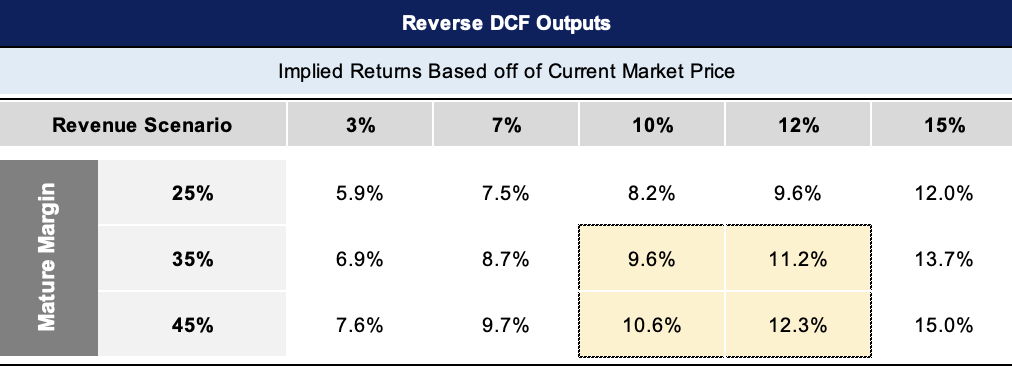
That table is similar to the bond yields we talked about, showing you what the return could potentially be under a different scenario.
The growth rates and margins are more qualitative, the equivalent of the risk of total loss, or the default rate of the bonds, except it says growth rates, since whenever you're making an assumption, there's risk inherent in it, and the less risky your assumption, the safer it is.
You're building up a probabilistic distribution of what can happen, and the investments I like to look for have very little that can negatively happen on the tail end, not likely to lose money, but likely to at least do as well as the stock market has done historically, with some chance of doing much better.
You probably noticed I didn't talk about individual stock positions or weightings, and that's because how much to put in a stock becomes connected to what all the other bets in your portfolio are, how many other stocks share a common underlying risk.
If I put 5% of my portfolio in a stock, you may already have 30% in something that shares a similar risk, or I may already have 20 stocks I like more and don't need a 21st, whereas you only have five, so adding one more does something good for your diversification.
It's different for different people.
If you are newer to investing, I do recommend you take smaller positions and diversify more, especially in a company you're new to.
Even if you researched it well, you're still getting comfortable with it, and you're going to learn more about it over time.
I personally very rarely, I can't even remember the last time, just researched a company and immediately took a full position in it, it's good to let the research breathe and let the emotions settle.
It's exciting when a stock sells off 20% and you think this is the perfect opportunity, but a real opportunity generally exists for more than a few days, usually at least a few weeks, sometimes months, so it's okay to be patient and build more familiarity over time.
Just generally, if you're newer, don't take Charlie Munger's advice of putting 50% of your portfolio in an individual stock, diversify a lot more while you're building up an understanding of what constitutes a good opportunity.
But the key takeaway is to make sure you're following the investment matching principle, matching the number of independently correlated bets in your portfolio to the risk-reward distribution of those investments.
For more on The Investment Matching Principle, check out the video below.
Nothing in this newsletter is investment advice nor should be construed as such. Contributors to the newsletter may own securities discussed. Furthermore, accounts contributors advise on may also have positions in companies discussed. Please see our full disclaimers here.
