What Investing REALLY Is

Get smarter on investing, business, and personal finance in 5 minutes.
What is investing?
It may seem like a trivial question to ask, but if you don't actually know what investing is, then you are kind of at risk of speculating or gambling.
So, in this week’s Five Minute Money, I explain what investing really means and what it is not.
The Two Categories of Investing.
There are two different categories of investing:
1) active investing and 2) passive investing.
When you are actively investing, what you are doing is you are individually picking stocks, you're researching them, and you are basically becoming your own investment manager.

Instead, what happens when you are passively investing is that you are just trying to get broad, diversified exposure into an entire asset class or an entire stock market or an entire country.
Now, sometimes these lines get a little bit blurred because there are products out there that are kind of sold as passive investing that let you passively invest in, say, AI or space, but I would say if you're starting to pick individual sectors, you're not really passively investing.
Instead, what you're doing at that point is you're taking an opinion on an entire industry and what should happen with that in the future, which you're still doing it in a diversified way, but it's now getting to the point that you're making your own judgment.
If you're just buying into the entire US stock market, you don't need to do research to do that.
What you're doing is you're basically assuming that capitalism is going to continue to work as it has in the past, and that companies, by and large, are going to continue to generate earnings.
They're going to take these earnings, they're going to reinvest them back into the business and generate more earnings like they have for hundreds of years, and this is going to lead to good results.
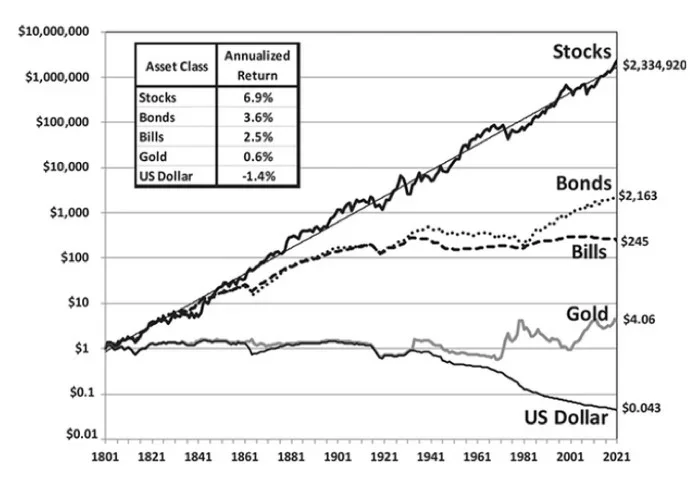
Now, you are not really doing analysis on what the returns could be or anything like that, but we know historically returns for investing in the US stock market are about nine percent.
Maybe that's on the high end going forward, we don't know for sure, or maybe we continue to hit that number.
Either way, though, you're kind of just along for the ride.
That is what a passive investment is.
Now, if you are an active investor, you want to do better than these passive investors.
You want to find individual businesses that can be the next Amazon, that can do very, very well, and this is an extremely hard activity to do.
JP Morgan has a study out there where they looked at stocks that had a catastrophic loss, which they defined as being down more than 70% and never recovering.
Over the 40 year period they looked at, it was about over 40% of all stocks had a catastrophic loss.
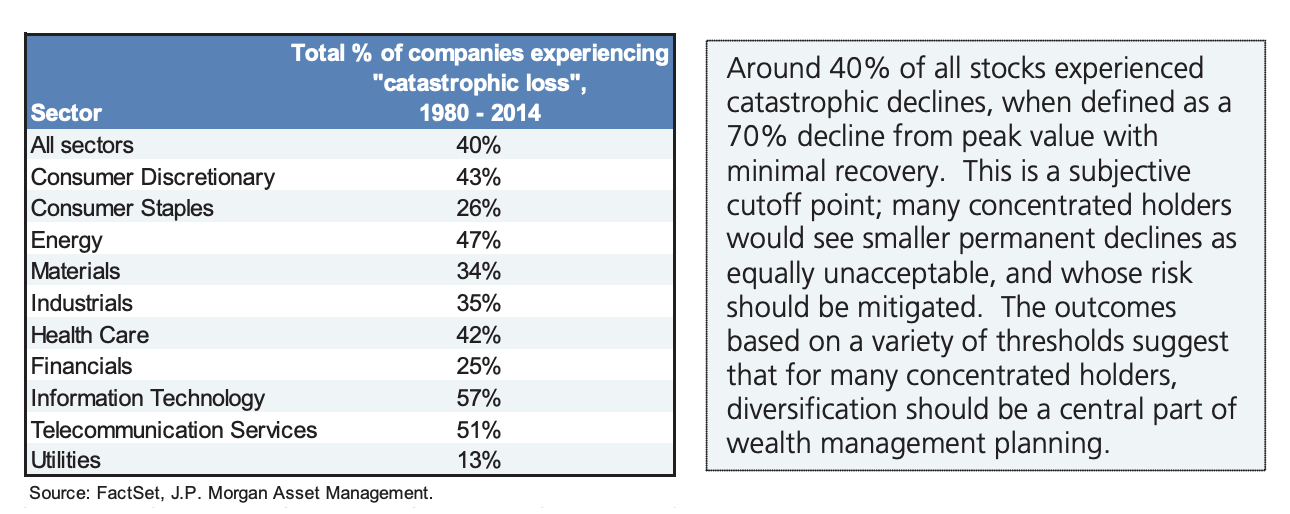
That means there's a pretty good chance that whatever stock you're picking is going to eventually lose money and not come back.
That is to say being an active investor is a very hard thing to do.
The 3Ps to Investing.
Warren Buffett's mentor, Benjamin Graham, has his definition of investing which is: “An investment operation is one which, upon thorough analysis, promises safety of principal and a satisfactory return. Operations not meeting these requirements are speculative.”
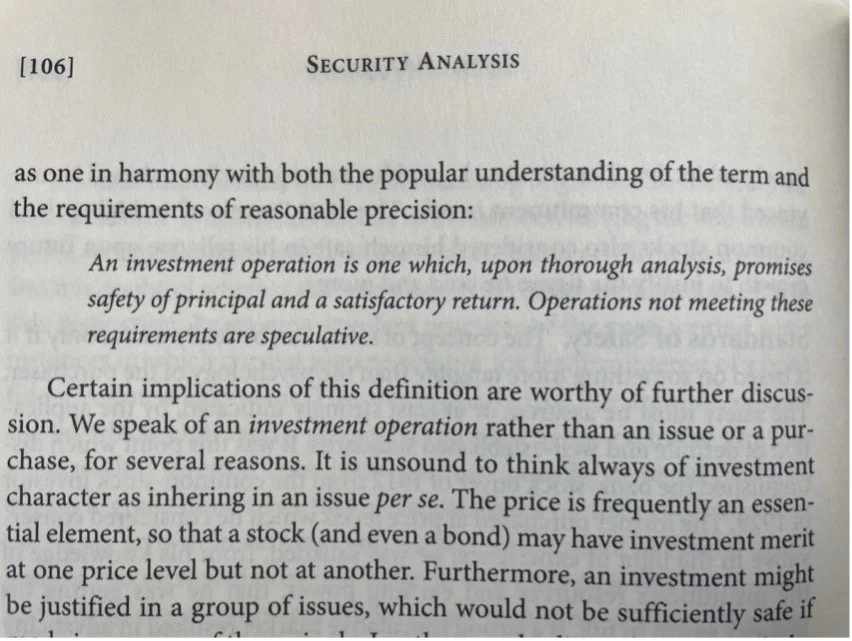
And there is that word that we are bringing in here, speculation.
I think that this is a very good definition of investing, because of 3 ideas.
1. You have to actually be doing research and diligence in order for it to be investing.
2. He mentions investing with a margin of safety. This is the idea that we're going to be a little bit conservative in what we're picking.
3. Adequate return. This is a little ambiguous and is subject to what individuals want their return to be, but it shows that there does have to be some sort of return associated with it.
While this is a good definition of investing, I have my own definition of investing, which is “Investing is the process of figuring out the probability of profits.”

The idea is it's very similar to what Graham says, but I don't actually emphasize that you need a margin of safety because there are different ways to invest.
Some people are going to be more conservative, and they're going to want a margin of safety, which is this idea basically that whatever your analysis you're doing, what you think is going to happen, things could end up being a little bit worse, and you're still going to be okay.
Now, some people invest differently, though.
You could have a VC investment.
There's no margin of safety when you're VC investing.
Instead, you know the majority of your companies you invest in are going to go to zero.
What provides you a little bit of safety is the amount of diversification.
Hopefully, you have 50 of these investments, and so even if 95 of them go to 0, you're going to have 4 of them that are going to be 5xs and then one of them that is going to be a 100x.
And that one investment is going to make up for everything.
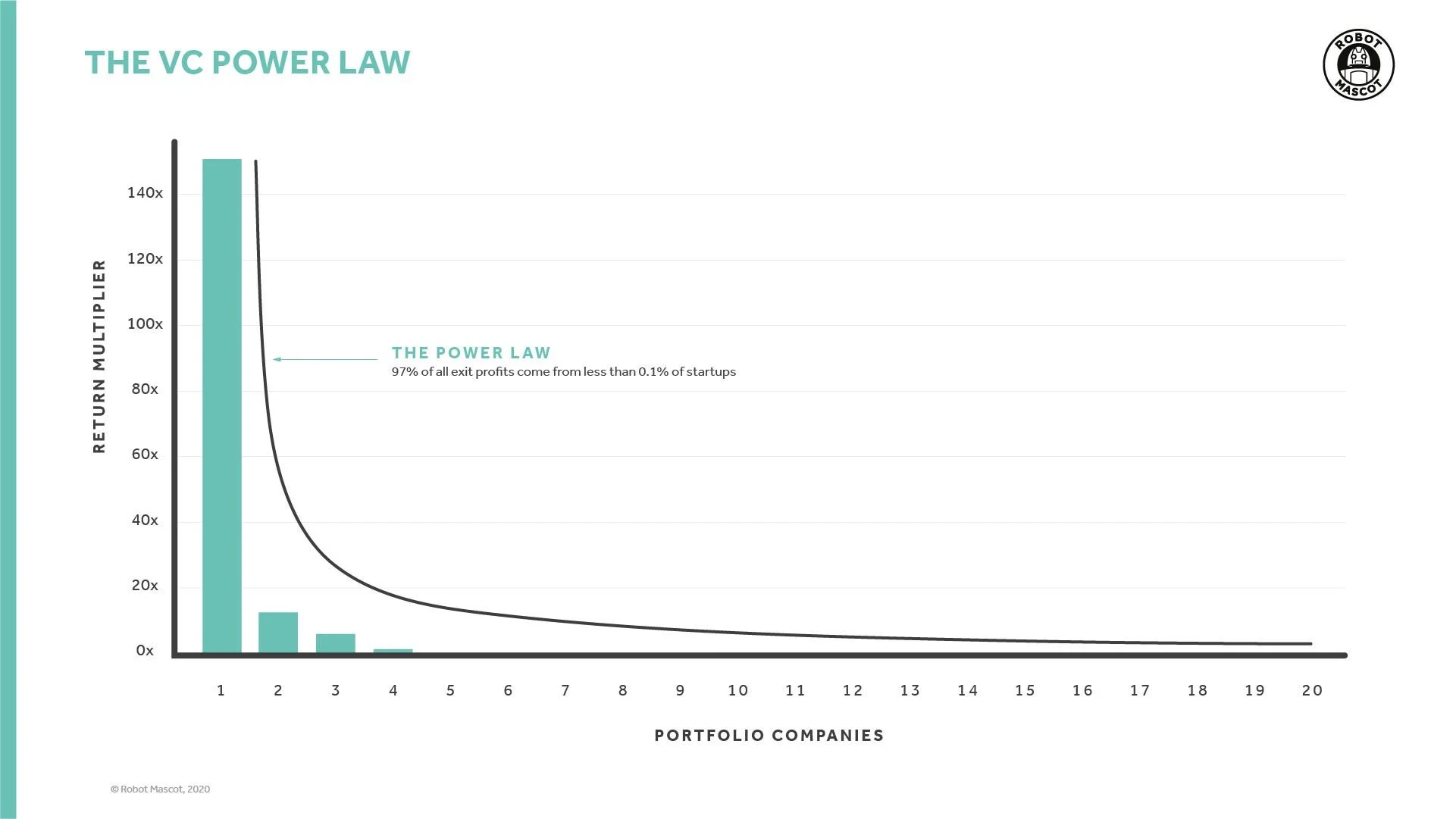
Because there's different strategies of investing, I think this definition is a little bit broader and fits all sort of potential active investing operations.
Now, this definition doesn't work for passive investing.
Own Productive Assets.
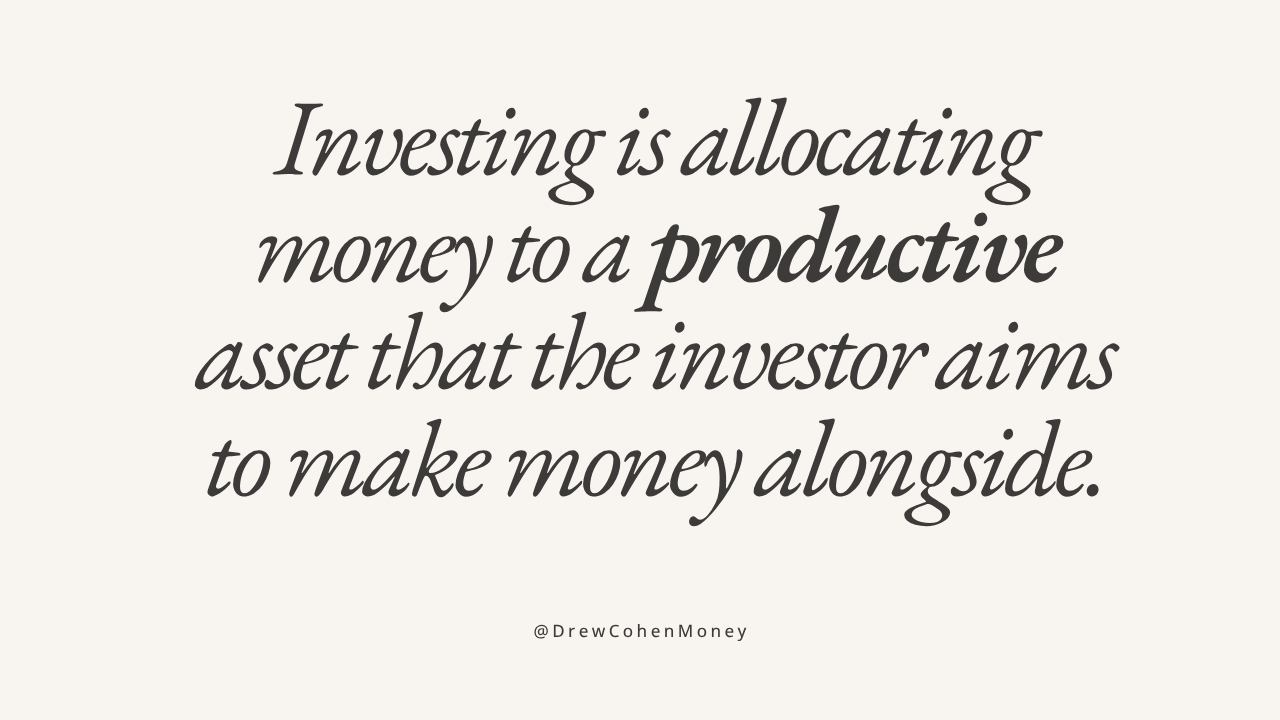
There's a more general definition of investing that fits all sort of activities, which is that “Investing is allocating money to a productive asset that the investor aims to make money alongside.”
When I say productive, that means cash flow generating.
As an investor, you make money in one of two ways.
The first way you make money off of an investment is it produces cash flow, and they could give you that cash flow.
There are 3 ways an investment produces cash flow:
1. You can buy a stock and it gives you dividends
2. You buy real estate and it gives you cash flow in the form of rent income
3. You buy a bond and it gives you interest income
The second way is you can profit from an investment is the increase in the value of that asset (capital allocation).
That can happen because, let's say the business chooses to retain the earnings they're generating, so instead of paying out a dividend to you, they hold those earnings in the business.
And when they hold the earnings in the business, it gets reinvested in that business into something else, making the business more valuable.
That also counts as investing.
What Doesn't Count as Investing.
Now, what doesn't count as investing, at least not in my opinion, and I think it is important we make this distinction, is that investing is not buying an asset in hopes of selling it to someone else at a higher price.
Now, don't get me wrong, of course, when you're buying a stock, you want to sell it at a higher price eventually, right?
But what you're doing when you're actually investing is you believe you're going to be able to sell this for a higher price because the valuation went up.
Because let's say you're buying Amazon stock today and you want to sell it maybe in 5 years from now.
In 5 years from now, your thesis is going to be that Amazon's a bigger business.
They have more cash flow in the future, they're a better business, maybe they have new business lines, and that increase in value of that Amazon business is going to be reflected in the stock price, which is why I will be able to sell it to someone else at a higher price.

In contrast, if you were going to buy a quantum computing stock where, you know, you think quantum computing's cool, but you don't really know how they're ever going to make money.
You didn't do a lot of research on it, but you think that this is going to be very popular, and people in a few years from now are going to find out about quantum, and you'll be able to sell this stock to someone else for a higher price.
That's speculating, right?

Because you're not actually figuring out how that business is going to increase in value over time.
Instead, you're just hoping that there's going to be someone else that you could sell it to at a higher price down the line.
Now, when you are speculating, it doesn't mean that you can't have any analysis.
The person who's buying a quantum computing stock could still have some vague notion that there's going to be some advancements in quantum computing or something could happen that can make it a more popular stock, which can increase demand for it.
That's totally possible.
Or you could buy into AI stocks right now, thinking the demand for AI stocks is only going to go up.
I still think that that is speculating because, once again, you are not making money off of the actual underlying business improving in value.
It's not because an asset is growing in value, it's because you're selling it to someone else at a higher price.
So, there are these two camps of activity.
1. Investment activity (which could either be active or passive)
2. Speculation.
What You Should Do as a New Investor.
When you're new to this game, and if you don't want to lose money, the best thing you could do is you invest and you focus on the passive investing strategies.
Now, I spend all of my days researching stocks, and I do actively invest, and I actively manage portfolios too for clients as a registered investment advisor.
But if you are newer to this investment analysis and investing, you should just passively invest into ETFs.
That is my suggestion to you, just given how hard it is to pick individual stocks and how hard it is to do all of the business analysis.
Now, you could certainly do both, and you could certainly learn the business analysis, but if you're newer, what I think you should do is basically allocate into the 1) S&P 500 (VOO), 2) the Nasdaq (QQQ), and then also 3) an equal weighted S&P 500 fund (RSP).
So, every month you can put a little bit of money in between those three.
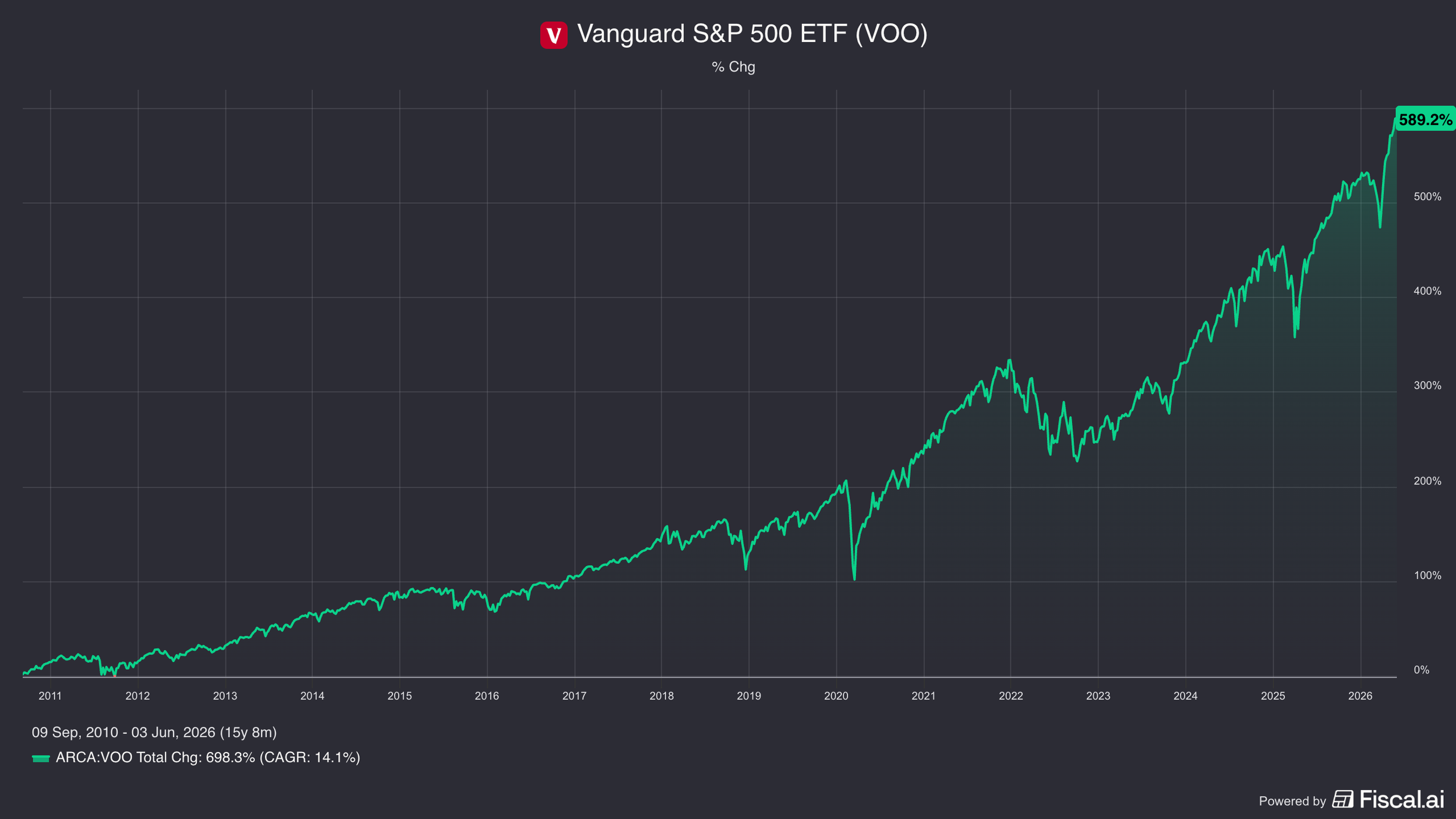
It's very important when you are investing, you make it systematic.
You could set up so every month from your paycheck or your savings, it just automatically goes into a brokerage account.
And then once it's in that brokerage account, you could just auto-invest into those three ETFs I mentioned.
Now, everyone is going to be at different stages in their investing career, so that kind of suggestion was assuming you're newer, you have a very long time horizon, and you're just wondering, 'How do I get started with investing?'
Once you get later into your life, different advice applies.
So that is only if you are young, you have extra money to invest.
As a rule of thumb, you really should have more than 10 years to invest if you're 100% invested in stocks.
If that's the case for you and you just want to know how to get started, I think that that is a fine place to go.
You could just allocate 33% each between VOO, QQQ, and RSP.
And every month when you get your next paycheck, you just continue to add a little bit more.
And hopefully, over time, that just continues to grow.
You don't have to worry about picking stocks.
That'll be a fine outcome for you.
For more on what investing really is, check out the video below.
Nothing in this newsletter is investment advice nor should be construed as such. Contributors to the newsletter may own securities discussed. Furthermore, accounts contributors advise on may also have positions in companies discussed. Please see our full disclaimers here.
