AppLovin Stock Breakdown
Get smarter on investing, business, and personal finance in 5 minutes.
Stock Breakdown
This newsletter is adapted from a recent video Drew Cohen did on AppLovin.
In the aftermath of COVID, and once the Fed started hiking interest rates, almost all tech stocks suffered, but perhaps no stock suffered more than AppLovin.
They were a COVID beneficiary because they're in mobile gaming, and usage boomed during COVID.
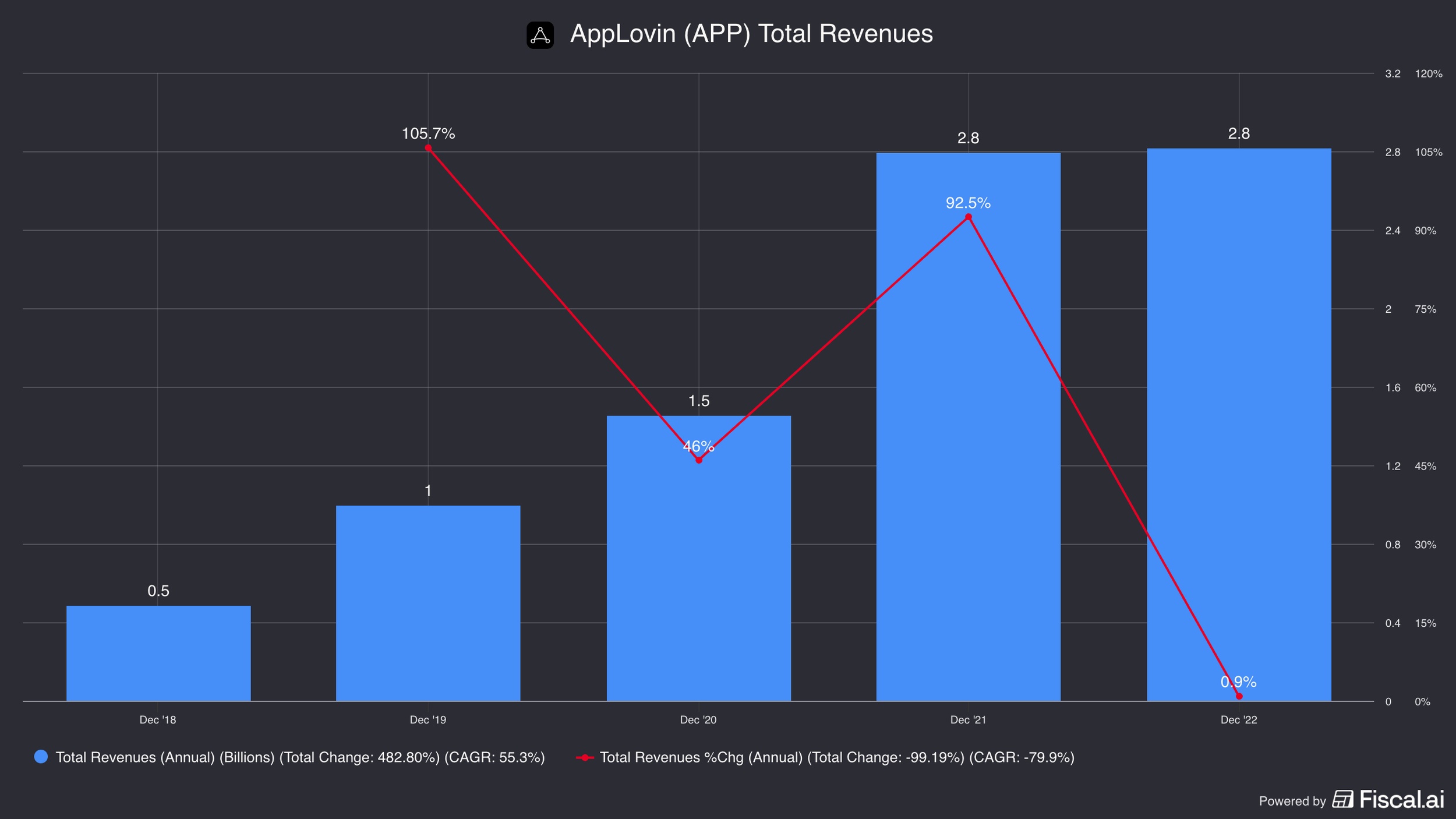
In 2021, revenue growth was 93%.
However, they got to experience the other side of that once COVID ended.
The following year, revenue growth fell to 1%.
Operating profits, which were $150mn, dipped into the negative, all while Apple was making privacy changes that could make it much harder for mobile advertisers like AppLovin.
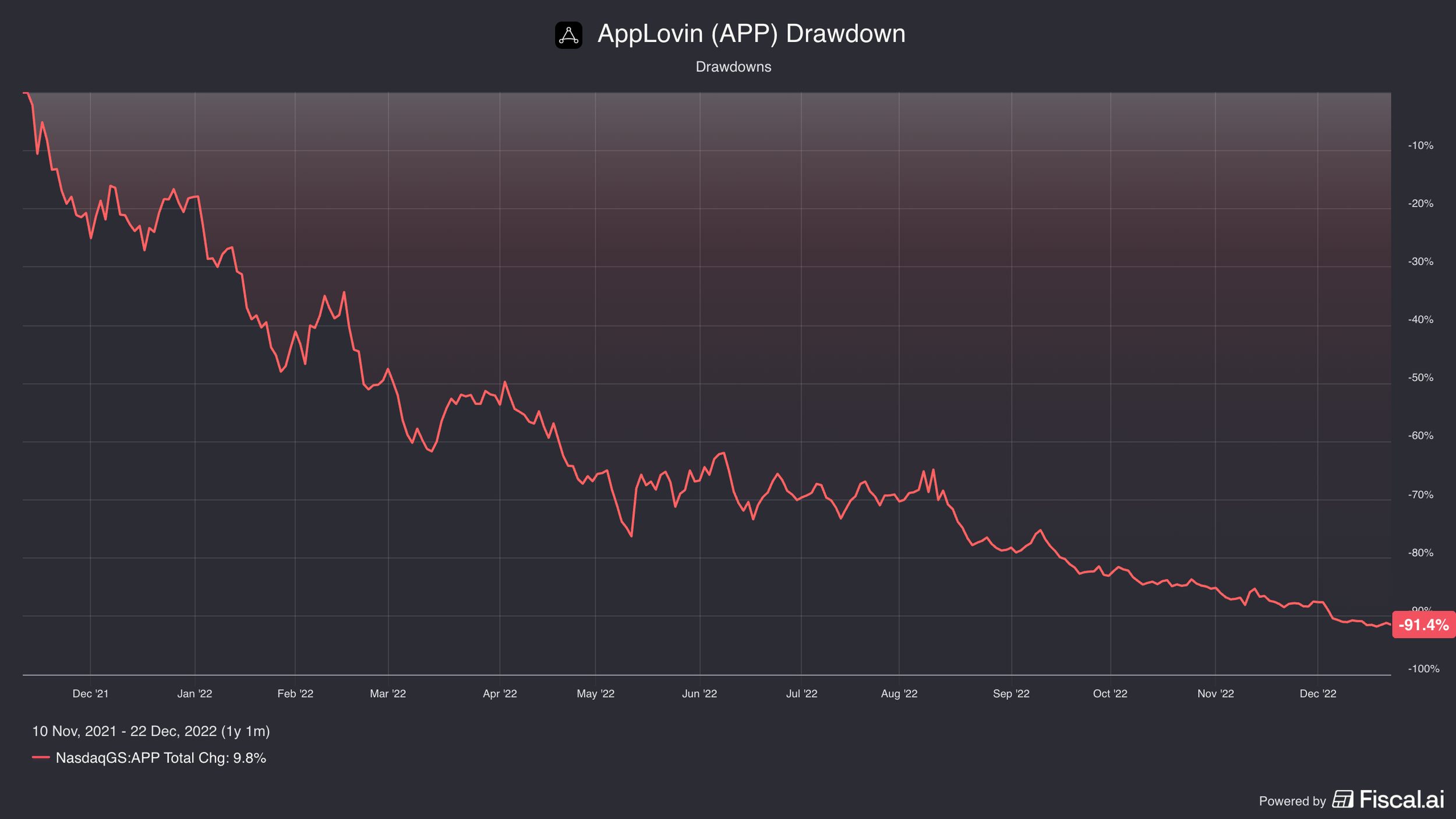
The stock market reacted brutally, sending shares down -91%.
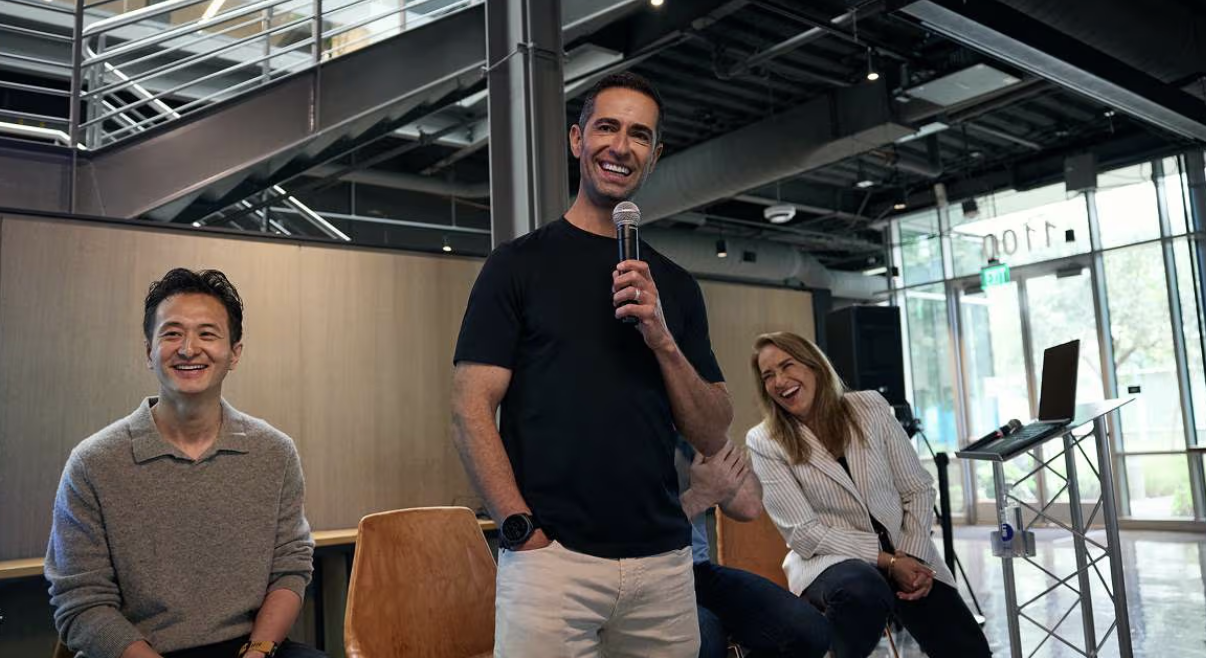
CEO and founder Adam Foroughi, though, had his own plan, quietly rebuilding the company's ad tech stack, and when they released it, it was a big success.
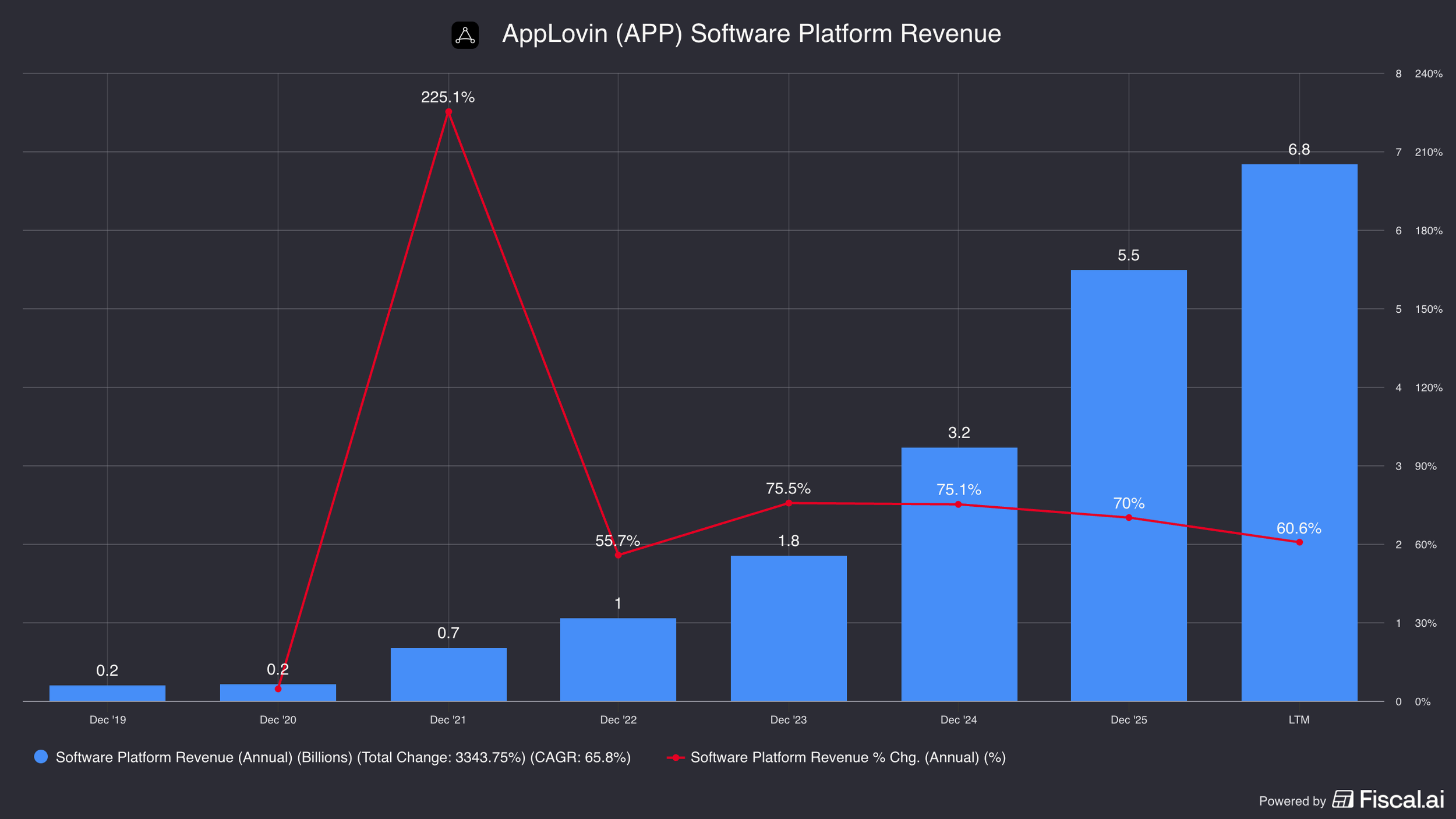
From 2022 to 2025, revenues jumped from $1bn to $5.5bn, inclusive of divesting a billion dollars of revenue when they got rid of their owned mobile game business.
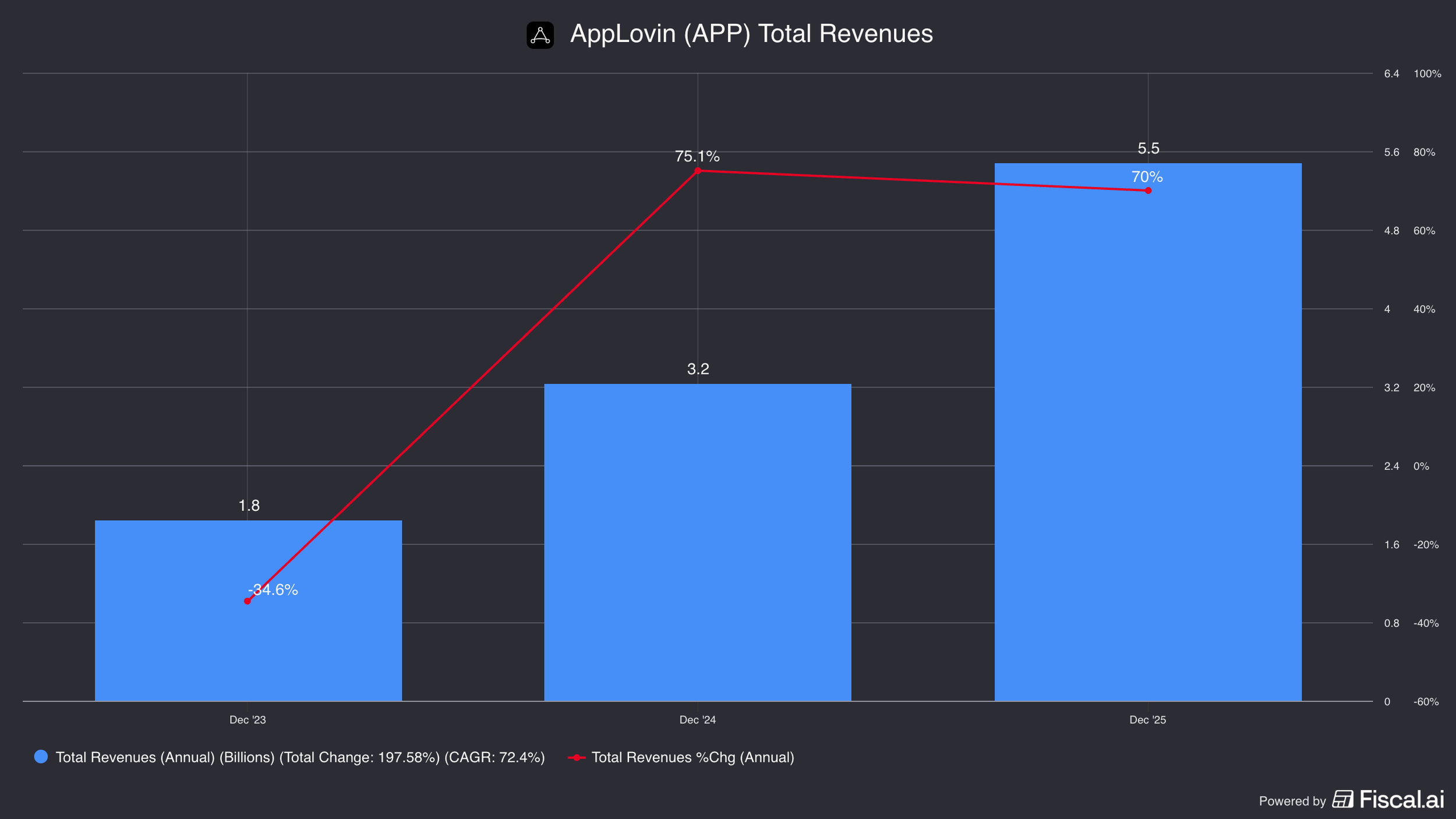
That is a three-year revenue CAGR of 75%, and last quarter they were still growing at 53%.
Foroughi has much more ambitious plans, though, wanting the platform to be on the same scale as a Meta or Google in advertising, but to get there they'll have to expand far beyond mobile gaming into new areas where they have no experience.
They also still compete against Google, Meta, and Unity, which is staging its own turnaround, and there's an ongoing SEC investigation.
With shares down -54% from recent highs, does the market see a risk some investors are missing, or is this a good opportunity?
In this week’s Five Minute Money, we will breakdown AppLovin!
From Failed Apps to Ad Tech.
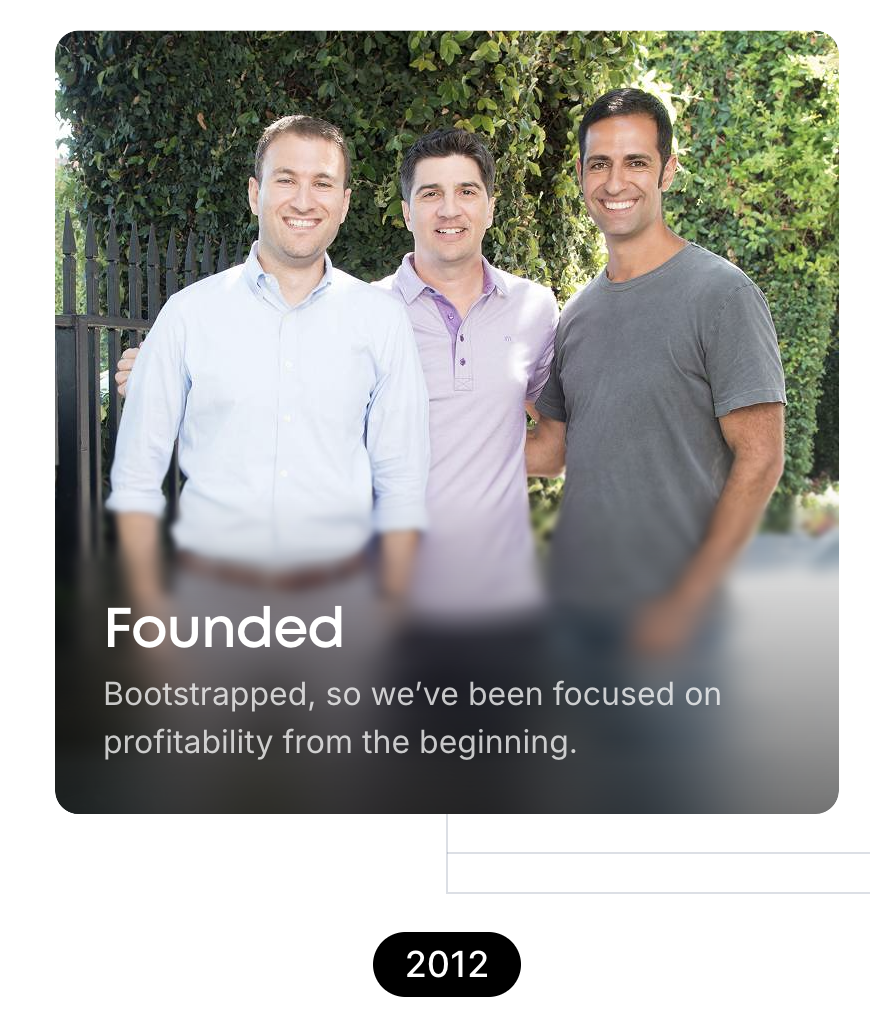
AppLovin started in 2012.
Founder Adam Foroughi was creating a couple of different apps, sensing mobile apps were going to be big: a dating app and a fashion app, both of which flopped.
He also created an app called AppLovin, where the company gets its name, a recommendation app meant to help consumers find other apps and connect with friends to play games together.
It also didn't do well, because the problem he was trying to solve was app distribution, and AppLovin itself had a distribution problem.
So he pivoted to advertising, realizing that advertising a mobile app would be the best way to distribute it.
As a subscale advertiser, though, no one wanted to advertise with them; like any marketplace, an ad exchange has a chicken-and-egg problem, needing both advertisers and publisher inventory before either side will join.
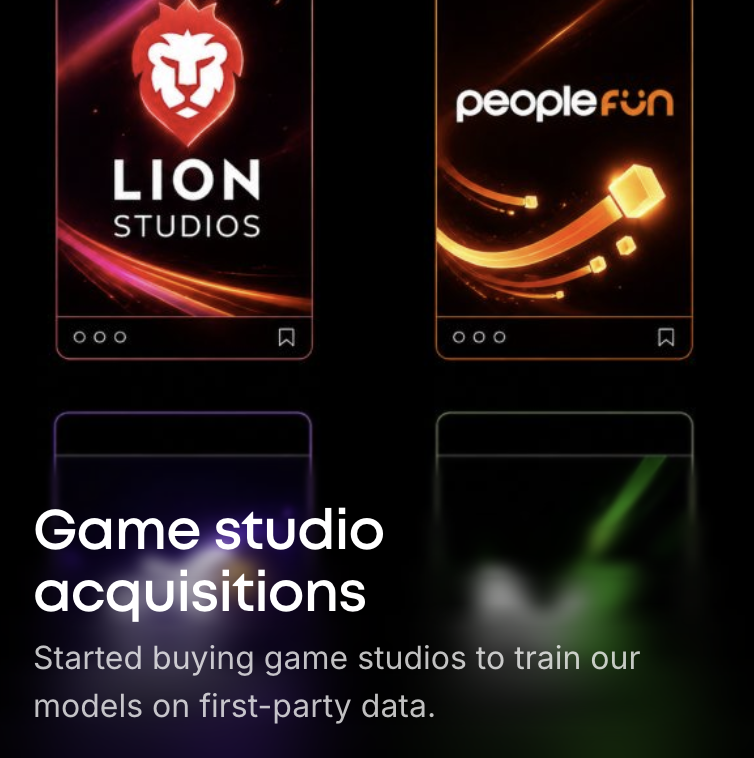
So they raised money and spent a billion dollars acquiring over a dozen mobile game studios, giving them inventory to sell and, more importantly, data to hone their ad algorithms.
In 2018, while still buying game studios, they also purchased MAX, a mediation tool that helps publishers monetize inventory by running multiple auctions.
By 2019, two-thirds of revenue came from monetizing their own games through in-app purchases, with the rest from advertising.
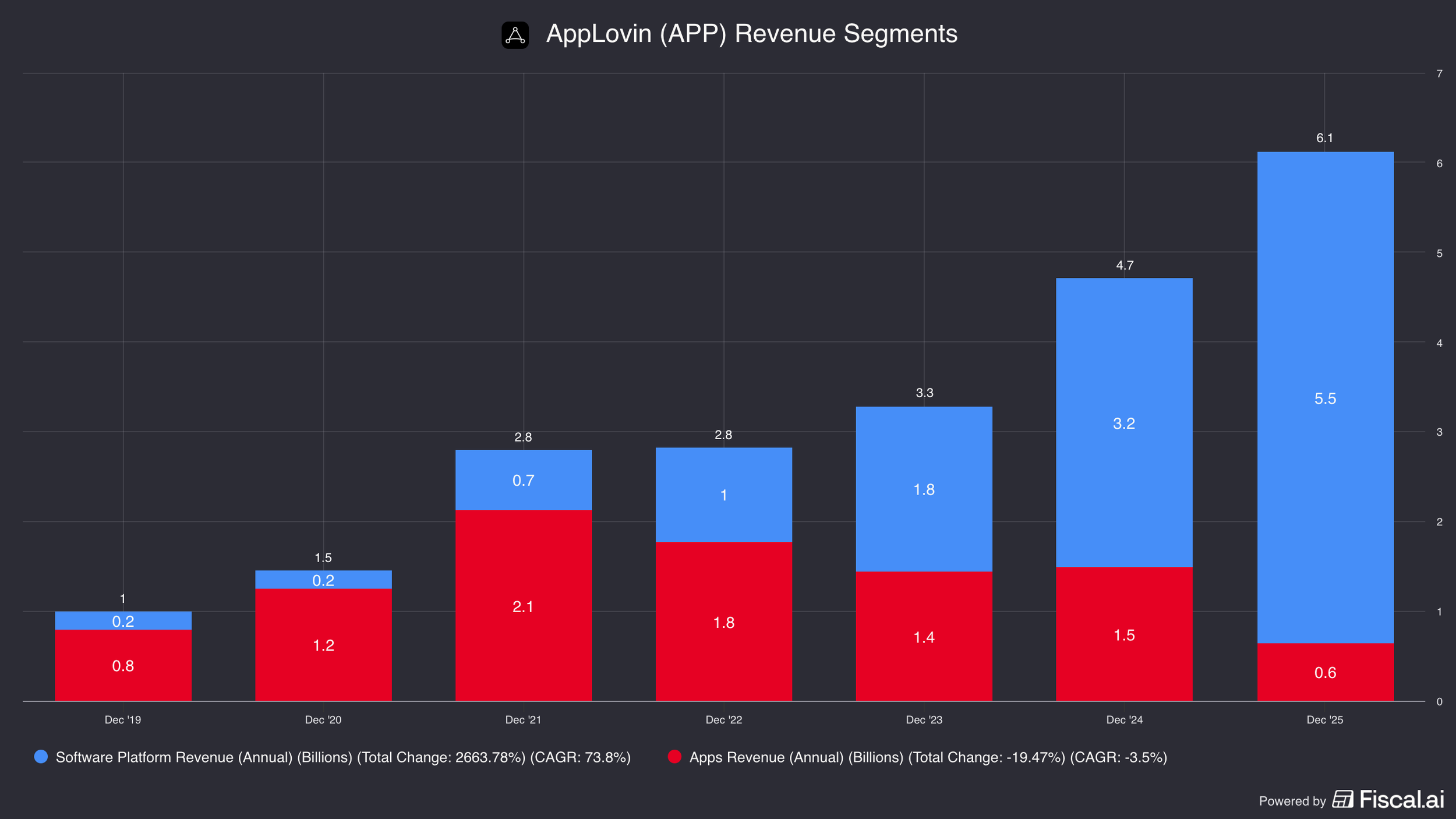
COVID boosted both businesses, but post-COVID the games business kept contracting, partly because Foroughi was never that passionate about building games.
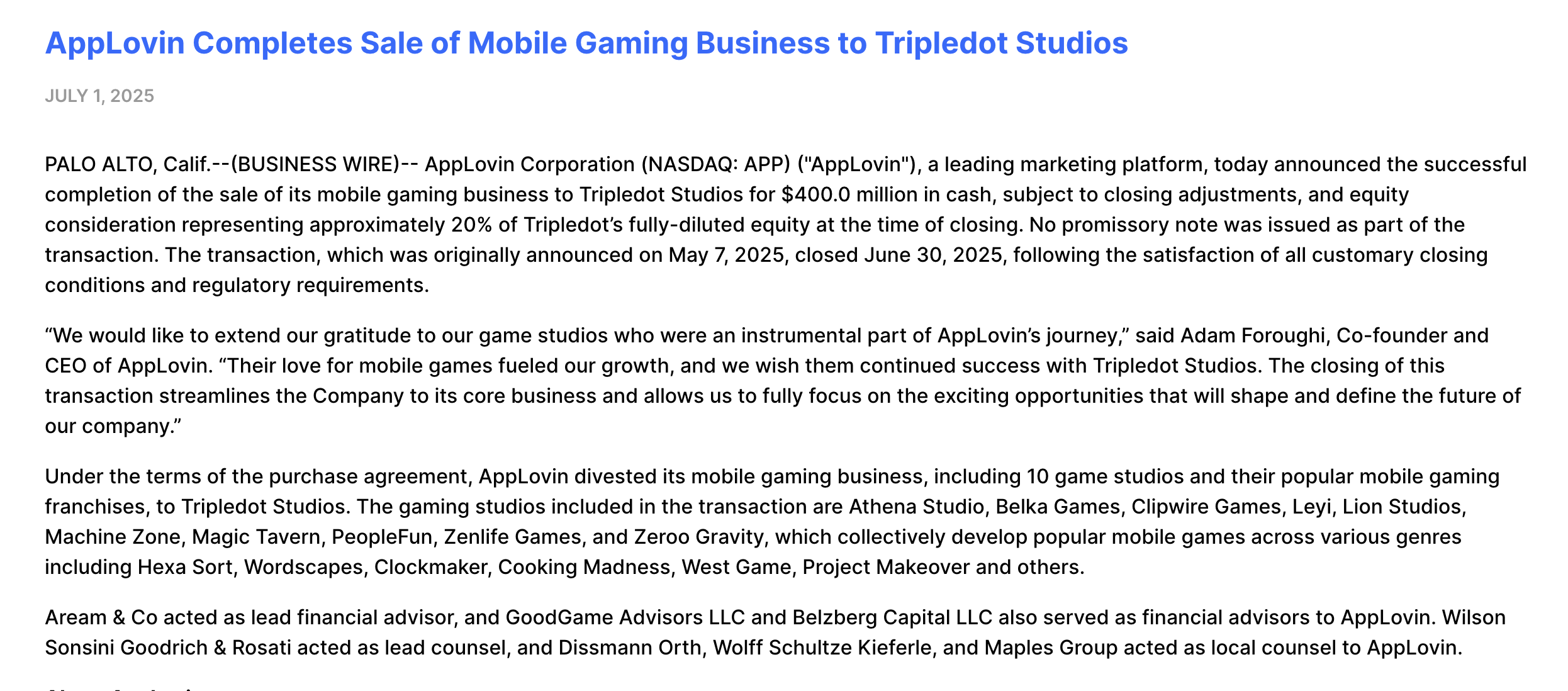
Once they no longer needed the data from owning games, they divested the business in 2025 for $800mn, $400mn in cash plus a twenty percent stake in the studio that bought them, Tripledot.
MoPub Acquisition and Axon.
Two things really helped AppLovin out of its post-COVID slump.
First, in 2021 they acquired MoPub from Twitter for ~$1bn.
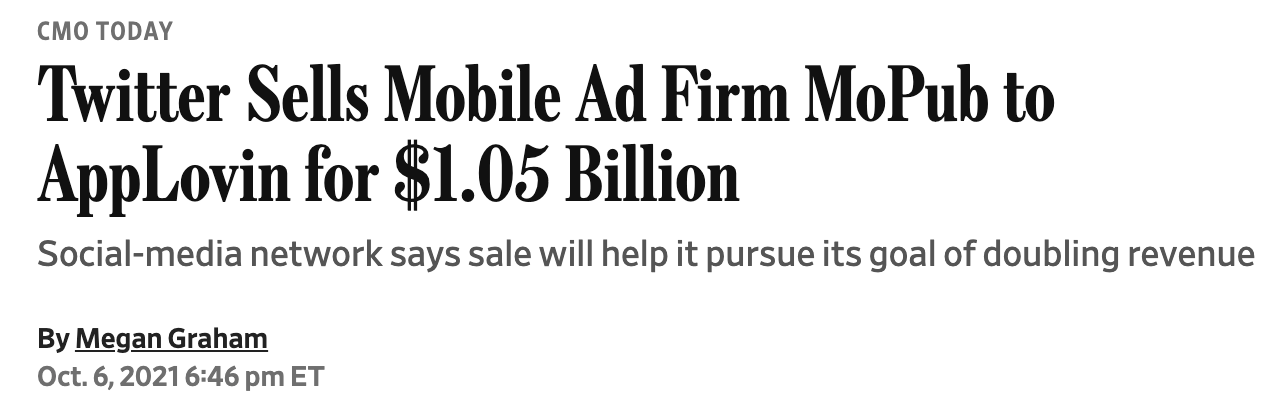
MoPub was similar to MAX, another mediation tool, but much more widely used, and they migrated basically all of MoPub's publishers over to MAX, giving MAX a lot more scale and consolidating market share.
Second is the launch of Axon 2.0, an advertising platform that takes billions of data points to bid on billions of ad slots on behalf of advertisers, making sure the right ad is shown to the right person to get the best return on ad spend.
An advertiser hands over a budget, and Axon's algorithms figure out where to best bid it.
They're still overwhelmingly focused on mobile gaming, just beginning to move into e-commerce, and it works because people who play mobile games tend to play other mobile games, creating a virtuous cycle where AppLovin gets very good at recommending the next game based on a player's behavior.
Since Axon 2.0 launched, advertising growth has been tremendous: 75% growth the first year, a re-acceleration from around 50% growth before that, and it's continued at that pace since, though it's decelerated somewhat to 53% growth last quarter, on a much larger base, with LTM revenue now around $6.8bn.
The Business Today: Lean and Extremely Profitable.
They historically had two segments, in-app purchases and software platform revenue, but since divesting the games business, the only business remaining is their advertising software platform.
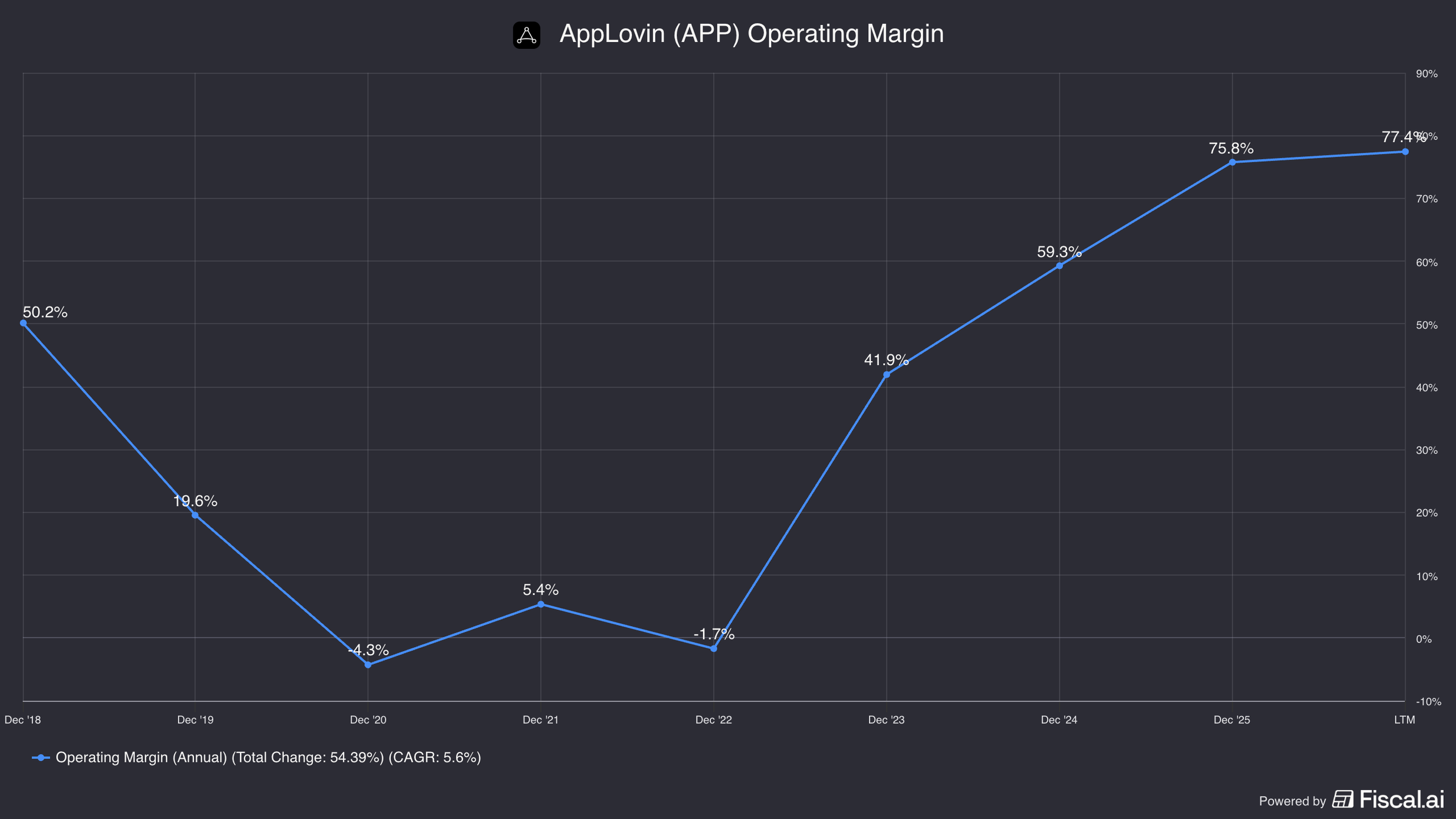
In the last twelve months, they've done $6.8bn in revenue, growing 53% last quarter, with 88% gross margins and, remarkably, 77% operating margins.
That's because the business is run incredibly lean: Adam Foroughi doesn't believe in hiring a lot of people, feeling that A-players only want to work with other A-players, and that more headcount means more bureaucracy, which slows things down and drives good people out.
The company has only 900 employees, putting revenue per employee at around $7mn, an extremely high number, and with the advent of LLMs and AI agents he feels even more emboldened to keep headcount lean.
They spend only a couple percent of revenue on G&A, unusually low for a software company.
It's one of the leanest companies out there, to the point that the margins themselves start to look like a risk: how sustainable can 77% operating margins really be?
How the Ad Tech Actually Works.
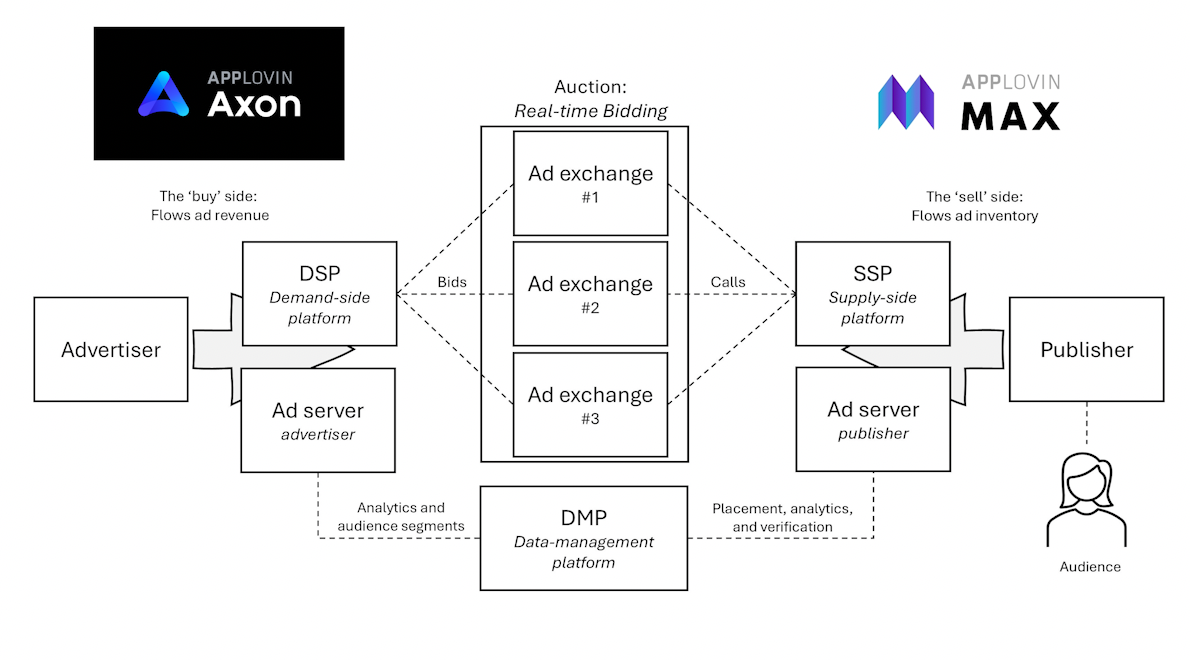
They have four main products: 1) MAX, 2) Axon Ad Manager, 3) Adjust, and 4) Whirl, though we'll focus mostly on the first two.
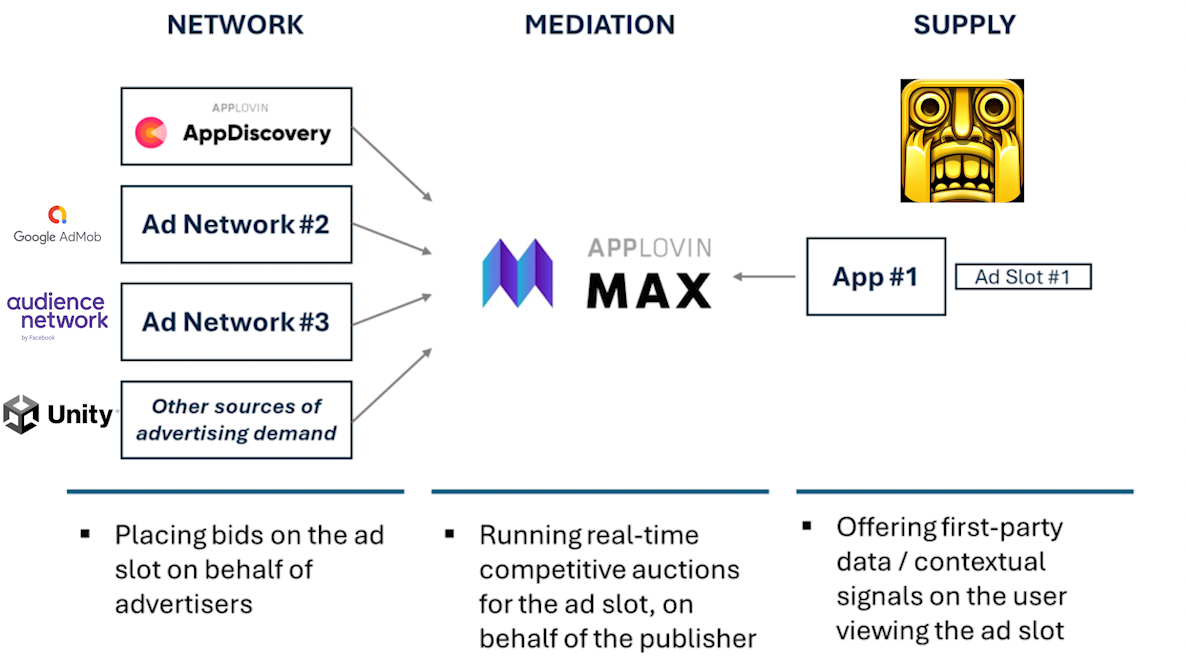
MAX is the product for publishers, someone who owns a game and wants to monetize it through ads.
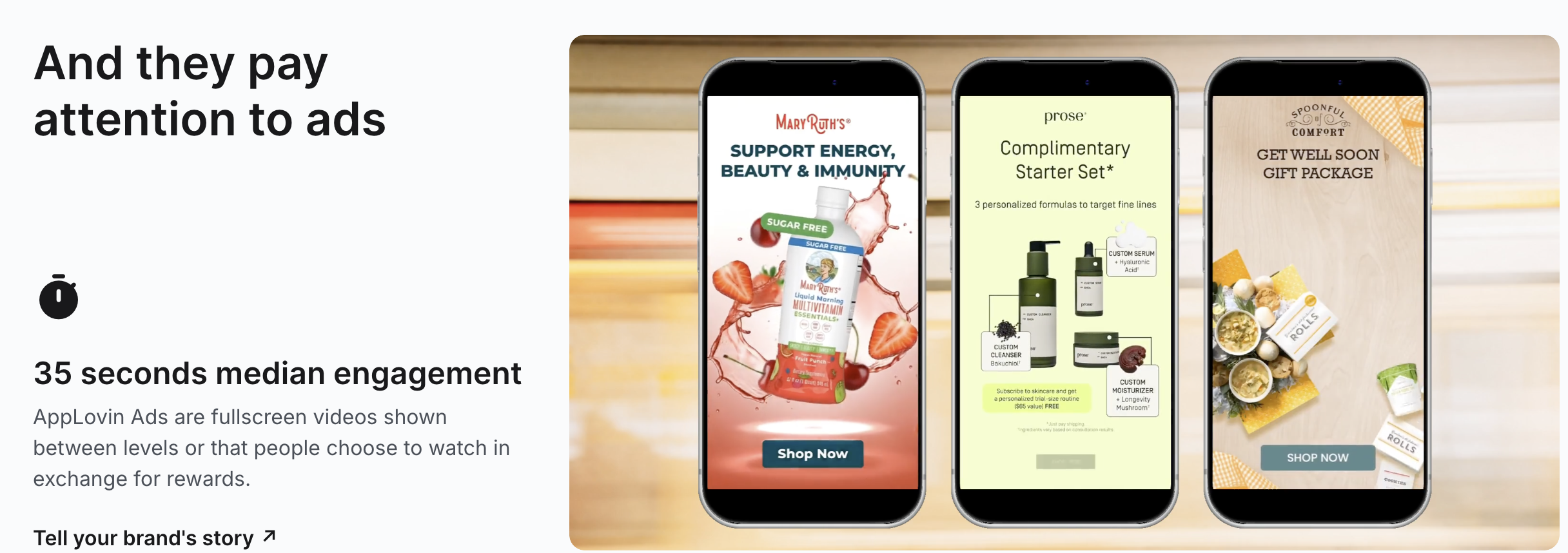
To be precise, a publisher isn't selling an ad, they're selling an ad slot, the option for an ad to appear at a certain point, like the thirty-second unskippable video you have to watch to keep playing after you lose.
MAX is called a mediation tool because it runs many auctions across many bidders, not just Axon, but also Google AdMob, Meta Audience Network, and other SSPs, comparing all the prices and awarding the ad slot to the highest bidder.
It's also technically an SSP, a sell-side platform, since that's where a publisher lists their ad inventory to be sold.
AppLovin has 1.5 billion daily users across the apps using MAX, but owning MAX doesn't mean the winning bid automatically goes to AppLovin's own Axon; it goes to whoever bids highest.
That transparency, versus the criticism that Google's auction is something of a black box, is part of how they built trust and gained market share.
On the other side is Axon Ad Manager, the demand-side platform where the advertiser funds a budget and sets a target return on ad spend.
Axon then looks across all available inventory, though they have an advantage bidding on MAX inventory specifically because of the closed loop of extra publisher data that gives them more insight into what an impression is really worth.
The Spread: How AppLovin Actually Makes Money.
Say you're playing Temple Run, which uses MAX, and lose, triggering an ad slot.
Google bids $10, Meta bids $11, Unity bids $7, and AppLovin's own Axon bids $13 and wins, since MAX just takes the highest bid.
But Axon's own math said this impression was probabilistically worth up to a $20 CPM, cost per thousand impressions, to their advertiser client.
So they only had to pay $13 to win it, and that $7 difference is the spread, which is how AppLovin makes money: the advertiser is willing to pay more than the publisher ultimately receives, and AppLovin pockets the gap.
Revenue on their P&L is net of that publisher cost.
We don't know their exact take rate on total ad spend across the platform, but there's good reason to think it's over 40%, maybe higher, especially given they've noted they're now a larger advertising platform than Snapchat, Pinterest, Twitter, or Reddit.
What actually matters to an advertiser isn't CPM but CPA, cost per action, meaning how many downloads they get for their money.
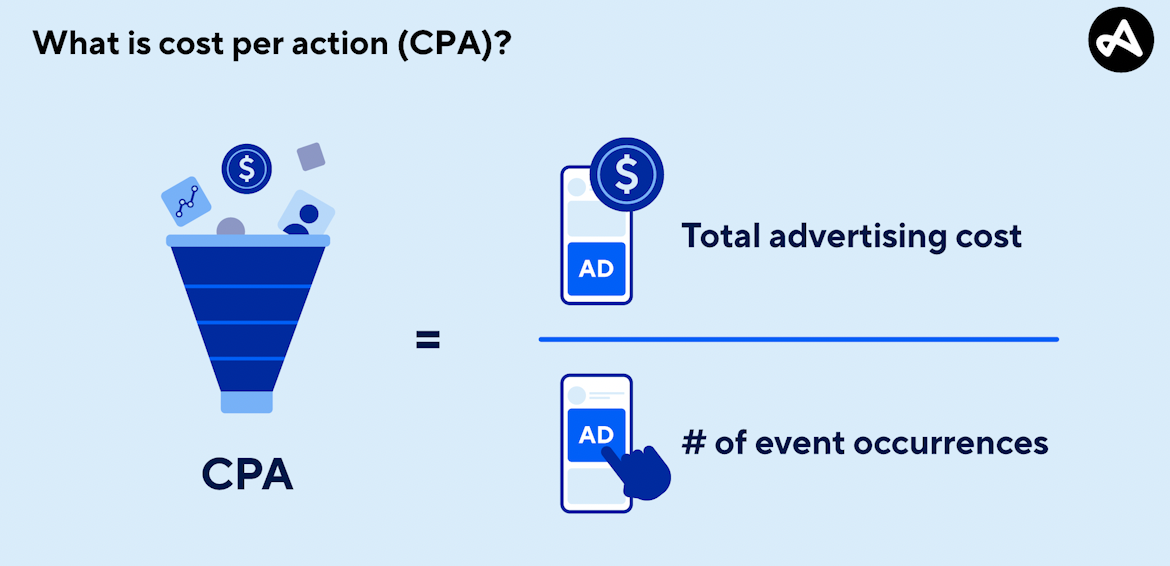
As AppLovin's matching technology improves, they need to show an ad to fewer people to get the same result with high confidence, freeing up impressions they can sell into a different deal and capture another spread on, which is a big part of how the growth compounds.
This is fundamentally direct response advertising where an advertiser can quickly see whether the spend worked, something that never worked well before mobile phones and really took off once Facebook and Instagram pioneered direct response ad formats.
If an advertiser gives Axon $5mn a month and gets $20mn of tracked revenue back, using lifetime value modeling to account for the lag between a download and eventual spending, they have no reason to ever turn that spend off, and it becomes a game of maintaining a good return on ad spend so the product sells itself.
That's part of why Foroughi doesn't want a large sales force: a genuinely good product that's making advertisers money shouldn't need a hard sell.
They also run a self-serve platform, letting any advertiser sign up and start spending online without a salesperson, the same approach Meta and Instagram use to grow the long tail of advertisers rather than relying on a traditional, manual sales-force model.
E-Commerce Opportunity.
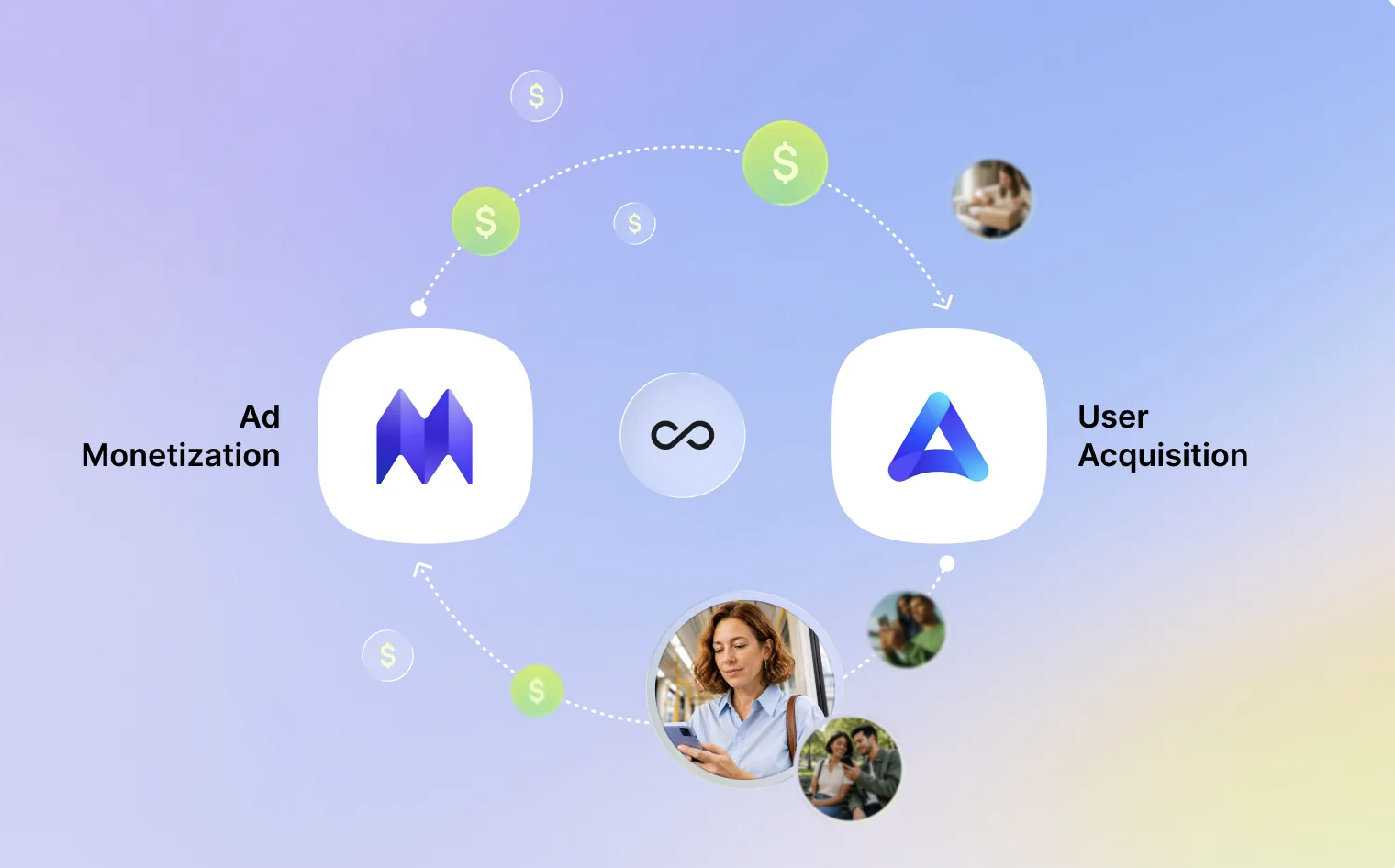
The first new vertical they want to add is e-commerce: while you're playing a mobile game, maybe you'd rather see an ad for an umbrella than another game.
That logic makes sense and should also improve the core algorithm, since more diverse ad inventory means a better match for someone not in the mood to download another game, part of why Meta is so effective with niche sellers across every category.
It could also unlock demand from developers who didn't want to advertise a competitor's game but would be fine with unrelated e-commerce ads, and there's real opportunity since even the best mobile games only monetize about 10% of users through in-app purchases.

It's harder to execute than it sounds, though, since it means individually signing up huge numbers of e-commerce sellers, a slow, manual process outside of shortcuts like a Shopify partnership.
Sellers also need to install a tracking pixel on the back end so a sale can be attributed to a specific user and ad, since this can't be done over the open internet anymore due to privacy rules.
Part of the reason the stock sold off recently was a report that pixel installs slowed month over month, from around 950 to 750, but that's hard to judge on a single month for a product that's only just rolling out.
Other Potential Verticals: Connected TV, Open Internet, and New Pricing Models.
Their product Wurl, is aimed at connected TV.
Connected TV is a genuinely hard market no one's cracked yet, since a shared living-room TV makes it unclear who you're advertising to, and there's no ability to track a direct response the way you can on a phone.
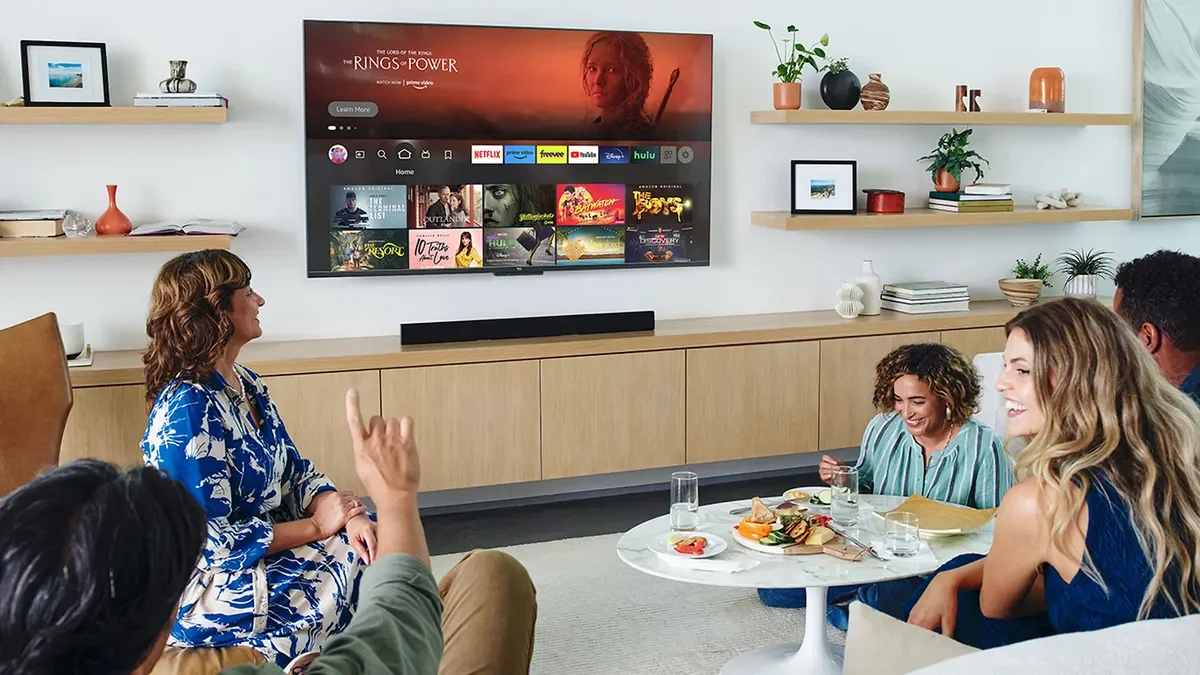
Amazon, Google, Trade Desk, and Netflix are all already competing there, and Adam has said he doesn't want to say much until they see the product actually tracking, so no numbers have been given; it's more of a call option than a core growth driver today.
They've also talked about a cost-per-lead pricing model, which could open up categories like financial products, healthcare, and insurance.
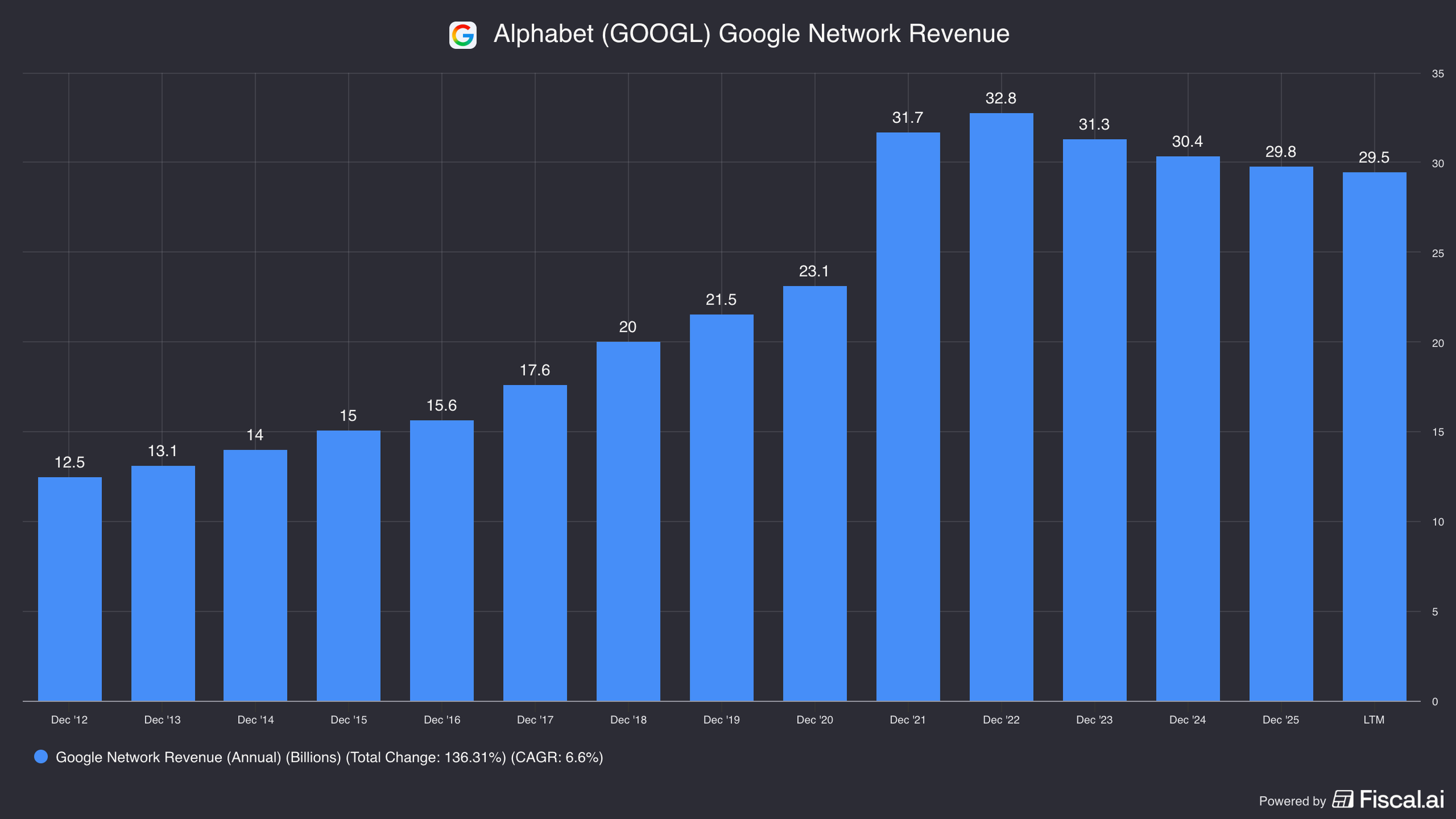
The open internet, ads on a random blog, mostly served today by Google, is a market I'd be less excited about, both because Google's own Google Network segment revenue is contracting due to AI reducing website traffic, and because it's a hard market to crack with a lot of legacy tech already installed.
Their strongest right to win is still mobile in-app advertising, where they have 1.5bn daily active users; the further they veer from that, the less likely success looks, though their mobile success came largely from the MAX and MoPub acquisitions specifically.
Competition.
One of the biggest competitors is Unity, which acquired IronSource and its mediation tool, Level Play, in a deal that was apparently botched, with the legacy product sunsetted amid cultural mismatches and a partial write-down, all while bleeding market share to AppLovin.
Unity's core game engine still has 70% market share among developers, and they tried to leverage that by waiving a per-download fee only for developers who used Level Play, a strategy developers hated since it felt coercive, badly damaging goodwill without meaningfully boosting usage.
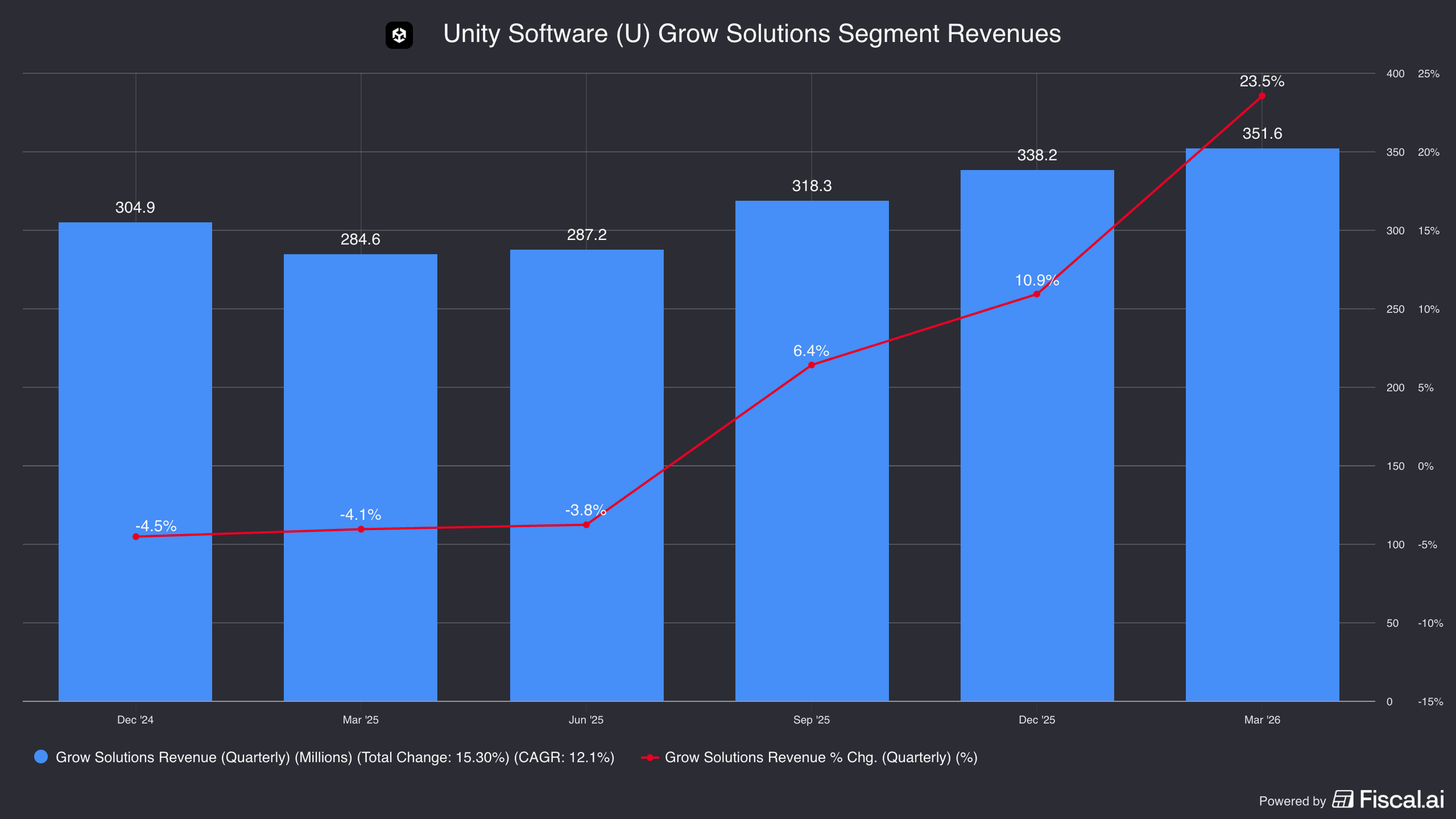
Still, all those developers remain on Unity's engine, a latent risk if their newer AI-native ad tool, Growth Vector, keeps improving; that segment went from negative growth four quarters ago to 23% growth last quarter, even though AppLovin's 53% growth is on a much larger base.
Google AdMob is a steady competitor, criticized for being something of a black box, and performs better on Android than iOS, though iOS users tend to be wealthier, which favors AppLovin.
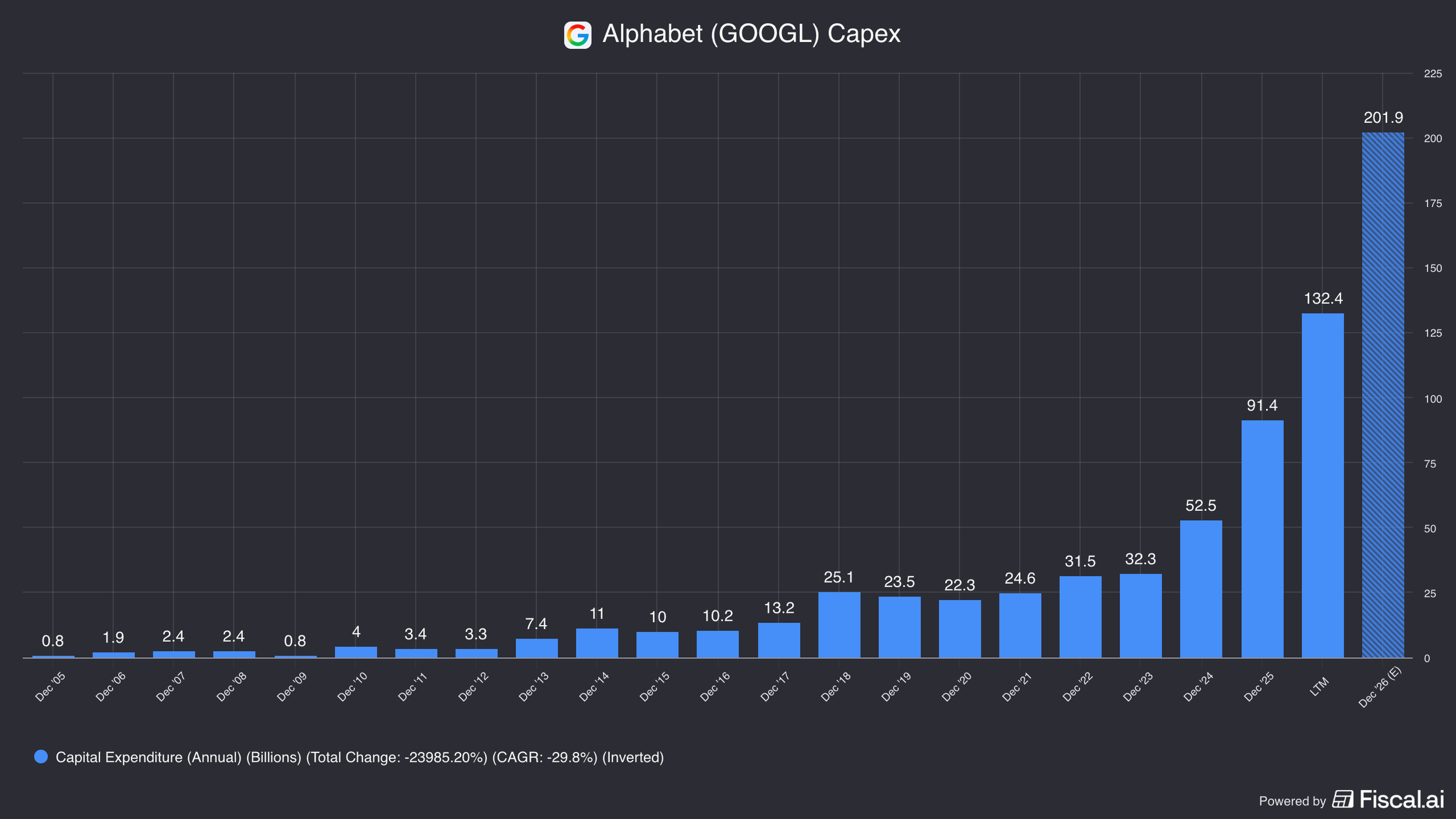
Google likely has bigger priorities right now, like its $200bn AI capex commitment, relative to AppLovin's $7bn in total revenue against Meta's $50bn in a single quarter.
Meta's Audience Network lets Meta advertisers show ads on third-party networks, but Meta has deprioritized it in favor of its own higher-returning, on-platform ads, and it was hit hard by Apple's App Tracking Transparency change, since it never really solved stitching together off-platform activity without something like MAX.
Smaller mediation tools like CloudX sit on top of MAX rather than replacing it and aren't a major threat.
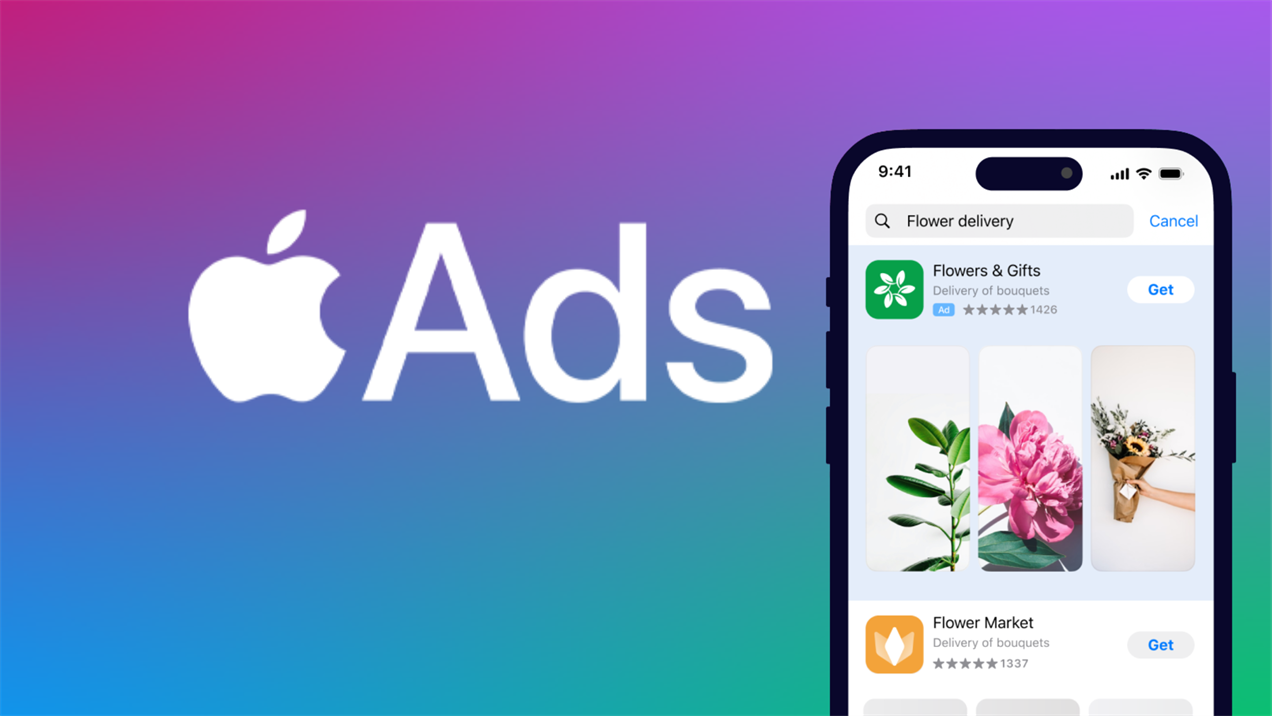
Apple also runs its own ad network, on Apple News and the Stocks app, with real first-party data advantages, though its privacy-focused brand positioning makes a bigger push into advertising awkward, a latent risk that hasn't really materialized so far.
The Spread Compression Risk.
The bigger fear isn't a competitor stealing AppLovin's customers outright, its competitors getting better at bidding and compressing AppLovin's spread.
Going back to the Temple Run example, if another bidder's ad matching improves enough that they're willing to bid fifteen or sixteen dollars instead of ten, AppLovin has to raise its own winning bid to match, shrinking that $7 spread down to $3-4, even if the advertiser's own return on ad spend stays fine.
It's hard to know exactly how big this risk is since we don't know their actual spreads, but any time you see seventy-seven percent operating margins, it's fair to wonder how sustainable that really is.
As it stands, AppLovin looks competitively superior to Unity, and Google and Meta don't appear to be catching up, so this is more of a future, theoretical risk than an immediate one, but worth tracking as they expand into categories like e-commerce, where Unity has no comparable inventory at all.
The SEC Investigation.
Around October 2024, short reports alleged several things, the most relevant being fingerprinting, creating a persistent user identity in a way that violates Apple's rules.
When Apple's ID for Advertisers, IDFA, went away, some advertisers reportedly began piecing together a device, IP address, location, and time of day into a workaround identity, exactly the kind of tracking Apple didn't want to allow, even though ironically their own now-discontinued IDFA did something similar.
This isn't necessarily illegal, just against Apple's platform rules, and the SEC investigation is about whether AppLovin failed to disclose a risk tied to its business model, not the legality of the practice itself.
AppLovin denies all wrongdoing and has called the short reports self-serving; a related money-laundering claim was retracted.
This is nearly a year old at this point, and if Apple or Google saw a real violation, they likely would have acted by now.
There was a whistleblower involved, though there are also claims the whistleblower may have had an incentive from short-selling hedge funds.
It gets murkier once you factor in measurement partners, MMPs, which are allowed but can inadvertently fingerprint depending on where their data comes from.
*As of this week’s earnings, the SEC investigation is now resolved.

A Skeptic's Reconsideration.
I was honestly a little surprised by how good Axon and AppLovin ultimately got at advertising, because I met with the company back around 2021 or 2022, right as Apple was rolling out App Tracking Transparency and Meta was calling it a $10bn headwind, with no clear solution yet in sight.
The games business was struggling at the same time, and I didn't think there was any real chance AppLovin could solve a problem that was proving so hard even for Meta, which is a big reason I dismissed the company and hadn't looked closely at it since.
It's possible their AI is simply very good, or that owning all those game studios for years gave them insights they could apply afterward, or that MAX's publisher-side data, combined with the limited data Apple still allows through the SKAdNetwork, opted-in user panels, and richer Android data, was enough to piece together a workable picture.
Whatever the mix, it's genuinely impressive, and by any measure this is an extremely well-run business; that revenue-per-employee figure alone is remarkable.
Valuation.
The stock is at $337 a share, $113bn market cap, down about -54% from a recent high of $720, trading at 26x trailing earnings.
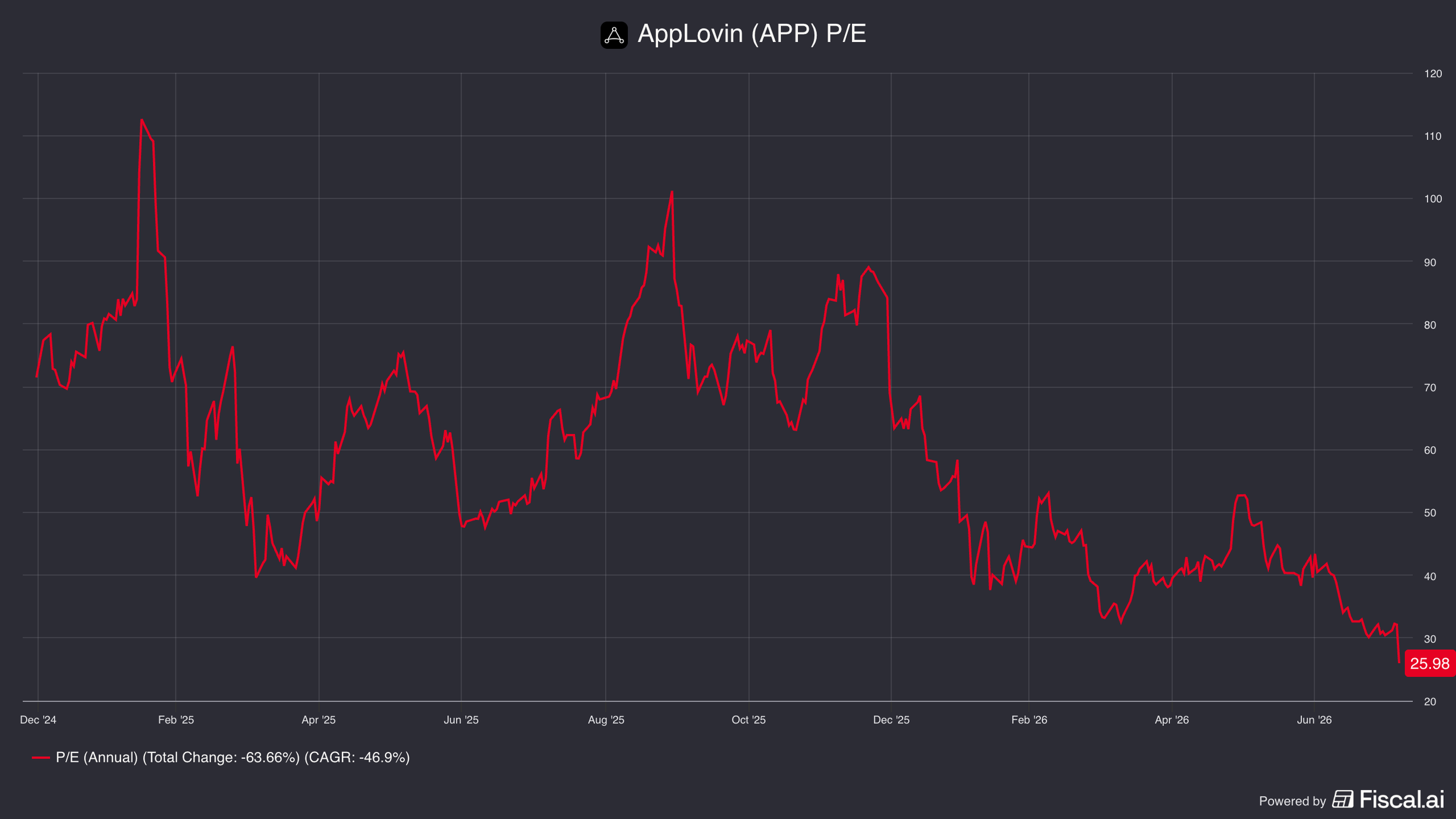
Estimating around $8bn in revenue this year, a number Adam himself seemed to corroborate at a conference, and holding margins flat while taxing at 20% gets you to a 23x multiple on this year's earnings.
It would only take about 30% more growth from here to bring that down to a market multiple, so if you're comfortable paying 23x and think they can grow faster than a roughly 10% market average, that gap is your source of outsized return.
They've talked about a 20-30% growth rate for 3-5 years.
Taking LTM revenue of $6.8bn dollars and holding the current 77% operating margin flat, 20-30% growth gets you to $7.2-9.2bn in NOPAT 3 years out.
A 20x multiple on that, implying something like high-single-digit growth by that point, would likely disappoint management, and works out to a 8-17% 3 year return CAGR.
A 25x multiple, more consistent with low-double-digit growth, moves the range to 17-27%, plus maybe another point of annualized return from cash generated along the way.
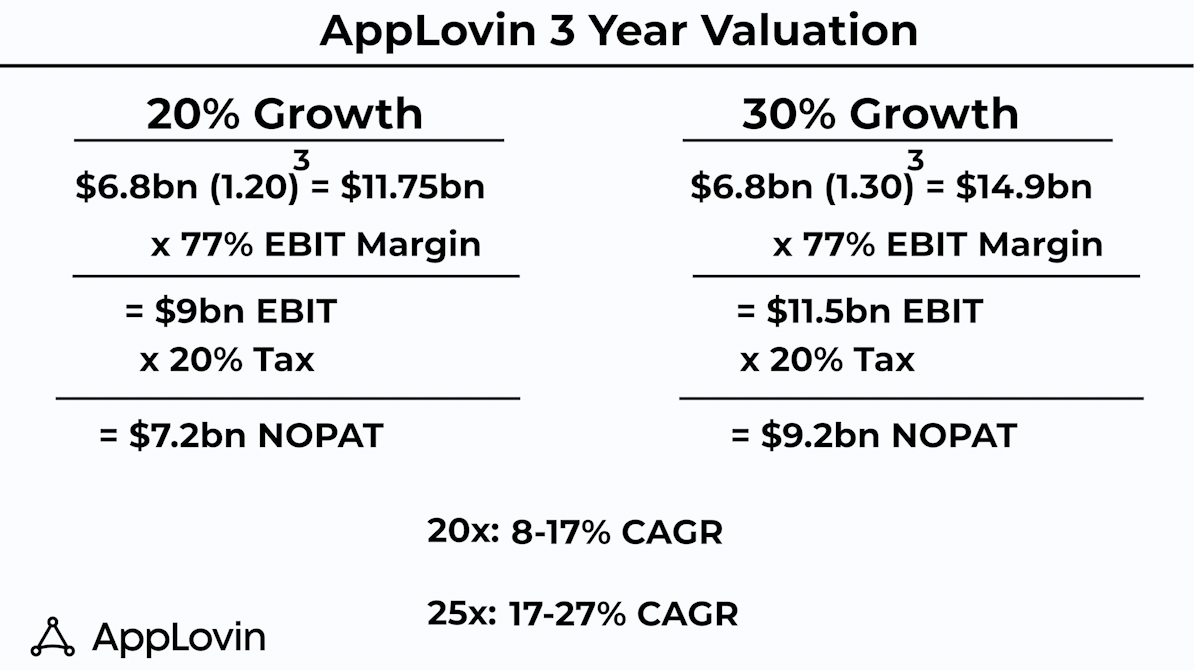
Running the same math over 5 years instead of 3 would look better if growth holds up longer; ultimately it comes down to what growth rate you're comfortable assuming.
On cash flow, excess cash has been going to buybacks, about $2.5bn over the last twelve months.
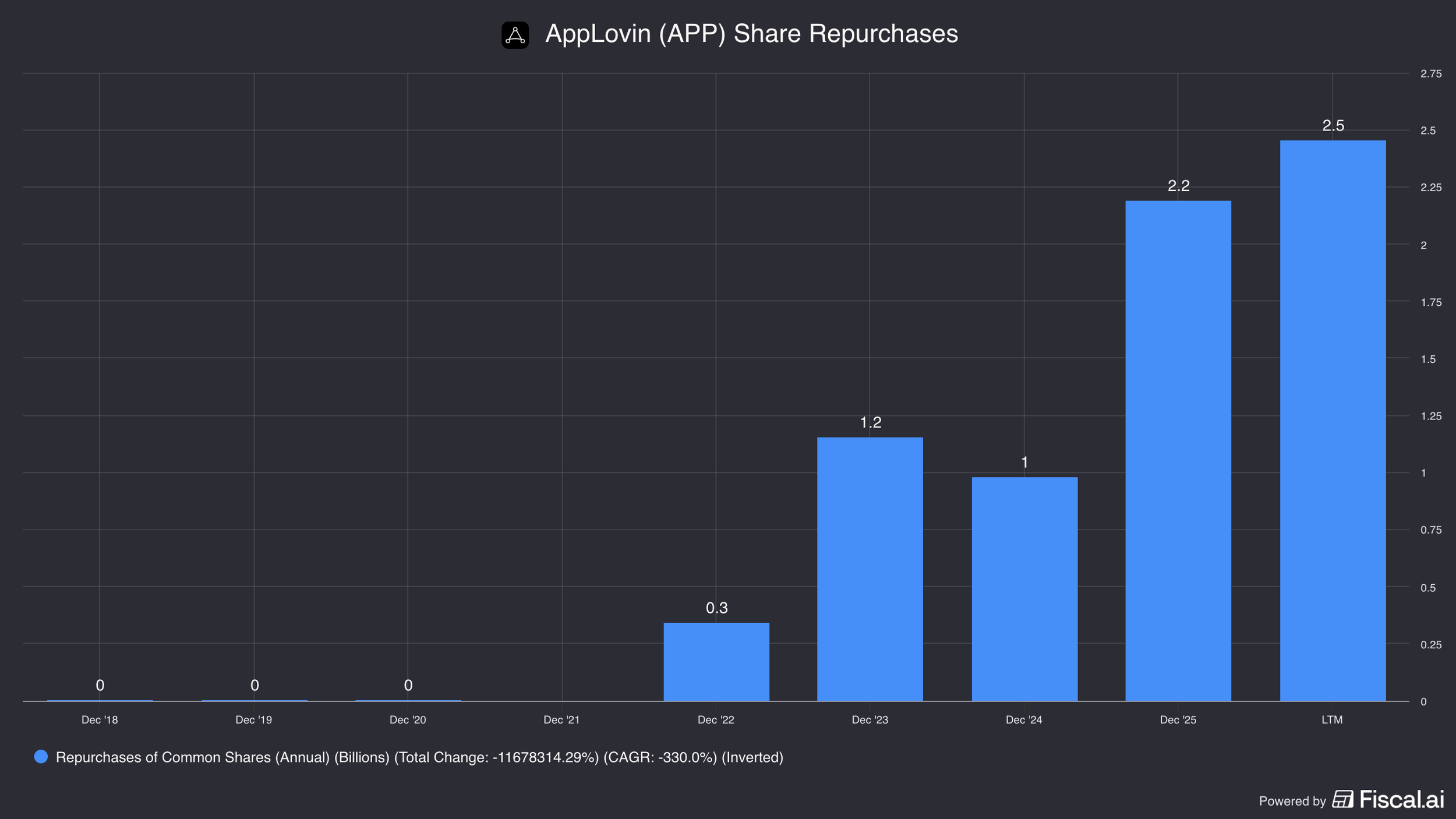
And Adam Foroughi still holds roughly a 9% ownership stake, though he's recently sold about $20mn dollars of stock, not too concerning against a stake still worth around $10bn.
Adam's Trillion-Dollar Math.
Adam has laid out a 10-year vision, implicitly for a trillion-dollar company.
Grow 25% a year for 10 years, reaching about $70bn in revenue, requiring about $200bn of ad spend, implying a 35% take rate, an implicit assumption of spread compression from where they likely are today.
Holding margins flat and taxing that gets you to roughly $43bn dollars in earnings, needing only a 23x multiple to justify a trillion-dollar valuation.
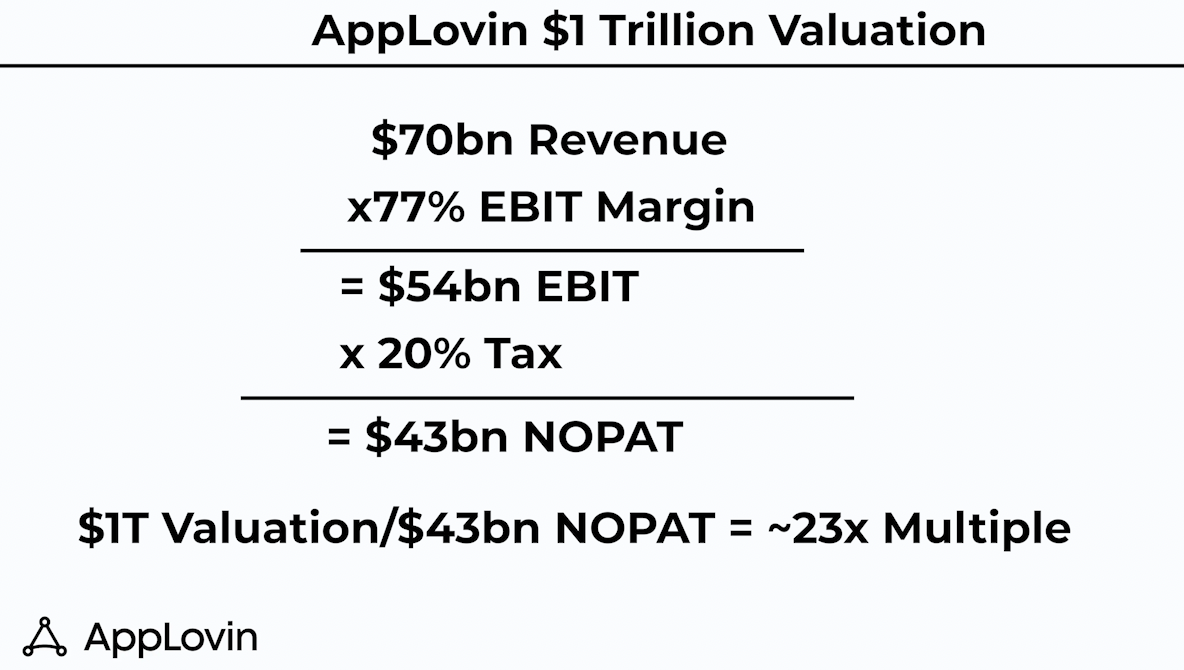
But 25% growth for 10 years, largely in markets they haven't entered yet, is no easy feat: e-commerce success seems plausible, several new verticals succeeding is less certain, connected TV is a toss-up, and the open internet looks tough too.
There's also platform risk if people spend meaningfully less time in mobile apps, whether from AI agents or a shift toward AR or VR gaming, though their captive, unskippable 35-second ad unit is a genuinely unique format.
Whether Google, Meta, and Unity stay complacent about current market share remains an open question, but Adam has clearly done a phenomenal job building this business where plenty of other platforms, including Twitter and Snapchat, tried and failed to become major advertising businesses.
Whether you want to join him on the path to a potentially $1 trillion market cap is ultimately your call to make.
For more on AppLovin, check out this video below.
Nothing in this newsletter is investment advice nor should be construed as such. Contributors to the newsletter may own securities discussed. Furthermore, accounts contributors advise on may also have positions in companies discussed. Please see our full disclaimers here.
