I Ran 10,000 Simulations: Renting Beats Buying 73% of the Time

Get smarter on investing, business, and personal finance in 5 minutes.
This newsletter is an adaptation from my recent YouTube video on Renting vs Buying a Home.
You might have been told, or feel like, renting is just throwing money away.
Or maybe someone has told you that buying a home will be the best investment you've ever made in your life.
On the other hand, maybe you've thought about, well, if I don't buy a home and I save the down payment and invest it in the stock market, surely that is going to outperform owning a home over the long run, right?
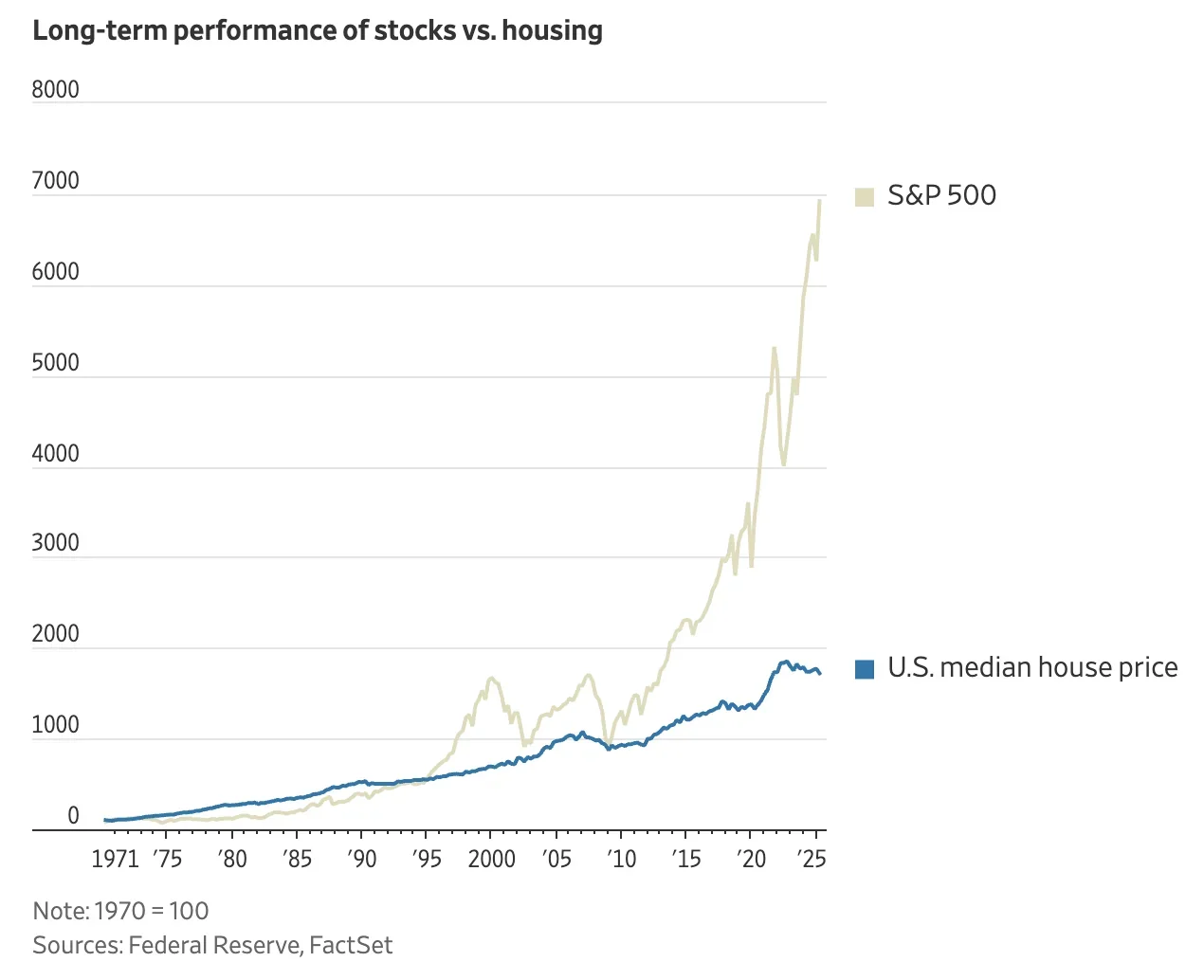
There are a lot of variables involved in whether or not buying a home is better than renting.
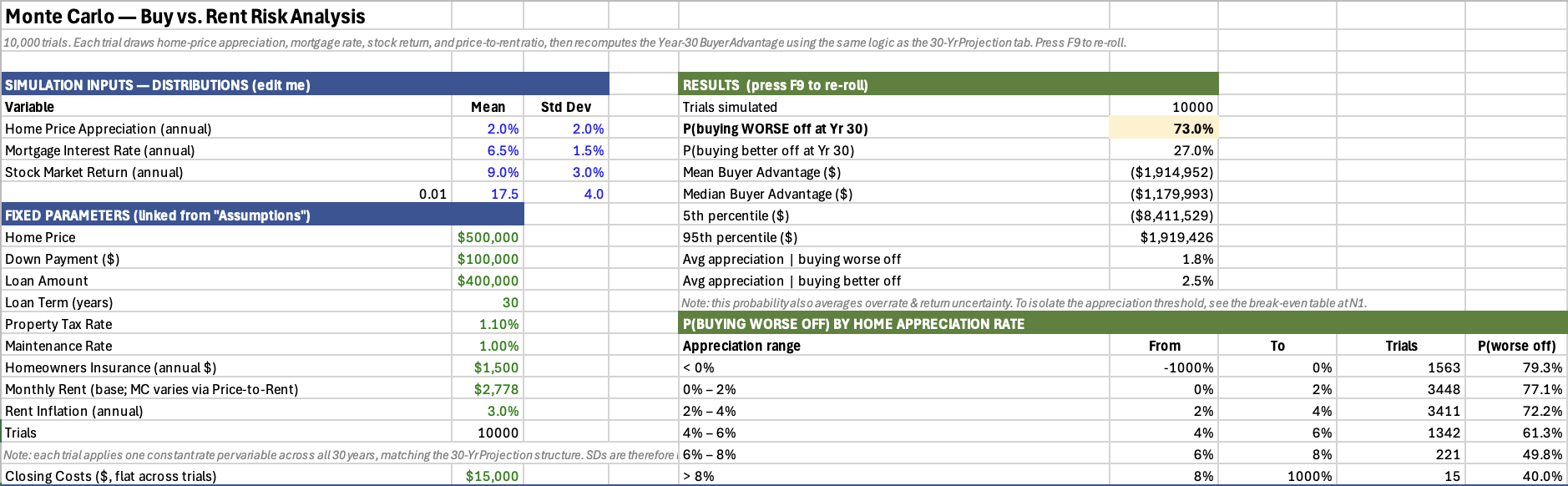
In order to answer the question, we ran a Monte Carlo simulation 10,000 times, and I won't hide the results from you.
73% of the time, renting was a better financial decision than buying, strictly off of the spreadsheet.
But what about all of those other scenarios when buying is better?
There is still a lot of variation in the analysis, so in order to boil it down and simplify it, in this video we are going to talk about five rules of thumb you should follow to know when buying a home is a better or worse financial decision than renting.
Of course, there are other considerations when you are buying a home that do not strictly come down to the financial spreadsheet.
So that is what we will cover today, buying a home versus renting from a financial perspective.
So let us get into the actual analysis and what we did.
How the Monte Carlo Simulation Works.
The crux of this analysis is a Monte Carlo simulation.
This is a very fancy word for a very simple concept.
You could run the math of what it is like to own a home for 30 years, what your home equity could be like at the end of that period, and how much it could be worth.
Then you could run another analysis for what happens if you rent instead, and you invest that down payment in the stock market, assuming a certain stock market return.
What does that look like at the end of the period?
Compare those two numbers.
Who wins?
Is it the home buyer, do they have a higher net worth from this decision, or is it the renter?
So the idea behind it is very simple.
The problem, though, is there are a lot of variables.
In total, there are 9 different variables that we went through in order to do this math.
A Monte Carlo simulation basically changes all of these assumptions for us, and keeps running the scenario again and again with different assumptions for each one.
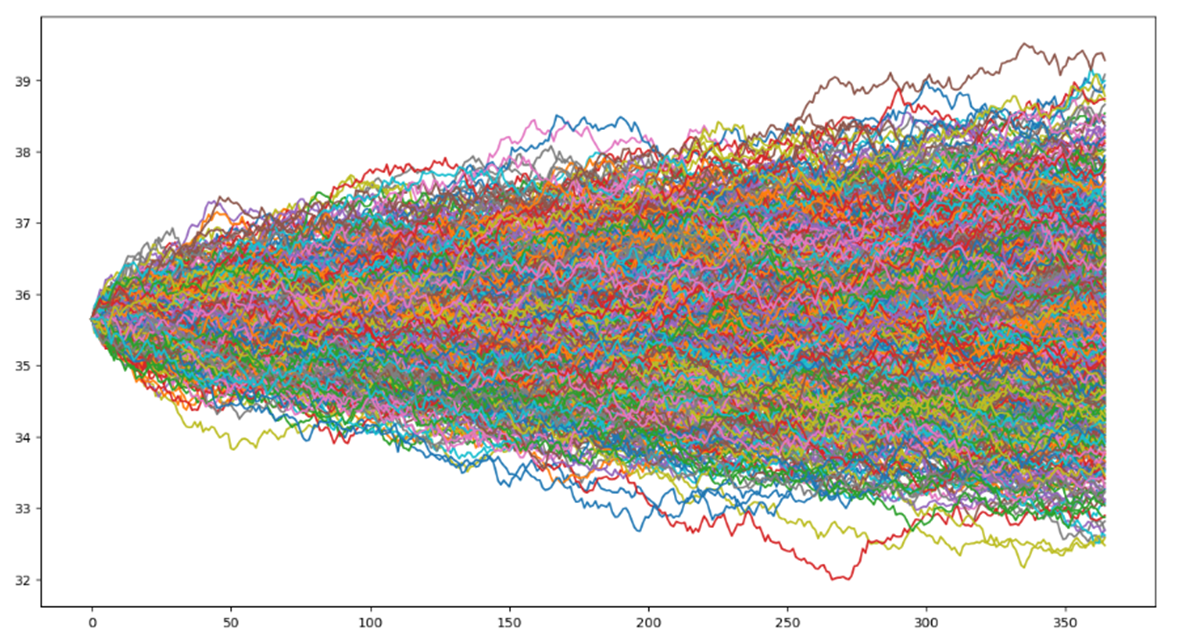
Then we're able to see the output of all of these different scenarios and draw a conclusion from that.
This is a more robust way to do an analysis, because we're not just thinking in one scenario if we assume home price appreciation of 5% and stock market returns of 8%.
Instead, we did this literally 10,000 times.
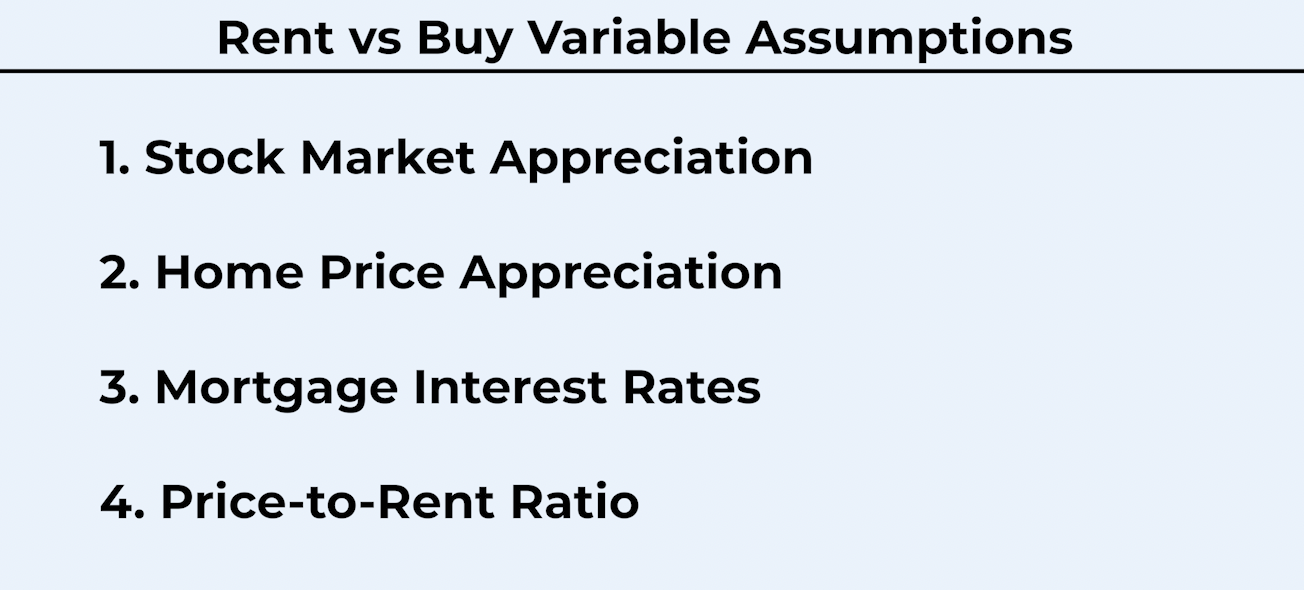
The assumptions in the model were split between fixed assumptions and four assumptions that we varied, because some assumptions aren't going to have that wide a band of outcomes.
Fixed Assumptions: 1%, maintenance as a home expense was held at 1% of the total value of the home, and we assumed a 20% down payment, a 30-year mortgage, and 3% closing cost.
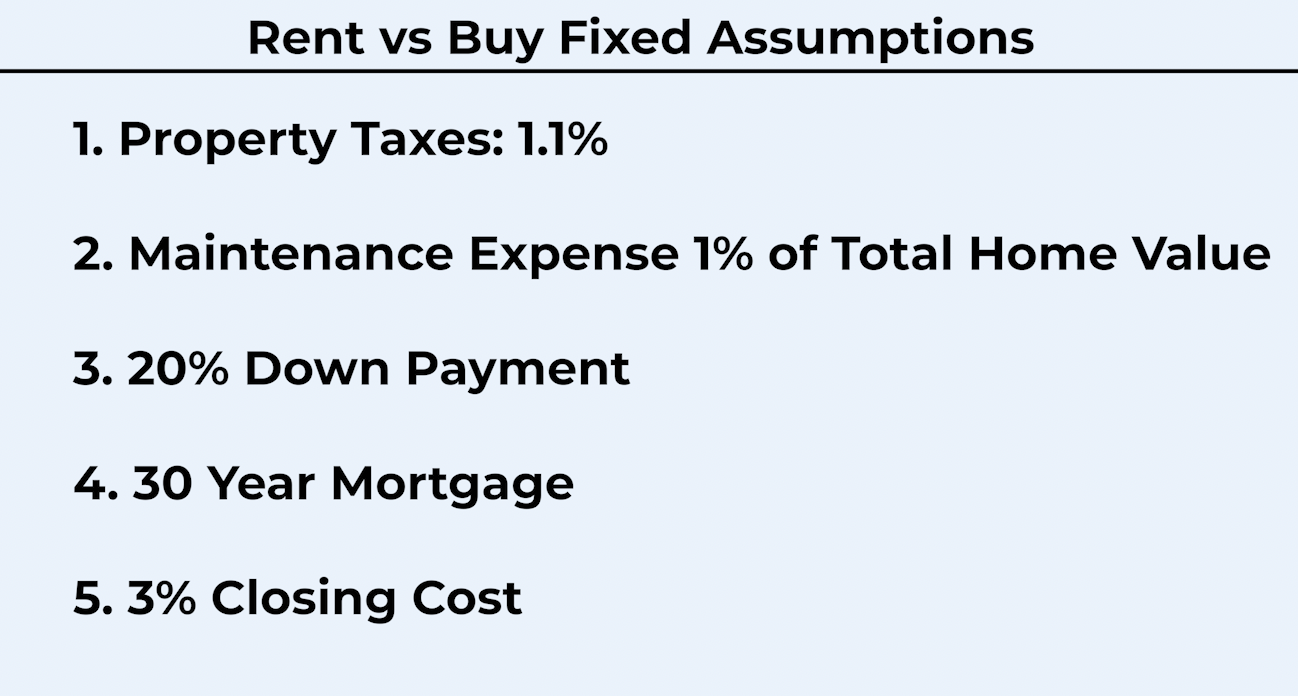
These numbers could be different, but they're not going to vary that wildly.
The numbers that vary a lot are stock market appreciation, how much stocks go up on average every year, home price appreciation, how much the home goes up every year, mortgage interest rates, and the fourth one is a price to rent ratio.
This is a really important ratio that is the crux of a lot of this analysis, as well as one of our rules of thumb.
It's a very simple calculation.
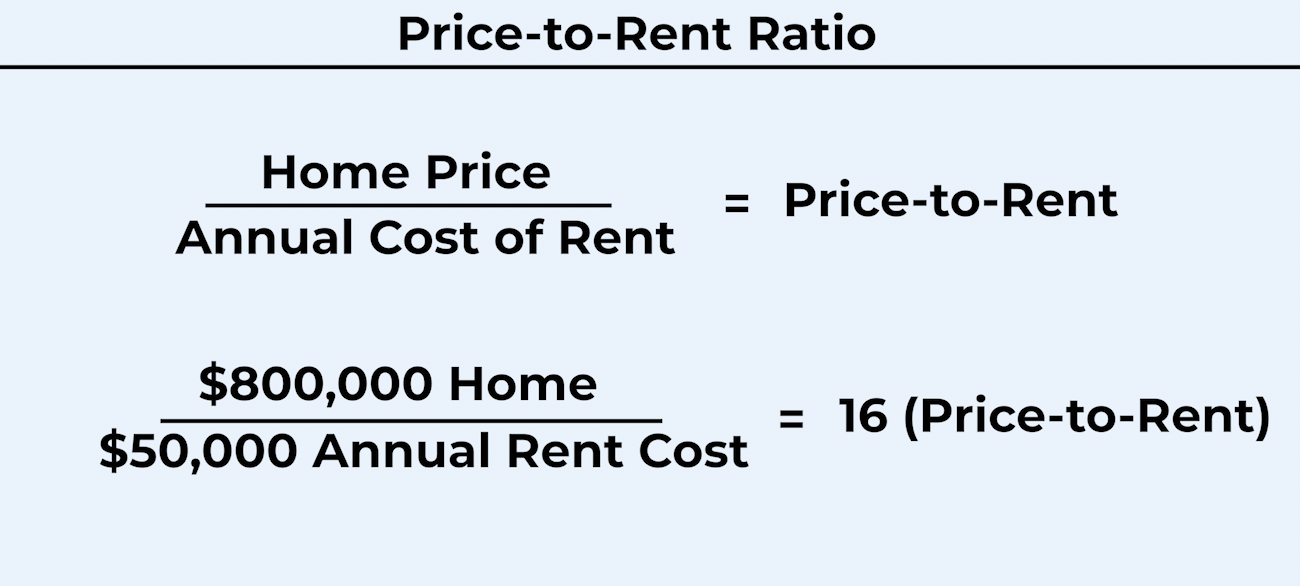
It's the home price divided by the annual cost of rent.
If you pay monthly rent, multiply that by 12, that's your annual cost of rent, and then take whatever the home price is and divide it by that.
If you're paying $50,000 in rent a year and it's an $800,000 home, that's a ratio of 16.
All the model is doing is varying these assumptions, giving us different outputs, and from the outputs we're able to draw different conclusions.
Buying vs Renting Benefits.
The idea behind comparing buying to renting is very simple.
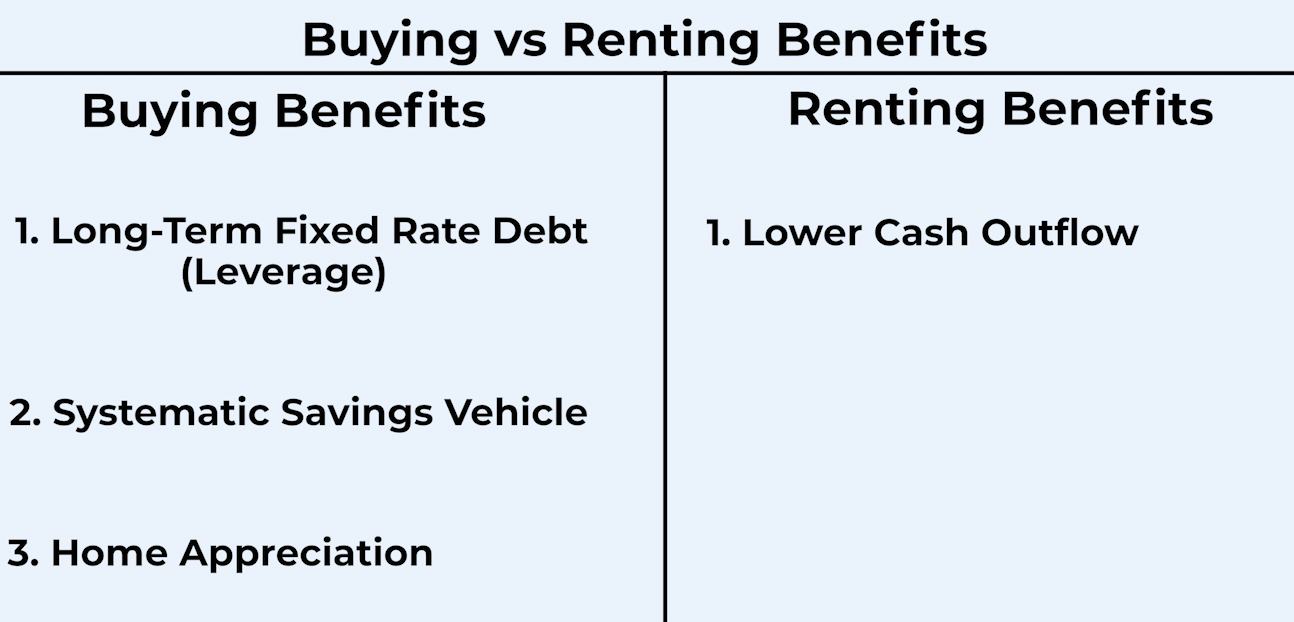
If you buy a home, you have the benefit of getting long-term fixed rate debt.
That's what a mortgage is, usually at a fixed rate, and the benefit is you basically get leverage on your purchasing.
Let's say you could buy a million dollar home by only putting $200,000 down, using leverage.
It's actually one of the few times an individual investor has access to long-term fixed rate debt, a rare thing for an individual to get access to.
That's a big benefit to home ownership, especially when interest rates are low and you can lock in a low rate.
The homeowner also has the benefit of a home payment basically being a systematic savings vehicle, because over time, as you pay down the principal on your loan, more of your payment is equity, so you're saving money every month by paying down your mortgage.
On top of that, the entire value of the home can appreciate.
The renter, in contrast, has a much lower cash outflow, maybe a one-month renter's deposit, and that's it.
The renter's monthly payment is also often much less than the homeowner's cash outflow, since the homeowner is paying interest expense and paying equity into the home, plus insurance, property tax, and maintenance, all cash outflows for the homeowner.
The renter has all of that baked into whatever their rental payment is.
The question, though, is at what point does buying become better than renting?
As mentioned, we ran this 10,000 times, and in 73% of the scenarios, renting was better than buying.
So we created five rules of thumb to help you understand when home buying makes more or less sense.
The 5 Rules of Thumb.
Rule One: The Price-to-Rent 15 Rule.
This rule says that if the price to rent ratio, the home price divided by the total annual cost of rent, is 15 or less, then home buying is more favored.
This ratio captures, on a relative basis, how much more expensive it is to buy a home versus rent, and when it's under fifteen, buying tends to be more favored.
If it is over 20, renting is strongly favored, coming out as the better financial decision ninety-three percent of the time.
In the middle, 15-20, you may have seen this thought of as a neutral zone elsewhere, but that's not what our model showed.
Renting is still strongly favored in that window, just a little less so, beating buying 82% of the time.
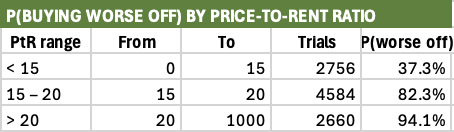
So you're really looking for a ratio of 15 or under to feel good about buying a home, though that alone doesn't mean buying is a sure better financial decision, which gets us to rule number two.
Rule Two: The 3.5% Gap Rule.
This could be thought of as rule 1B, since it goes together with rule one.
It says that if you expect the gap between the expected return of stocks and the expected return of home prices is less than 3.5%, then buying becomes strongly favored.
So if you think the stock market is going to return 7% and buying a home is going to return 5%, since that difference is less than three and a half percent, buying is strongly favored.
That difference is really important.
In fact, if both rule one and rule two hold, a price to rent ratio under 15 and a gap under 3.5% in our model, buying a home is better than renting 98% of the time.
If these two rules hold, it is one of the strongest modeled scenarios where buying a home becomes much more favored than renting.
There are three other rules of thumb that are a little more standalone.
Rule Three: The Mortgage Favorability Test.
This one is the mortgage favorability test.
If you could get a mortgage at 3% or under, buying a home again becomes a more favored decision versus renting, but not by a large amount, just passing about 50%.
So if you could get a home at a 3% mortgage rate, 50% of the time it's a better decision than renting, kind of a coin flip, which is honestly a little surprising.
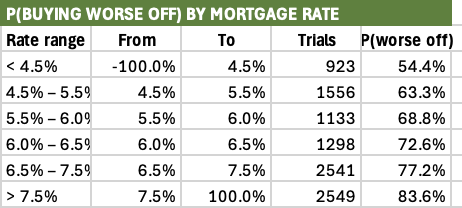
You would have thought a lower mortgage rate would have meant this was a better decision to buy in more scenarios.
So don't worry if you didn't lock in that super low COVID 3% mortgage, it probably wouldn't have been a total game changer for this math.
It helps in terms of favorability, but it is not an absolute rule.
Rule Four: The Duration Test.
This one is pretty simple.
It's not worth buying a home unless you plan on being there for usually at least 7 years, because closing costs are going to be about 3%.
These will vary, but we could use 3% as an estimate, and it takes a long time for those to amortize through owning the home for this math to start to flip more in the buyer's favor.
It doesn't mean it flips automatically at 7 years, it just means if you're less than that, it is almost never in your favor to buy a home.
That is why you'll want to only buy a home if it's a long-term decision for you, not something to settle for a few years and then flip, because you're going to have closing costs when you buy the home and when you sell it, and then buy a new one with new closing costs.
You definitely want a good amount of time to spread out that cost of closing.
Rule Five: The 6% Return Line.
This is another standalone rule, and an interesting one.
It says that if you expect stocks to return less than 6%, buying a home is a better financial decision two-thirds of the time.
So if you're kind of a perma-bear and don't have very high expectations for stock market returns going forward, that on its own is a very strong reason why you should buy instead of rent, all else being equal, where you actually have the money to buy a home and aren't scraping your savings or blowing up your emergency savings account.
What Isn't on the Spreadsheet.
So those are the five rules, and right now you might be thinking, well, how do I know what the stock market is going to return over time, or what home price appreciation should be?
You don't.
These are assumptions you're going to have to put into your model and be comfortable with in order to make these decisions.
You may be thinking there's no way you could possibly know these things.
It's true, and what I'd push back with is that then you can't say with confidence whether buying a home is going to be a better or worse decision than investing.
If we're basing it off history, though, the US stock market has returned 9-10%, whereas median home prices have returned about 2%, and in very popular metropolitan areas like Los Angeles, San Francisco, and New York, maybe that figure is more like 5% or higher.
That difference between the 10% and even the 5% number is still way higher than the 3.5% gap we talked about, which suggests, and this is what the analysis showed, that 73% of the time renting is better.
Now, if you don't want to make assumptions on home prices or stock market returns, you could just focus on the price to rent 15 rule, buying a home when that ratio is 15 or less, and pass the duration test, making sure you're in that home for at least 7 years.
But these two rules on their own are not as strong as the other three put together if you're really looking at it strictly from a financial spreadsheet decision.
Now, buying a home should not be a strict financial spreadsheet decision.
Even though I'm a financial advisor, I'm advising you to make buying a home not just a financial decision.
It's something you definitely need to be cognizant of in terms of what it financially will do to you, how it could set you back.
But it is equally, if not more important, for you to understand the other non-financial benefits, which many people understand subconsciously.
It is not just a financial investment, but an investment in security, in comfortability, in optionality.
If you own your home, you never have to ask a landlord whether you can paint, do light renovation, or garden outside.
These are all things you'd have to get approval for otherwise.
You also don't have to worry about rent increasing, and you don't have to worry about getting kicked out, eminent domain aside.
It should not be understated, the psychological benefits and the peace of mind of owning your own home, which is why for many people it is a dream in the first place.
Remember, the point of money is not just to take your money and make more money with it.
It's to support your lifestyle.
Buying a home is one of the best decisions many people feel they have ever made, even if it didn't financially make the most sense on a spreadsheet.
Having said that, if you cannot currently afford a home, or you're a renter and not a homeowner, you should take solace in the fact that you're probably making a better financial decision, and are probably going to compound your wealth at a little bit faster rate than if you did own a home.
For more on Buying vs Renting a Home, check out this video below.
Nothing in this newsletter is investment advice nor should be construed as such. Contributors to the newsletter may own securities discussed. Furthermore, accounts contributors advise on may also have positions in companies discussed. Please see our full disclaimers here.
