Uber Update: Getting Disrupted or Misunderstood Risk?
Get smarter on investing, business, and personal finance in 5 minutes.
Business Update
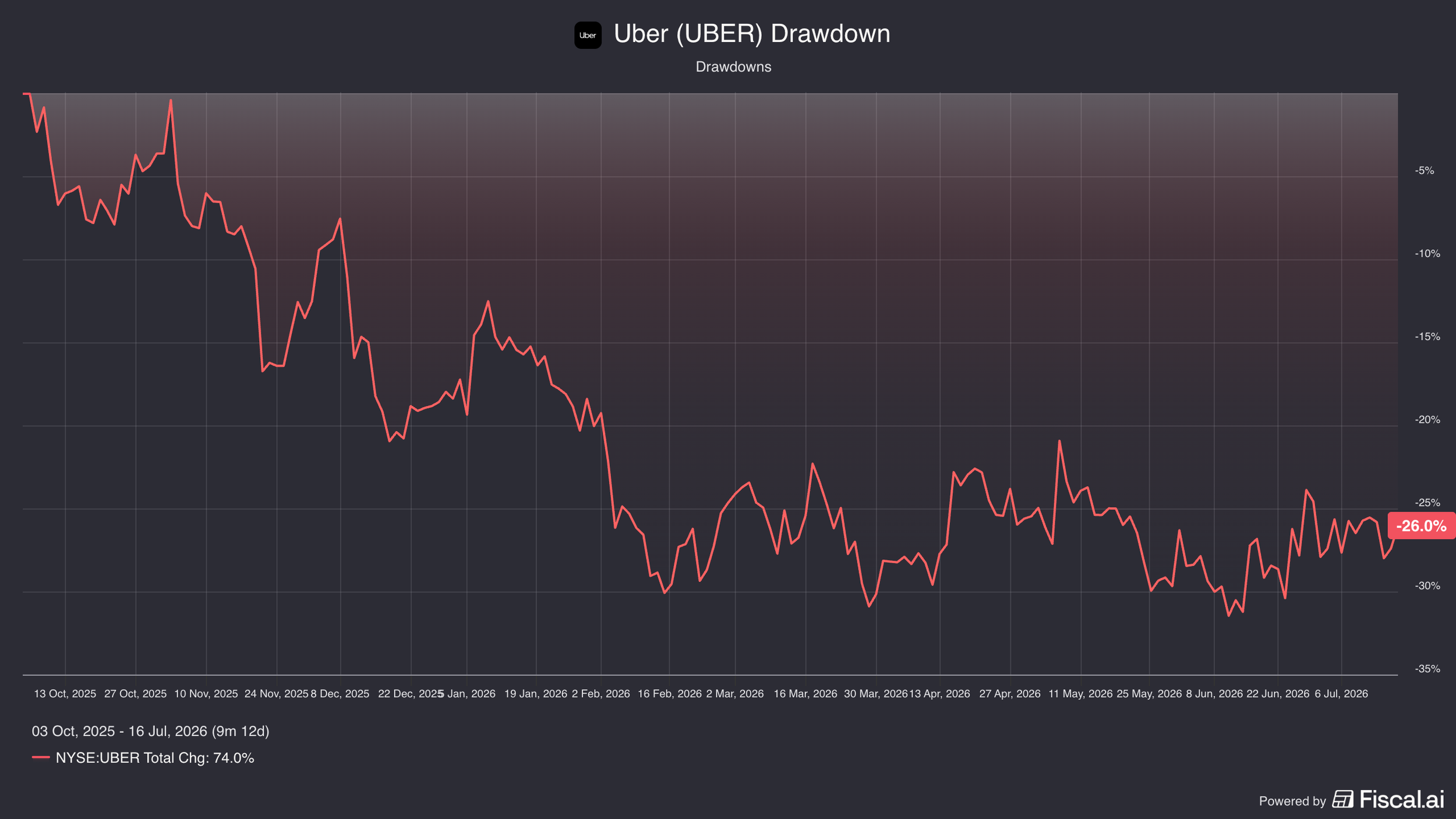
Uber stock is down -25% from its all-time high and down -8% year to date.
This is all the while their financials have never looked better.
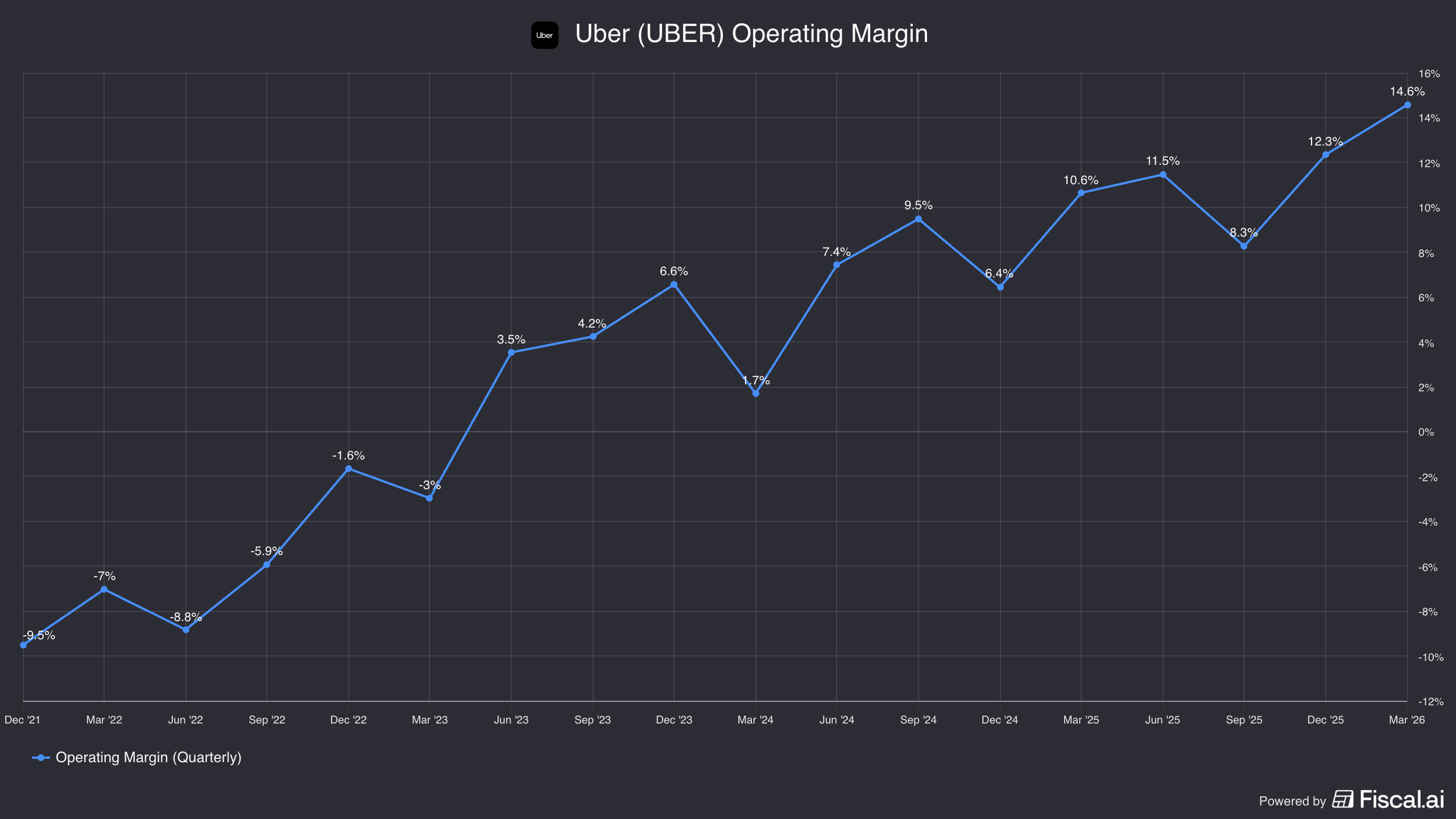
Revenues and operating profits have continued to increase quarter after quarter, hitting an all-time operating profit margin high just last quarter.
Customers grew +17% y/y in the last quarter, trips grew +20%, and gross bookings grew +25%.
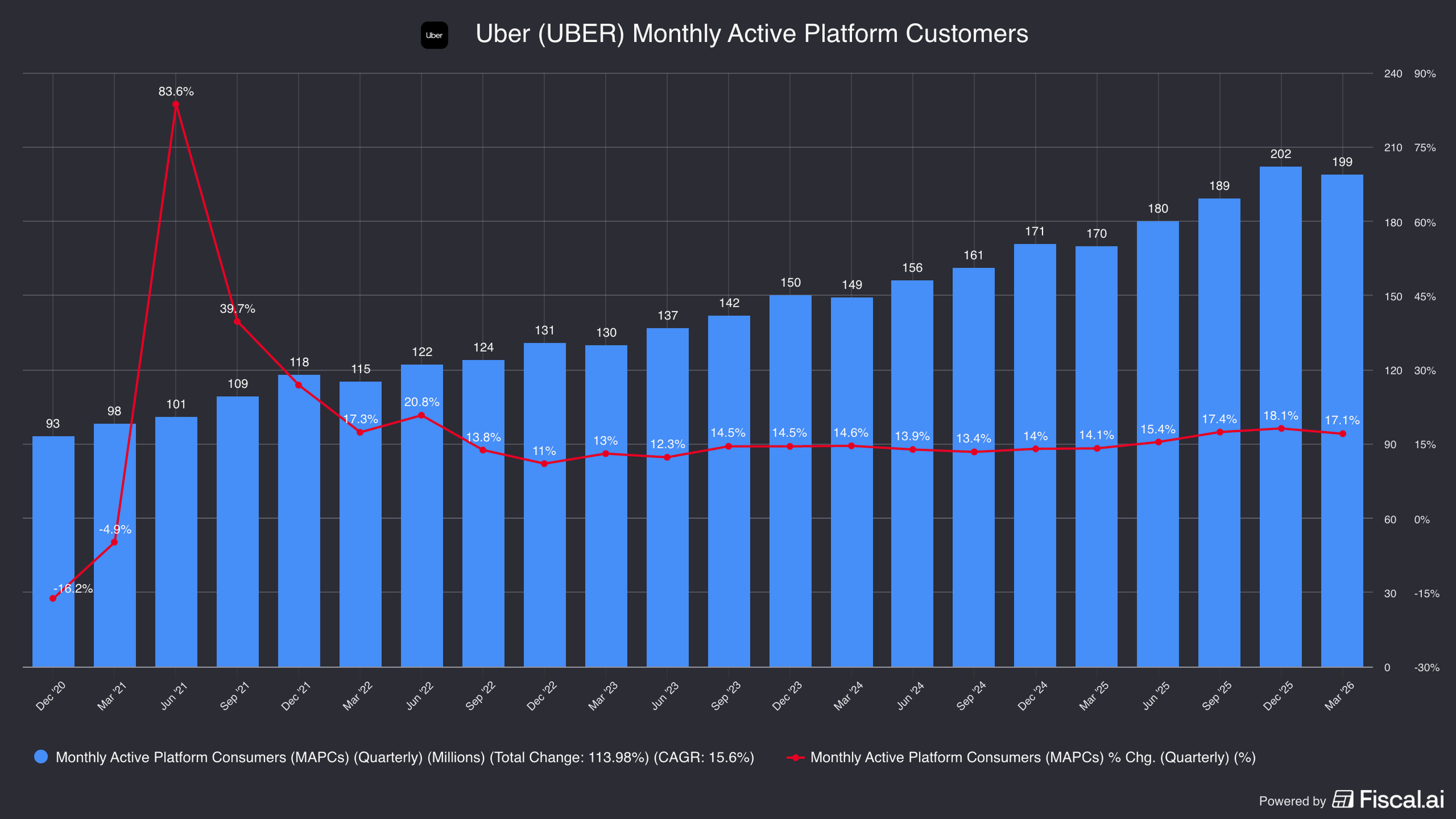
So the question is, what are investors worried about, because it clearly isn't showing up in the financials.
Well, you probably already know the answer, and it is autonomous vehicles.
What are the ramifications for Uber's network if a lot of cars all of a sudden become autonomous and maybe aren't accessible through Uber's platform?
We will touch on all things autonomous vehicles and the risk related for investors in this week’s Five Minute Money!
Two Non-AV Business Updates.
Launching Hotel Bookings.
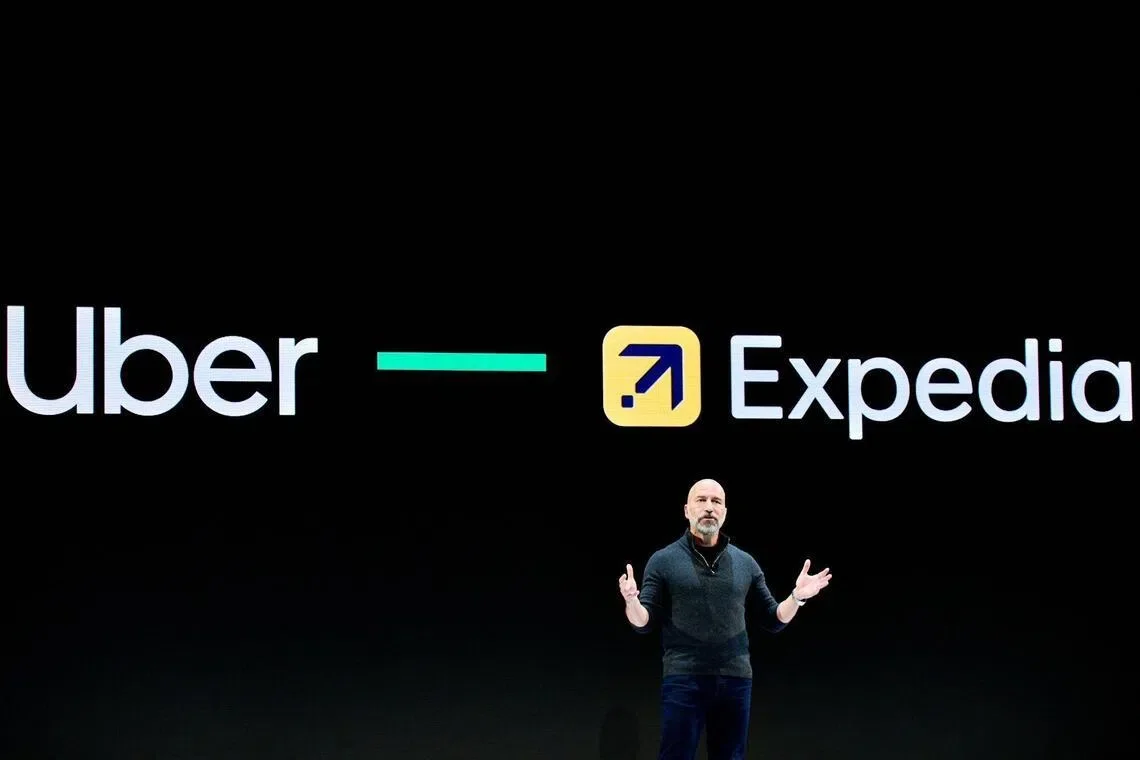
The first thing not AV related is their launch of hotel bookings, an interesting new market vertical for Uber.
The current CEO of Uber, Dara, used to be the CEO of Expedia, so he knows that business well.
The other key to understanding this is the super app strategy, and specifically what Meituan has done in China.
Meituan is a super app in China, but the first service they got big on was food delivery, a very low-margin but high-frequency service.
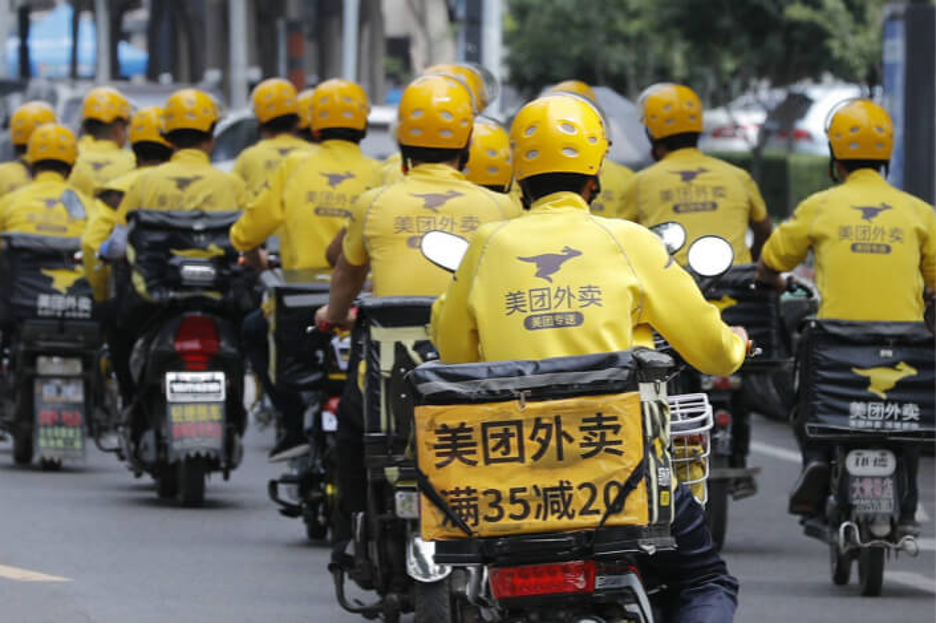
Founder Wang Xing set a directive to figure out business verticals they could add to find a profit center, since food delivery wasn't that profitable.
The most successful addition was hotel bookings, much lower frequency but much higher margin, and food delivery acted as a customer acquisition cost for hotel booking.
It's one of the few examples of a cross-sell really working in a totally different vertical.
When Uber split into Uber and Uber Eats, they put Eats functionality back into the main app because they want that same cross-sell advantage.
The hard part is acquiring a customer, and it's easier to cross-sell a service when it's a familiar brand with preloaded login and payment.
It's a partnership with Expedia, a B2B business that handles aggregating the hotel listings and availability, while Uber brings customer acquisition.
The big distinction between Uber and Meituan is that Meituan offered hotel booking in a market underpenetrated by online travel agencies, focusing on tier three and tier four cities that often couldn't be booked online elsewhere.
There was a clear value prop.
With Uber, most people already have an Expedia or Booking account, or are a Marriott loyalty member, so they're not really solving a pain point so much as bundling services, because customers who use more than one Uber service tend to grow 1.5x faster.
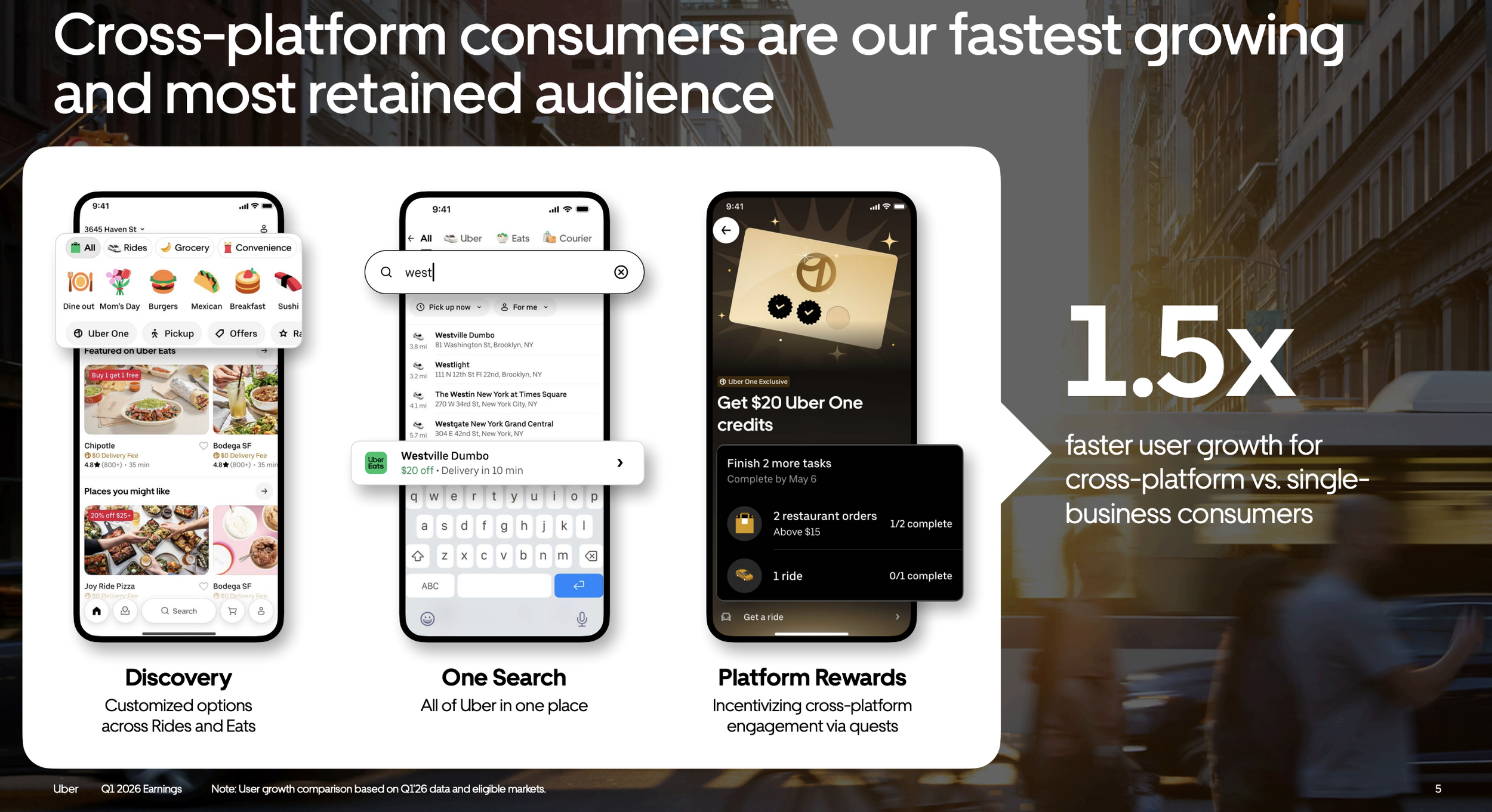
Right now they're leaning on subsidies and promotions, especially for Uber One members, but consumers may wonder who they're dealing with if there's an issue, since more intermediaries between customer and hotel tends to lead to worse service.
So can it work?
Possibly.
Does it solve a real pain point for customers?
No, it doesn't, but it's worth experimenting with.
Deepening the Retail Delivery Push.
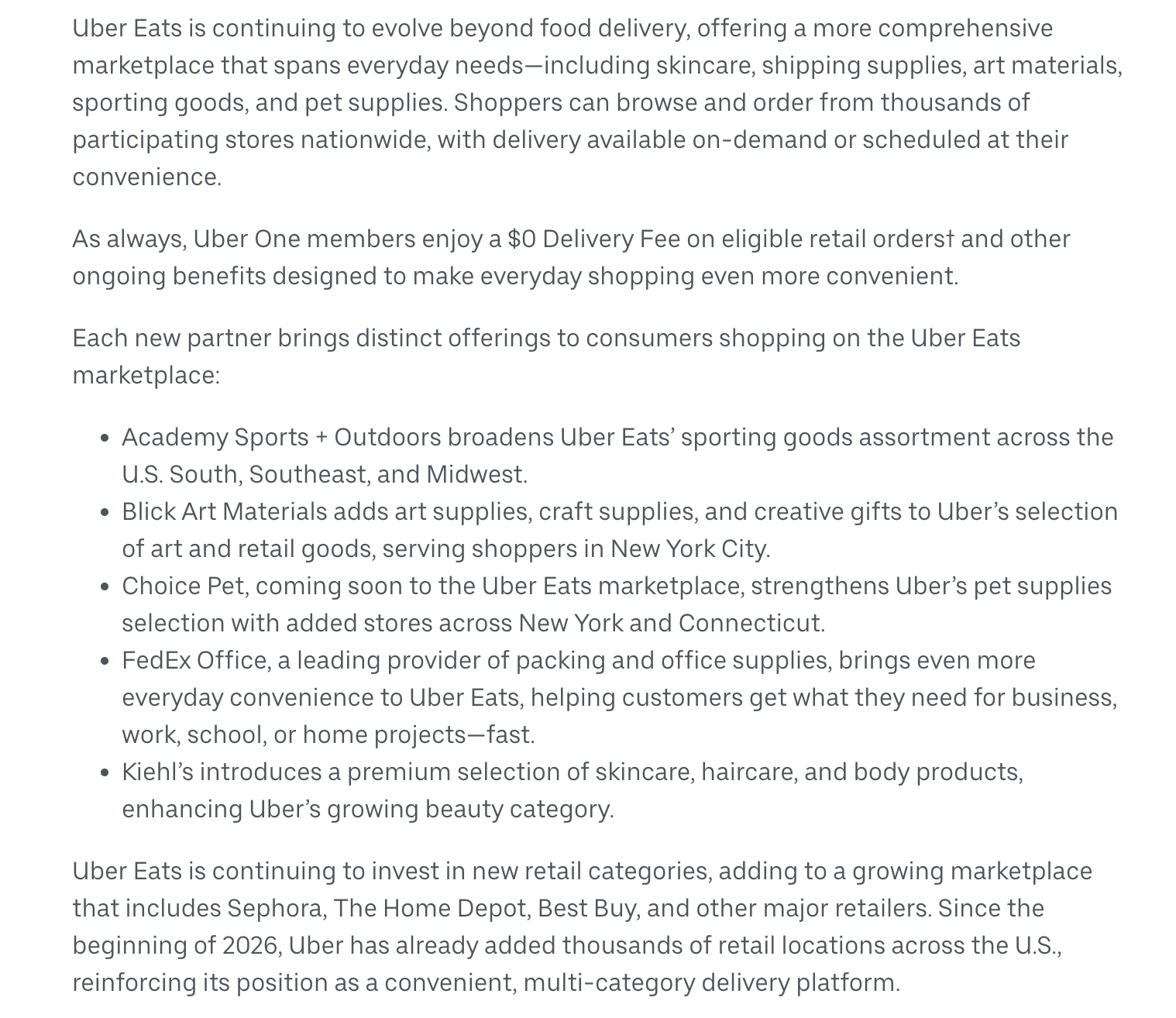
The second update is a push further into retail with the food delivery business.
There have been a lot more retail partners signing up, and the idea is they already have the delivery network, so they can slot in more partners and become the defense for retail players against Amazon.
If you're a retailer with just a physical footprint who doesn't want to sell on Amazon, you go to Uber to deliver items quickly.
They've announced thousands of retail partners, and most recently are working with FedEx.
The value add to the customer is access to businesses that didn't have delivery options otherwise, though you could question how many items really need that quick of delivery.
AV News.
A lot has been going on in this space in the last six months.
I'm going to list a bunch of these news items, and then we'll get to the actual analysis and the ramifications for Uber.
The Rivian Partnership.
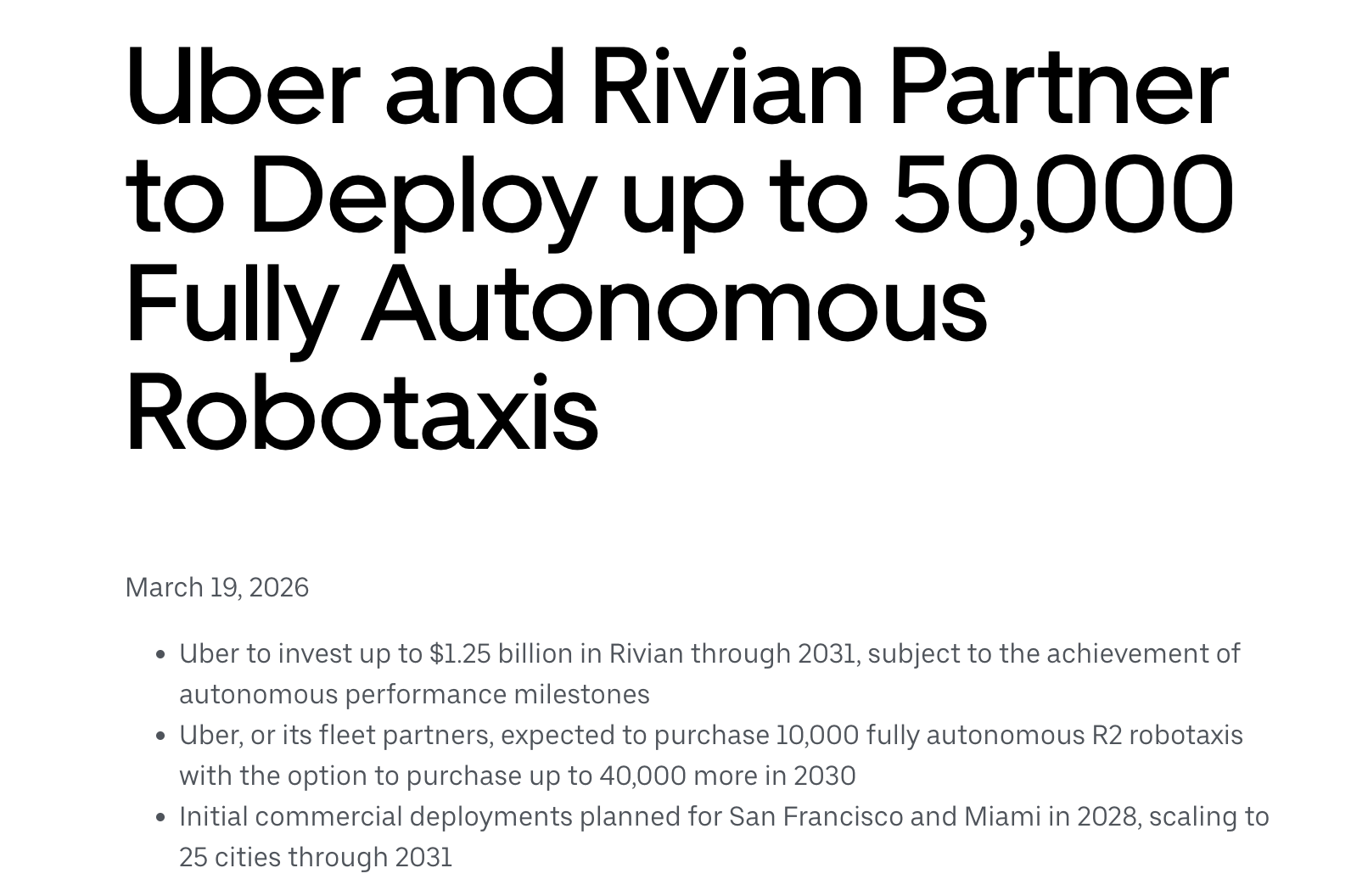
Uber and Rivian announced a partnership to invest $1.25 billion into them contingent on hitting certain markers.
The partnership originally includes an order of 10,000 vehicles, which could go up to another 40,000.
They're targeting a fully autonomous L4 deployment, meaning no human assistance needed, which is where Waymo is right now, with San Francisco and Miami launches for 2028 and a total of 25 cities in 2031.
NVIDIA's Drive Platform.
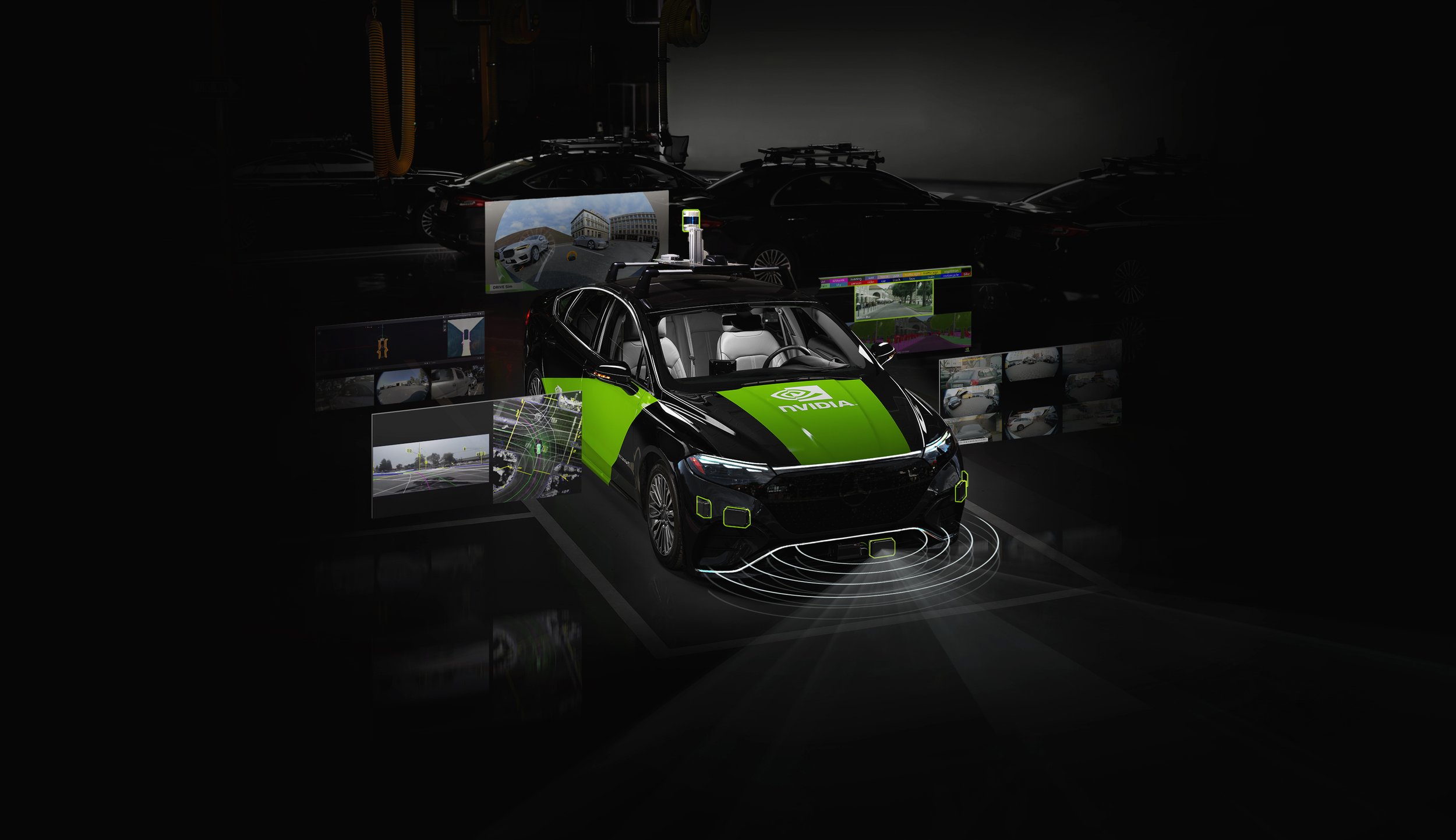
NVIDIA announced an even bigger push here with a lot more partners.
NVIDIA has hardware equipped to help an automaker start their own autonomous vehicle research platform, including hardware and software, which accelerates development so companies aren't doing everything in-house the way Waymo had to.
This should enable original equipment manufacturers, the big legacy car companies as well as newer EV companies like BYD, along with Mercedes and Nissan and many others, to kickstart their own autonomous vehicle programs, with timelines mostly targeting the next two to three years.
Lucid and Nuro.
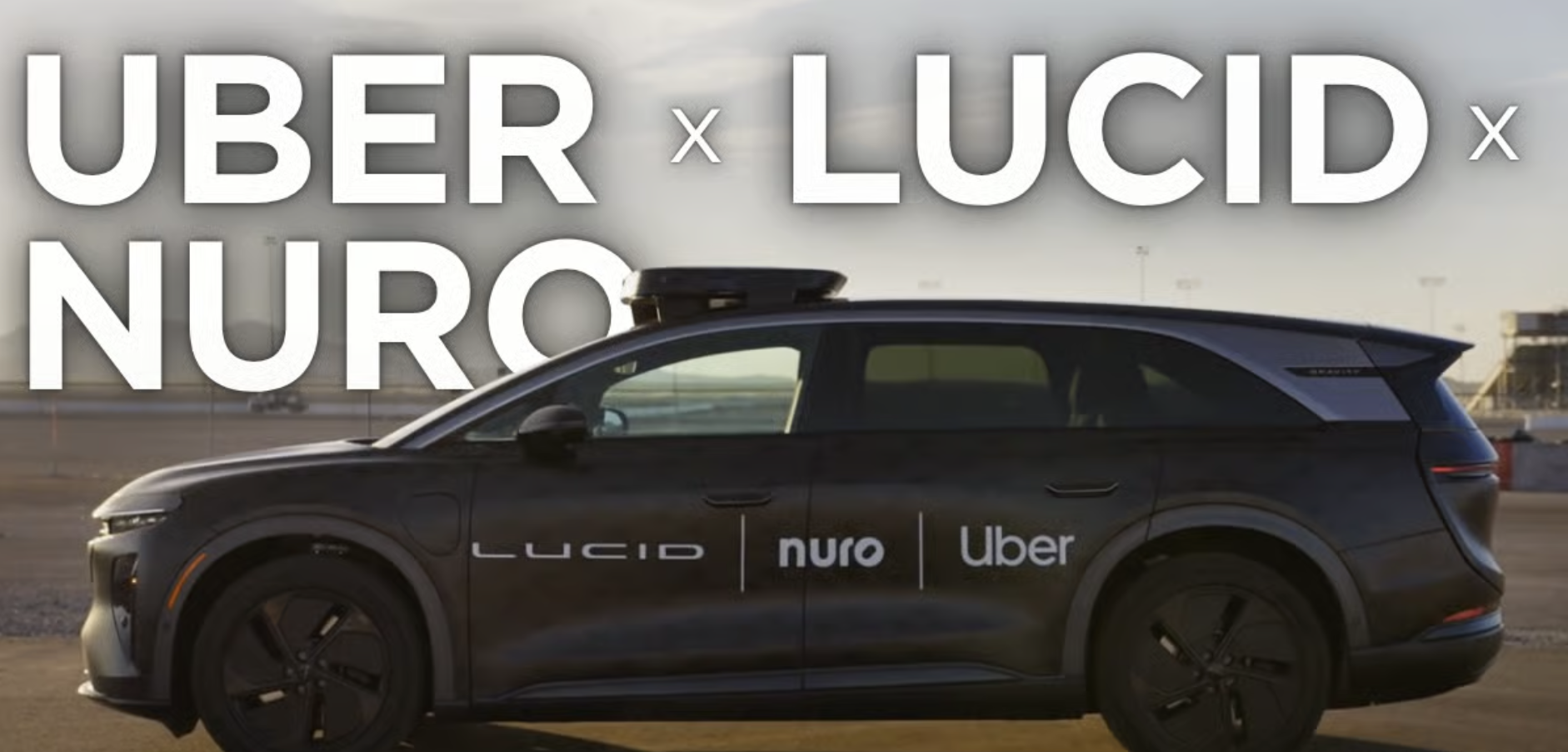
The third piece of AV news is a partnership between Lucid, Nuro, and Uber.
Nuro provides autonomous vehicle technology but licenses it out rather than building vehicles themselves, and they have this partnership with Lucid to build out the autonomous vehicle platform, targeting San Francisco testing potentially later this year and another city in 2027.
Zoox.
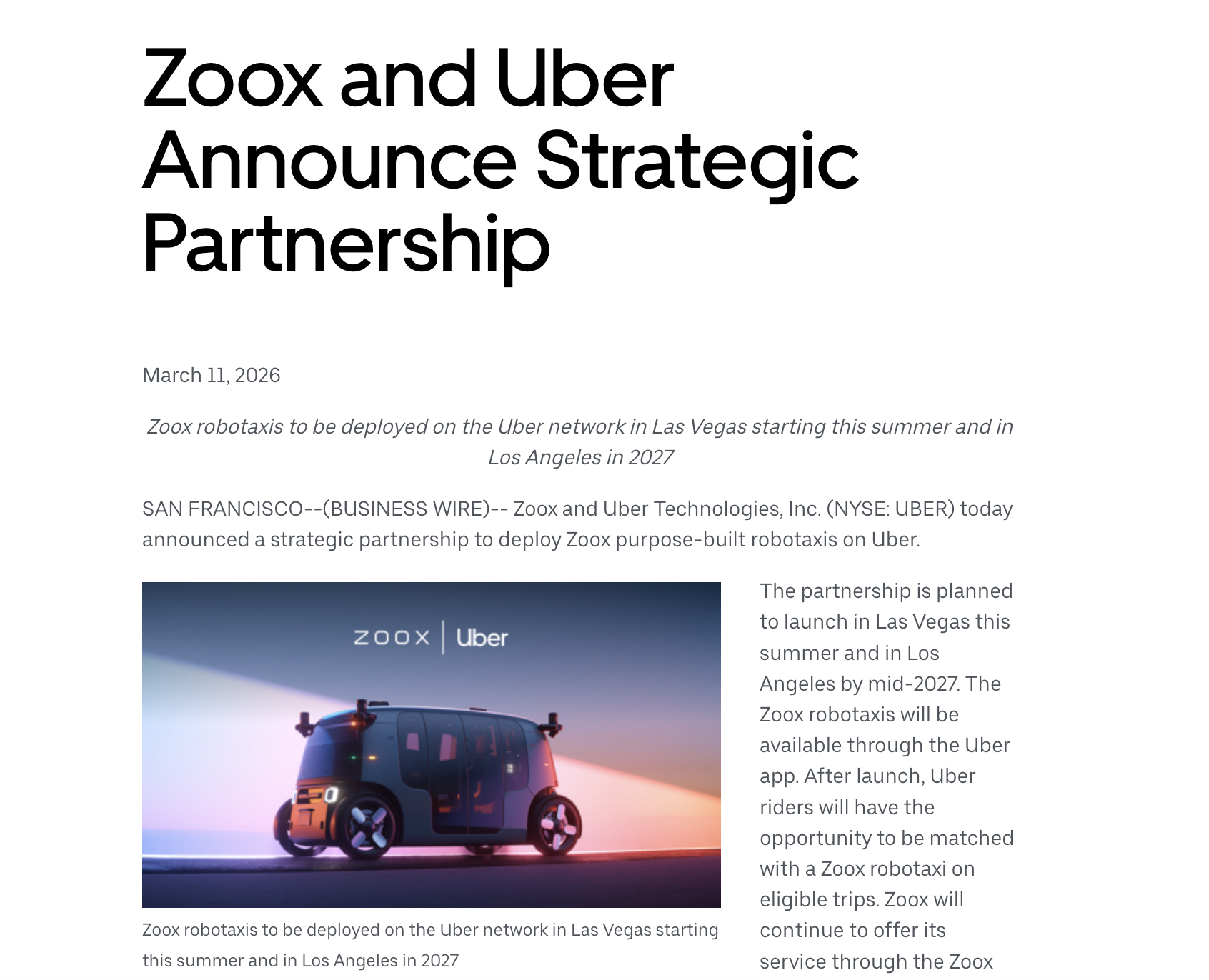
The fourth piece of news is Zoox, backed in part by Amazon.
They're currently operating in Las Vegas with plans to open in Los Angeles in 2027.
Tesla's Delayed Robotaxi.
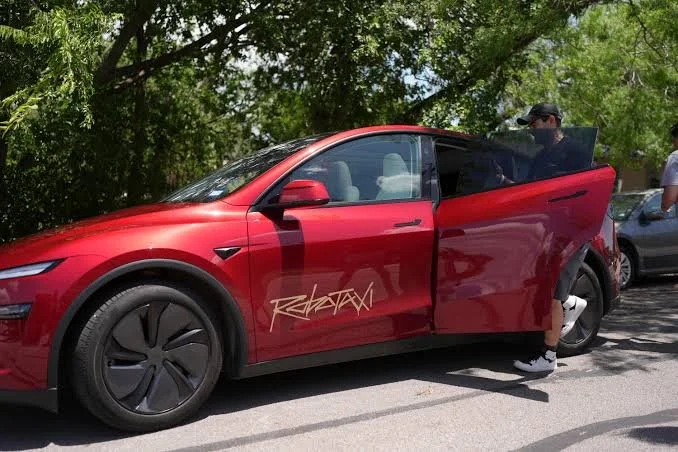
Fifth, Tesla delayed their robotaxi rollout, with some cynics saying no surprise there, but they're still targeting a broader rollout in late 2026 or 2027.
This has been a broken theme with Tesla since 2019, when they said it would be out the next year.
Nevertheless, they're currently operating unsupervised, without a driver, on a small test basis in Texas, and if successful, that could roll out more broadly.
Waymo's Shifting Aggregator Strategy.
The sixth update has to do with Waymo.
They've been attempting a dual-pronged strategy, creating their own app in some cities while partnering with Uber in others, like Atlanta and Austin.
In Phoenix they operated both models simultaneously, but that pilot partnership just expired and isn't being renewed, so Waymo will operate in Phoenix on their own app only.
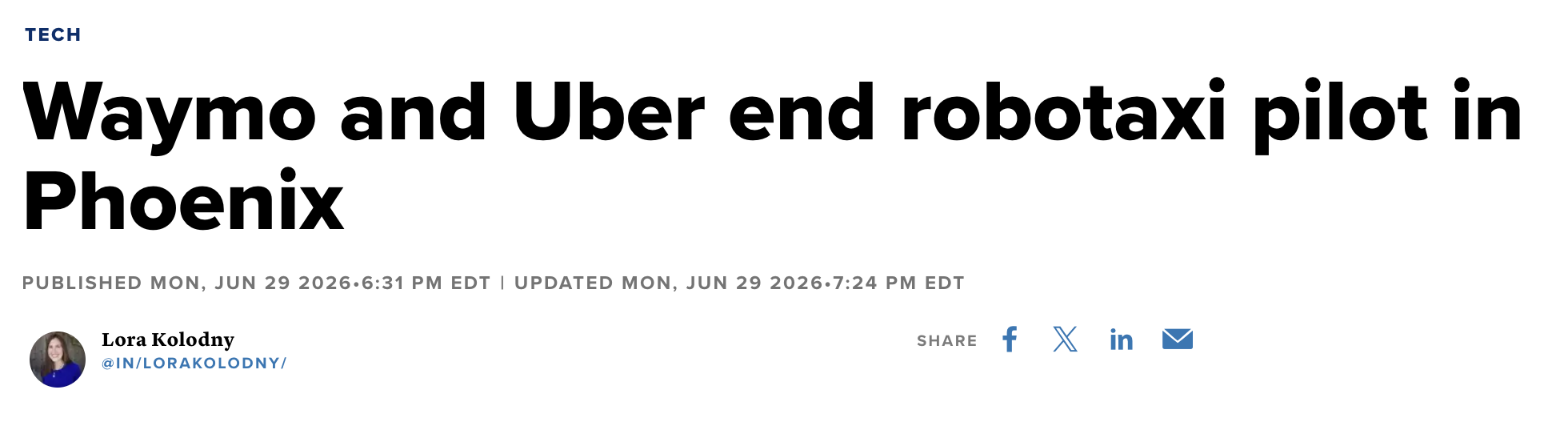
It's certainly not a positive if Waymo feels they don't need Uber to continue operating in a city.
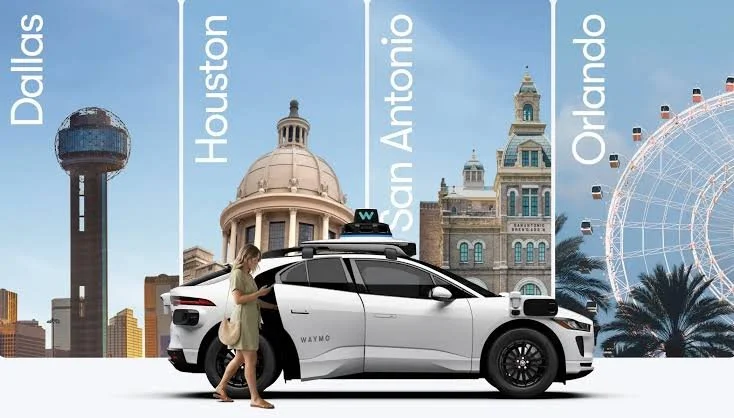
In addition, Waymo has launched six new cities, all without Uber, rolling out their own app with no intermediary.
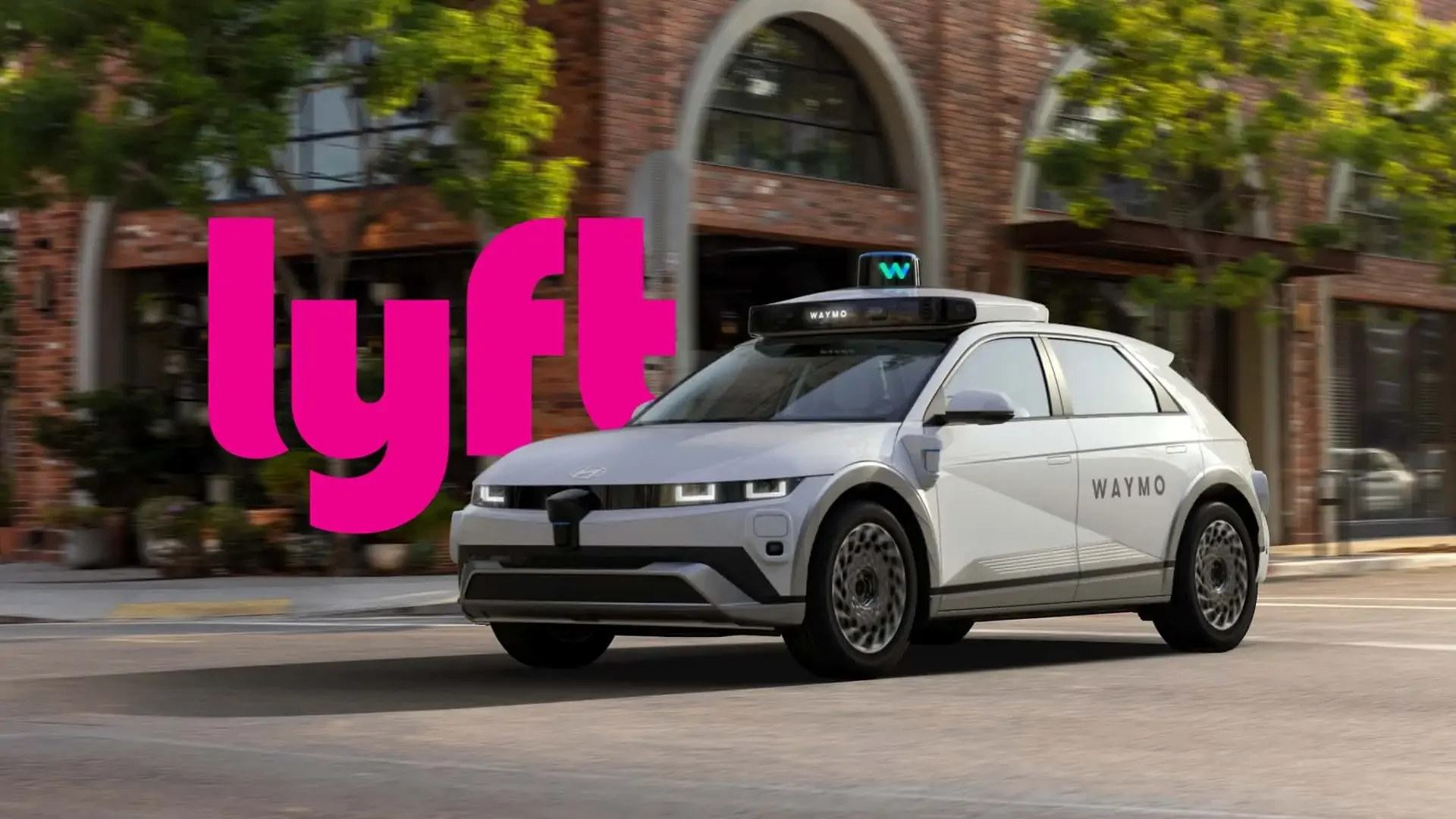
On top of that, they've partnered with Lyft in Nashville in a non-exclusive deal, which suggests maybe they will partner with an aggregator again, but maybe not necessarily Uber.
How much these different AV players use aggregators, and whether they need to, is going to be a key deciding factor in Uber's business model over time.
Uber's Own Autonomous Vehicle Solutions.
The seventh update is that Uber rolled out a new service called Autonomous Vehicle Solutions, basically fleet management and charging stations that they'll own, catering to autonomous vehicles, since many AV fleet owners may not want to do that physical labor themselves.
That's a lower margin service than just being a platform taking a take rate off a ride, so it probably isn't a great business on its own, but it could deepen their moat and give them a relevant place when AV becomes bigger.
Why Consumers Have Preferred Waymo.
Now let's get into a real autonomous vehicle discussion, starting from the consumer perspective on why Waymo's been so successful.
Five years ago, common thinking would say it would be very expensive to launch a consumer ride-hail app, yet Waymo got a lot of app downloads in almost every city with relatively little marketing spend.
Thinking about this from the consumer hierarchy of preferences, consumers turned out to have a big preference for privacy, actually liking not having a driver in the car.
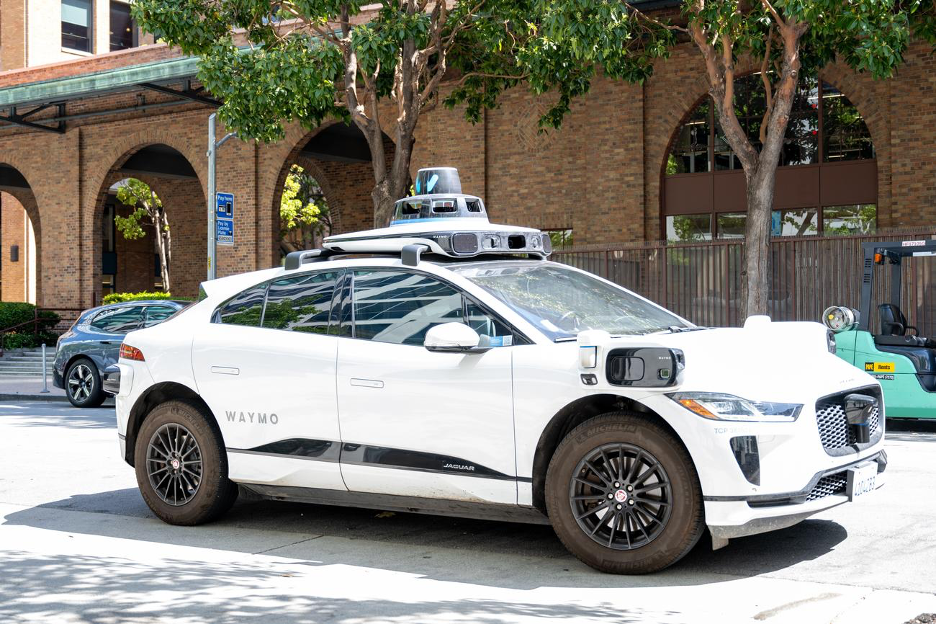
The second thing was that Waymo's fleet was all brand new, nice luxury Jaguars, giving consistency, whereas an UberX is unpredictable in car and driver.
The lesson from Airbnb is that consumers really value consistency, since Airbnb's biggest critique has always been that you don't know what you're getting with independent supply, and that's the biggest growth limiter for them.
Waymo's entirely owned fleet gave a very consistent experience, somewhat accidentally.
There's also a novelty aspect that may wane over time, but I think there's a lingering preference for a more consistent ride-hail experience that Waymo is better positioned to offer than Uber, which will always be an aggregation of supply.
That said, if Waymo enables other OEMs to put their technology in more cars, this consistency advantage could fade over time.
But let's get into the two biggest AV risks fro Uber.
Risk One: Exclusive Autonomous Vehicle Supply.
Number one is that there's a lot of exclusive autonomous vehicle supply Uber doesn't have access to, and ride-hailers prefer autonomous vehicles to driver ones.
This is a risk today, but Waymo is still a very small portion of overall miles driven, about 10 basis points.
Waymo has a head start and it seems likely to be at least a couple of years before real alternatives emerge, but eventually Uber will likely get access to autonomous vehicles.
When that happens, competitive dynamics shift back to what is the quickest and cheapest car with availability nearby, which is what Uber excels at.
The more fragmented AV supply is, the more benefit there is to Uber as an aggregator, since more differentiated supply means more value add for them.
A key bet for Uber investors is that autonomous vehicle technology becomes commoditized across half a dozen or more players rather than staying locked up by one.
I don't think this is actually the biggest risk to an investor in Uber.
Risk Two: A New Subsidy War.
The second risk is harder to argue against, which is what results from this new competition and whether it kickstarts an entirely new subsidy war.
Uber and Lyft were historically pretty crappy business models because customer acquisition costs were so high and it was expensive to retain drivers.
In their fourth quarter 2025 update, Uber made a rebuttal about why AVs won't be that bad, noting that Waymo's utilization was lower, meaning less time spent actually driving passengers, which they framed as Uber's demand advantage.
But they also noted Waymo has already resorted to promotional activity, and didn't seem concerned about that, though I think they should be.
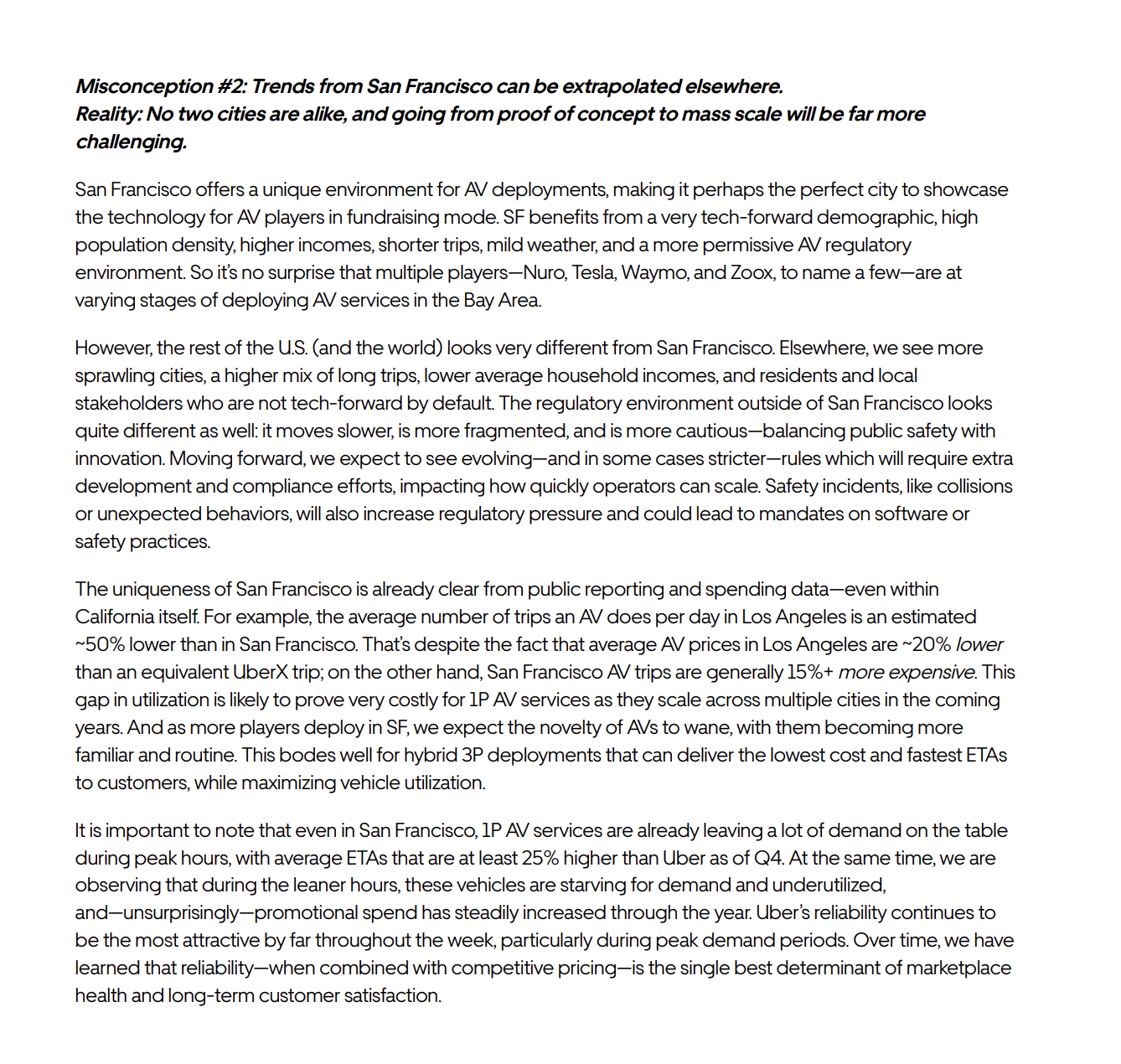
When you don't have to pay a driver and are already covering fixed costs during peak hours, you can discount heavily on off-hours and still cover variable costs.
Waymo has a competitive advantage in discounting because they don't have Uber's roughly 70% payout ratio to drivers, and that portion can be rebated back to the consumer.
This isn't positive for Uber if more competitors enter wanting their own consumer-facing business and are willing to promote to get it.
New competitive market structures will eventually settle, but that could take five years or longer, the way it took Uber and Lyft the better part of a decade to settle at roughly two-thirds and one-third market share.
A Waymo may also not need the same utilization as an Uber car to get a decent return on capital, since it's currently operated by Google rather than fleet managers maximizing ROIC, so they can keep growing under the assumption demand increases over time.
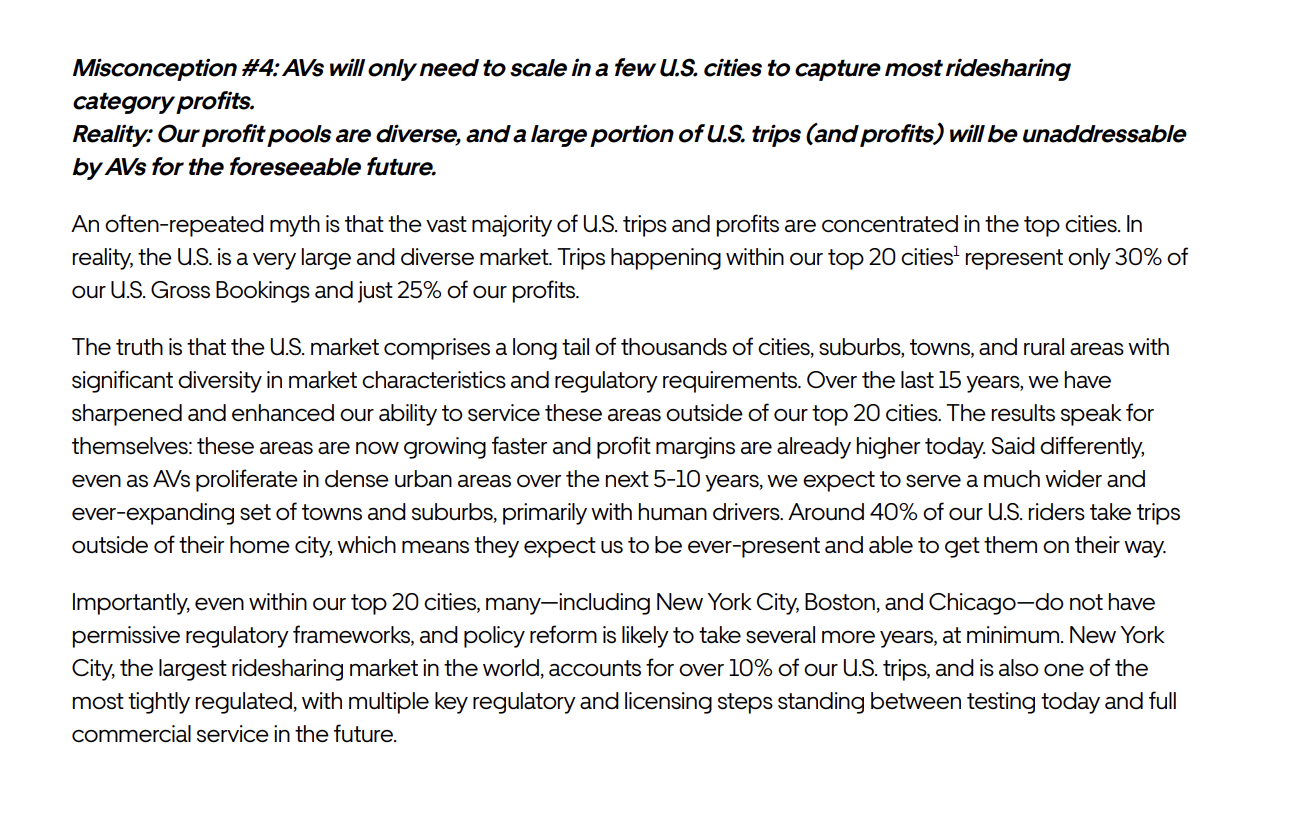
Waymo is targeting the biggest cities for now and may never expand to suburbs and smaller cities.
Uber frames this as insulation, noting the top 20 US cities are only 30% of US bookings and 25% of US profits, but that's still a good chunk of profits to have a brand new competitor defending against, and this competition is coming internationally too, starting in London at the end of this year.
Waymo is also operating in an environment where Uber already exists, so they don't need to be as reliable as Uber had to be initially, since a consumer can always just call an Uber as backup.
That lets Waymo pick off the most affluent customers who care most about a driverless car and are willing to wait longer and pay more for it, which is precisely the trade-off Uber points to as an AV weakness.
Waymo could build a real large consumer-facing business before Uber can support an alternative AV network on its own platform, meaning the market could become Uber, Lyft, Waymo, and a fourth player, Tesla.
Tesla seems set on having their own app rather than joining the Uber network, and if you own a Tesla, you might be contractually restricted to only lease it out on their robotaxi network rather than choosing Uber.
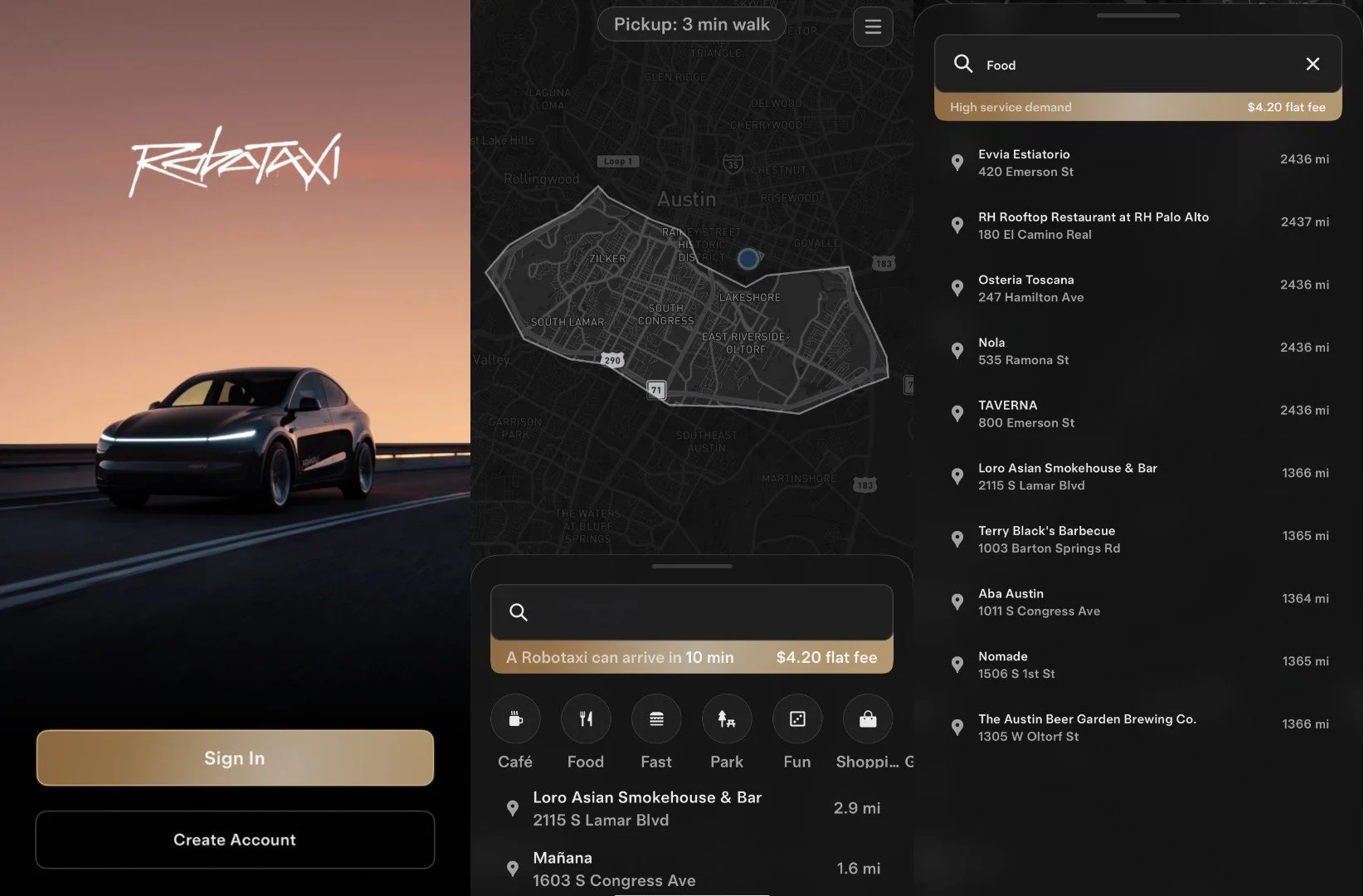
Waymo's co-CEO has also talked about licensing Waymo technology to other OEMs, meaning a Ford using Waymo tech might have to rent through the Waymo app, creating a landscape of fleet owners restricted to whichever network's technology they use.
Uber still has plenty of advantages: the most reliable network with global coverage, hundreds of millions of users with an existing Uber habit, the biggest fleet, the lowest wait times and prices, and Uber One loyalty with over 50 million members.
Customers who use both Uber and Uber Eats get more locked into the platform.
It's not that Uber is at existential risk, but the environment is likely more competitive a few years from now than today, especially once you add in agentic AI, where a consumer might just ask an assistant to book a ride through an MCP with no app interaction at all, which would cost Uber valuable advertising revenue even as their network advantage still shows through.
An investor should ultimately be asking what is priced in and what you need to assume to make a return.
Valuation.
Uber has a market cap of about $155 billion, about a $75 stock price.
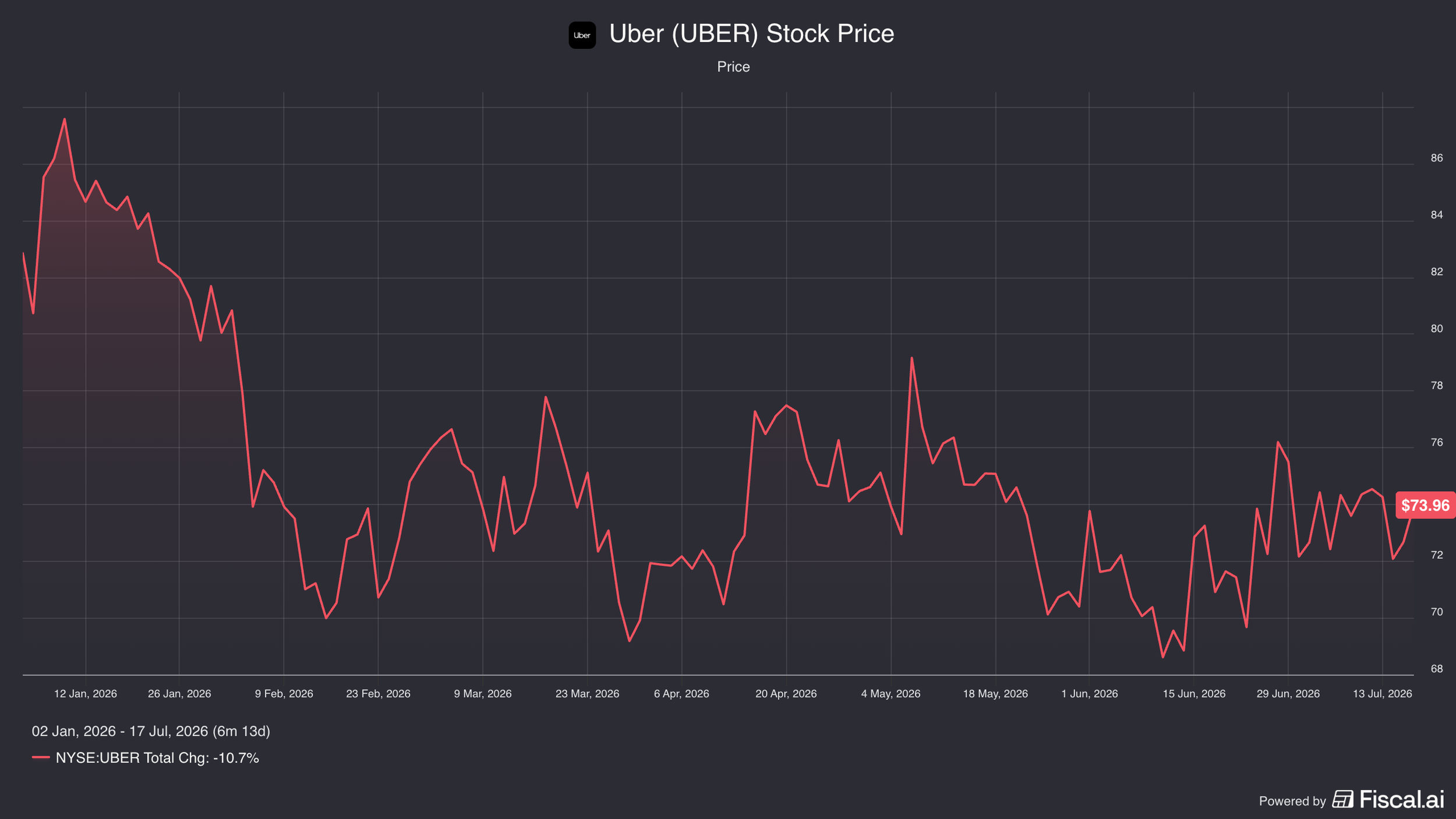
With $3 billion in EBIT, and taxing that gets a 32 times trailing earnings multiple.
A quick warning on their financials: they have certain loss-generating investment write-offs flowing through earnings, and they've also had large tax benefits recently inflating the EPS number with one-time charges, so it's better to start at operating income and tax that.
Some prefer cash flow, but there's an idiosyncratic insurance accrual adjustment to deal with there, so I just look at operating earnings.
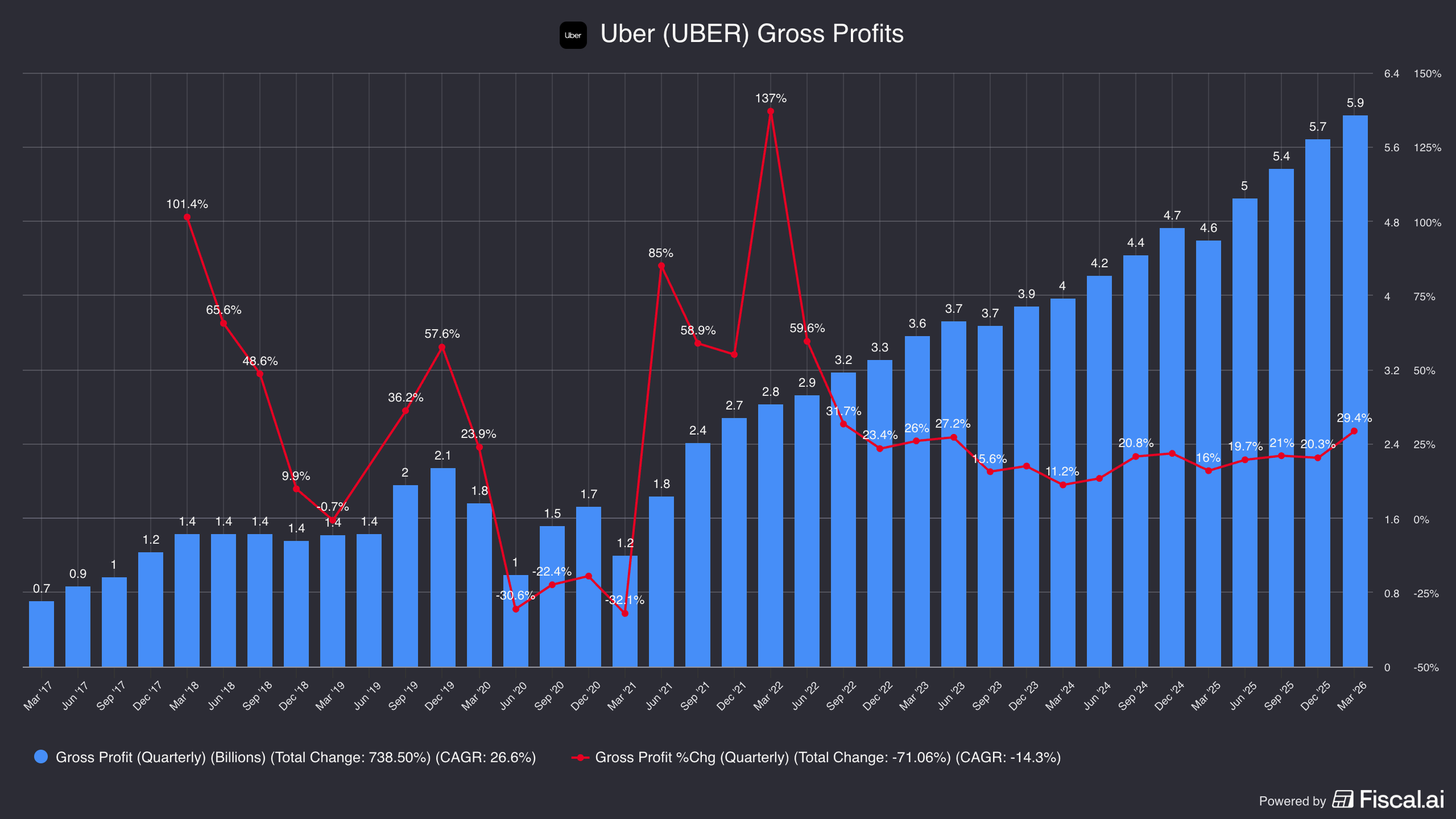
Gross bookings were growing 25%, but revenue in the last quarter on constant currency was only growing 10%, a misleading figure due to accounting changes in how they record ride value versus commission.
I suggest focusing on gross profit, which grew 29%, with some currency benefit of maybe four to five points, but still solidly over 20% growth.
Operating margins have been increasing a lot, from zero a few years ago and negative before that, to around 14.5% last quarter, and I don't see why this couldn't be a 30% operating margin platform or higher, aside from the competitive factors we've discussed that keep requiring promotional responses.
Bull Case: A Benign AV Environment.
I'll do one scenario assuming a benign autonomous vehicle environment with competitive intensity not picking up, and another more moderate scenario.
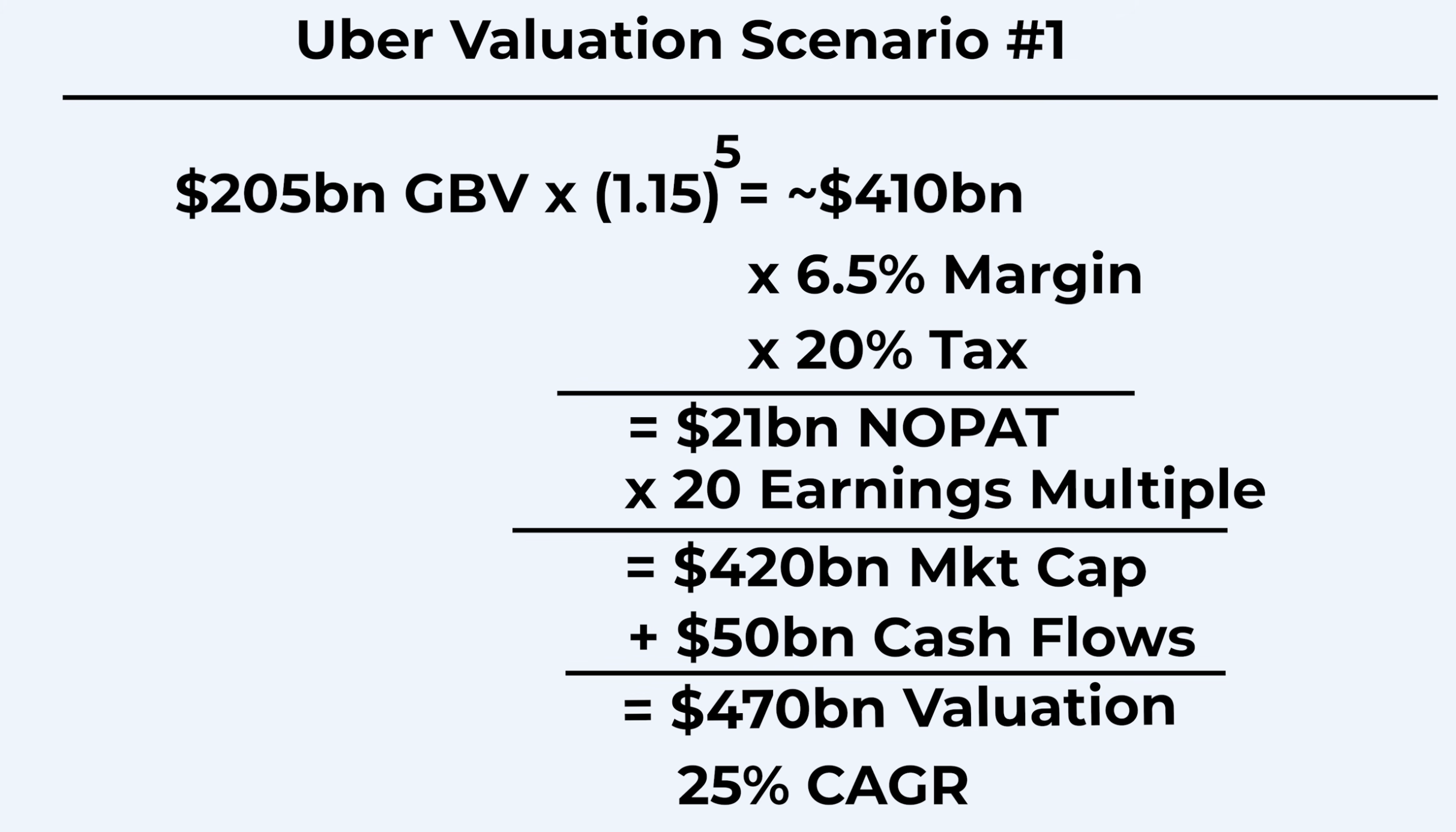
In the first, I want to get Uber from a roughly 15% margin today to a 25% margin in five years, using operating profit as a percent of gross booking value rather than revenue because of the accounting issue.
Uber has $3 billion in operating profit, about a 3% operating margin on gross booking.
If that number got to 6.5%, that would map to margins expanding from 15 to 25%.
If we grow gross booking value 15% a year for five years, that's roughly doubling to $410 billion.
Applying 6.5% of that to operating profit and taxing it gets us $21 billion in NOPAT, a massive number versus about $5 billion today.
Putting a 20 times multiple on that, since a lot of the margin expansion has already happened by that point, gets us a market cap of $420 billion.
Adding a rough $50 billion of accumulated cash gets a $470 billion valuation, a 25% CAGR from today's $155 billion market cap.
That's a high number, but I wouldn't call these assumptions conservative.
If you believe autonomous vehicles are a non-factor and competitive intensity doesn't pick up much more, that's probably a fair estimate.
Bear Case: Renewed Competition.
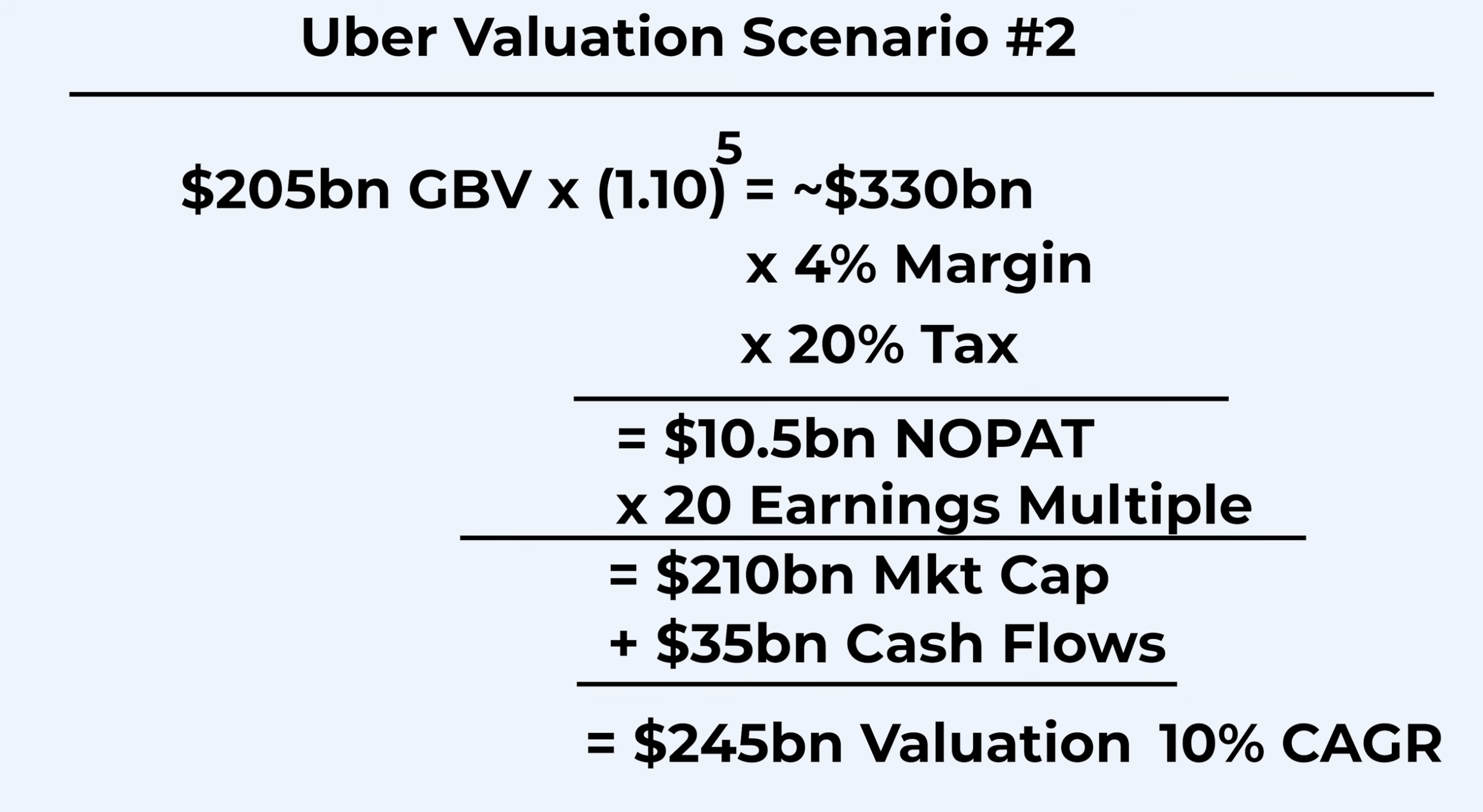
The other scenario is lower growth, since growth is harder in the future especially with AV operators potentially lopping off the most profitable markets, alongside subsidies kicking back up.
Here I still assume some margin expansion, from 3% to 4%, but grow gross booking value at 10% instead.
$10.5 billion of NOPAT, a 20 times multiple, and adding back about $35 billion in accumulated cash gets a return of about 10%.
The real bear case, though, is that new AV competition means promotions and subsidies kick back up, margins stay flat or go down, and growth materially slows as riders get new options.
There's also potential agentic risk where advertising revenue goes away.
A lot of risk still exists with Uber, but certainly an opportunity for an investor to take a strong opinion here if they want to or wait for a pitch that feels fatter.
For more on Uber, check out this video below.
Nothing in this newsletter is investment advice nor should be construed as such. Contributors to the newsletter may own securities discussed. Furthermore, accounts contributors advise on may also have positions in companies discussed. Please see our full disclaimers here.
